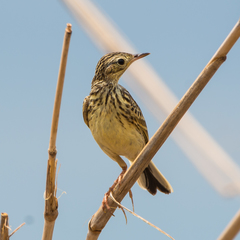
Yellowish Pipit

Yellowish Pipit

Anthus chii

Silhouette: Susan Murphy (original photograph), T. Michael Keesey (vectorization) · PhyloPic

LCLeast ConcernNTVUENCR
Daily sighting probability <5% · Rare
at Rio de Janeiro

In 3 days <5%

7 Verified sightings at Rio de Janeiro
498 In all 7 parks From 2019 to 2026
July Best month
☀️ Diurnal When it's spotted

About the Yellowish Pipit

The yellowish pipit (Anthus chii) is a species of bird in the family Motacillidae, the wagtails and pipits. It is found in Panama and in every mainland South American country except Ecuador and Chile. The yellowish pipit was described in 1818 with the binomial Anthus chii. For much of the twentieth century and into the twenty-first it bore the binomial Anthus lutescens. A paper published in 2021 showed that by the principle of priority its original binomial was correct and taxonomic systems soon made the change.

What is now the Peruvian pipit (A. peruvianus) was previously treated as a third subspecies. It was separated based on a study published in 2018. The yellowish pipit is one of the smallest members of genus Anthus, and is unusually long-legged and short-tailed. It is 10.5 to 14 cm (4.1 to 5.5 in) long and weighs 13 to 18 g (0.46 to 0.63 oz). The sexes have the same plumage. In fresh plumage adults have a dark brown head with a very pale supercilium and a thin white eye-ring. Their upperparts are dark brown with buff... Wikipedia →

Sounds

Recording0:18

Brazil · 2020

Fernando Sessegolo · iNaturalist · CC0

Recording0:14

Argentina · 2026

© Tomás Carranza Perales · iNaturalist · CC BY 4.0

Recording0:05

Brazil · 2026

© Pedro Giannotti · iNaturalist · CC BY-NC 4.0

Global Distribution

Parks Where Found

# Park Country Daily sighting probability
1 Iberá National Park 🇦🇷 Argentina
~20%
2 Serra da Canastra National Park 🇧🇷 Brazil
<5%
3 El Impenetrable National Park 🇦🇷 Argentina
<5%
4 Serra dos Órgãos National Park 🇧🇷 Brazil
<5%
5 Iguaçu National Park 🇧🇷 Brazil
<5%
6 Parque Estadual Encontro das Águas 🇧🇷 Brazil
<5%
7 Iguazú National Park 🇦🇷 Argentina
<5%

Cities Where Found

# City Country Daily sighting probability
1 Curitiba 🇧🇷 Brazil
<5%
2 Asuncion 🇵🇾 Paraguay
<5%
3 São Paulo 🇧🇷 Brazil
<5%
4 Santa Cruz de la Sierra 🇧🇴 Bolivia
<5%
5 Campinas 🇧🇷 Brazil
<5%
6 Salvador 🇧🇷 Brazil
<5%
7 Belo Horizonte 🇧🇷 Brazil
<5%
8 Santos 🇧🇷 Brazil
<5%
9 Campo Grande 🇧🇷 Brazil
<5%
10 Rio de Janeiro 🇧🇷 Brazil
<5%

Before you go

What are the chances of seeing a Yellowish Pipit in Rio de Janeiro?

Rare

Under 5% of wildlife watchers report a Yellowish Pipit sighting in Rio de Janeiro on a given day, based on 7 verified sightings from GBIF citizen-science data. It is the 265th most-seen of the 278 birds we can rate there. Over three days the chance rises to under 5%, if each day is a fresh chance.

When is the best time to see a Yellowish Pipit in Rio de Janeiro?

Any time of year

In every month with enough records, under 5% of wildlife watchers report a Yellowish Pipit in Rio de Janeiro on a given day, so our monthly data shows no clear season.

What time of day is best to see a Yellowish Pipit?

Between 8 and 11 am

Across all the parks we cover, that three-hour window holds the most Yellowish Pipit sightings with a recorded time, and about 9 in 10 of them come between 6 am and 6 pm: it is a daytime animal.

Is Rio de Janeiro the best place to see a Yellowish Pipit?

Among the best

Of the 10 cities where we can rate Yellowish Pipit sightings, Rio de Janeiro ranks 10th at under 5%, level with the leaders once rounded. The best odds are in Curitiba (Brazil, under 5%), Asuncion (Paraguay, under 5%) and São Paulo (Brazil, under 5%).

Which relatives of the Yellowish Pipit live in Rio de Janeiro?

Same order: Passeriformes

The closest relatives of the Yellowish Pipit that you can see in Rio de Janeiro (order Passeriformes, Perching Birds) are Great Kiskadee (about 90%), Palm Tanager (about 80%) and Southern House Wren (about 80%), with each one's daily chance of a sighting.

Where does the Yellowish Pipit sighting chance come from?

GBIF citizen-science records

It is estimated from how often the Yellowish Pipit is recorded against all the birds logged in Rio de Janeiro (7 verified sightings), calibrated against known sighting rates. Figures are rounded to the nearest 10% because citizen-science data supports honest approximations, not decimals, and months with records from fewer than five people show "—". How it works.

← Back to Rio de Janeiro