Melodious Warbler

Melodious Warbler

Hippolais polyglotta

Silhouette: John Gerrard Keulemans · PhyloPic

LCLeast ConcernNTVUENCR
Daily sighting probability <5% · Rare
at Rome

In 3 days <5% in a week ~10%

15 Verified sightings at Rome
1,099 In all 10 parks From 2019 to 2026
August Best month
☀️ Diurnal When it's spotted

About the Melodious Warbler

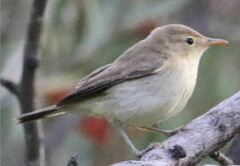
The melodious warbler (Hippolais polyglotta) is an Old World warbler in the tree warbler genus Hippolais. It breeds in southwest Europe and northwest Africa. It is migratory, wintering in sub-Saharan Africa. This small passerine bird is a species found in open woodland with bushes. Three to five eggs are laid in a nest in a tree or a bush. This is a common bird in many parts of its wide range and the International Union for Conservation of Nature has rated its conservation status as being of "least concern".

The genus name Hippolais is from Ancient Greek hupolais, as misspelt by Linnaeus. It referred to a small bird mentioned by Aristotle and others and may be onomatopoeic or derived from hupo,"under", and laas, "stone". The specific polyglotta is from Ancient Greek polus, "many", and glossa, "tongue" and means "harmonious".

This is a medium-sized warbler, 12 to 13 cm (4.7 to 5.1 in) in length, and similar to its eastern counterpart, the icterine warbler (Hippolais icterina). The adult has a plain brown back and wings, and yellowish underparts. Compared to the icterine warbler, the upper parts are rather browner and the under parts rather yellower... Wikipedia →

Sounds

Alarm call1:30

Slovenia · 2026

© Dare Šere · XC1142563 · CC BY-NC-ND 4.0

Song0:16

France · 2026

© Ryan Boswarthick · XC1137277 · CC BY-NC-SA 4.0

Call0:20

Spain · 2023

© Jacobo Ramil Millarengo · XC858833 · CC BY-NC-SA 4.0

Global Distribution

Parks Where Found

# Park Country Daily sighting probability
1 Niokolo-Koba National Park 🇸🇳 Senegal
~20%
2 Cévennes National Park 🇫🇷 France
~10%
3 Sierra de Guadarrama National Park 🇪🇸 Spain
~10%
4 Camargue 🇫🇷 France
~10%
5 Sierra Nevada National Park 🇪🇸 Spain
~10%
6 Doñana National Park 🇪🇸 Spain
~10%
7 Monfragüe National Park 🇪🇸 Spain
<5%
8 Pyrénées National Park 🇫🇷 France
<5%
9 Ordesa y Monte Perdido National Park 🇪🇸 Spain
<5%
10 Picos de Europa National Park 🇪🇸 Spain
<5%

Cities Where Found

# City Country Daily sighting probability
1 Ouagadougou 🇧🇫 Burkina Faso
~30%
2 Marrakesh 🇲🇦 Morocco
<5%
3 Madrid 🇪🇸 Spain
<5%
4 Milan 🇮🇹 Italy
<5%
5 Turin 🇮🇹 Italy
<5%
6 Barcelona 🇪🇸 Spain
<5%
7 Lisbon 🇵🇹 Portugal
<5%
8 Rome 🇮🇹 Italy
<5%
9 Serrekunda 🇬🇲 Gambia
<5%
10 Porto 🇵🇹 Portugal
<5%

Before you go

What are the chances of seeing a Melodious Warbler in Rome?

Rare

Under 5% of wildlife watchers report a Melodious Warbler sighting in Rome on a given day, based on 15 verified sightings from GBIF citizen-science data. It is the 80th most-seen of the 101 birds we can rate there. Over three days the chance rises to under 5%, and over a week to about 10%, if each day is a fresh chance.

When is the best time to see a Melodious Warbler in Rome?

Any time of year

In every month with enough records, under 5% of wildlife watchers report a Melodious Warbler in Rome on a given day, so our monthly data shows no clear season.

What time of day is best to see a Melodious Warbler?

Between 8 and 11 am

Across all the parks we cover, that three-hour window holds the most Melodious Warbler sightings with a recorded time, and about 8 in 10 of them come between 6 am and 6 pm: it is a daytime animal.

Is Rome the best place to see a Melodious Warbler?

8th of 12

Of the 12 cities where we can rate Melodious Warbler sightings, Rome ranks 8th at under 5%. The best odds are in Ouagadougou (Burkina Faso, about 30%), Marrakesh (Morocco, under 5%) and Madrid (Spain, under 5%).

Where does the Melodious Warbler sighting chance come from?

GBIF citizen-science records

It is estimated from how often the Melodious Warbler is recorded against all the birds logged in Rome (15 verified sightings), calibrated against known sighting rates. Figures are rounded to the nearest 10% because citizen-science data supports honest approximations, not decimals, and months with records from fewer than five people show "—". How it works.

← Back to Rome