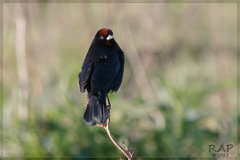
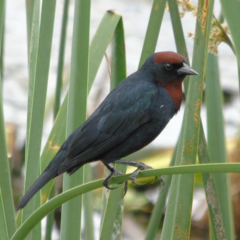
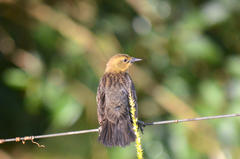
Chestnut-capped Blackbird

Chestnut-capped Blackbird

Chrysomus ruficapillus

Silhouette: Sheatherius · PhyloPic

LCLeast ConcernNTVUENCR
Daily sighting probability ~30% · Possible
at Rosario

In 3 days ~60% in a week ~90%

71 Verified sightings at Rosario
460 In all 9 parks From 2019 to 2026
April Best month
☀️ Diurnal When it's spotted

About the Chestnut-capped Blackbird

The chestnut-capped blackbird (Chrysomus ruficapillus) is a species of bird in the family Icteridae, the oropendolas, New World orioles, and New World blackbirds. It is found in Argentina, Bolivia, Brazil, Paraguay, and Uruguay.

The chestnut-capped blackbird was formally described in 1819 with the binomial Agelaius ruficapillus. In the late twentieth century it was reassigned to its present genus Chrysomus, which had been erected in 1837. It shares that genus with the yellow-hooded blackbird (C. icterocephalus).

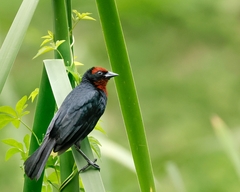
Male chestnut-capped blackbirds average 18.5 cm (7.3 in) long and females 17.1 cm (6.7 in). Males weigh an average of 41.3 g (1.5 oz) and females average 32.2 g (1.1 oz). The species is sexually dimorphic. Adult males of the nominate subspecies have a deep dark chestnut forecrown, midcrown, throat, and upper breast. The rest of their plumages is black with a faint bluish gloss. Adult females of the nominate subspecies have a mostly olivaceous brown head with a faint buffish supercilium.... Wikipedia →

Sounds

Call0:57

Brazil · 2026

© JAYRSON ARAUJO DE OLIVEIRA · XC1136814 · CC BY-NC-SA 4.0

Song0:07

Brazil · 2026

© Fabrício Grigolin · XC1071833 · CC BY-NC-SA 4.0

Recording0:28

Argentina · 2020

© Capovilla Pablo H · XC619068 · CC BY-NC-SA 4.0

Global Distribution

Parks Where Found

# Park Country Daily sighting probability
1 Iberá National Park 🇦🇷 Argentina
~10%
2 Chapada Diamantina National Park 🇧🇷 Brazil
~10%
3 Serra da Canastra National Park 🇧🇷 Brazil
~10%
4 El Impenetrable National Park 🇦🇷 Argentina
~10%
5 Serra dos Órgãos National Park 🇧🇷 Brazil
<5%
6 Itatiaia National Park 🇧🇷 Brazil
<5%
7 Iguaçu National Park 🇧🇷 Brazil
<5%
8 Parque Estadual Encontro das Águas 🇧🇷 Brazil
<5%
9 Iguazú National Park 🇦🇷 Argentina
<5%

Cities Where Found

# City Country Daily sighting probability
1 Rosario 🇦🇷 Argentina
~30%
2 Curitiba 🇧🇷 Brazil
~10%
3 Goiânia 🇧🇷 Brazil
~10%
4 Belo Horizonte 🇧🇷 Brazil
~10%
5 Campinas 🇧🇷 Brazil
~10%
6 São Paulo 🇧🇷 Brazil
~10%
7 Santa Cruz de la Sierra 🇧🇴 Bolivia
<5%
8 Asuncion 🇵🇾 Paraguay
<5%
9 Brasilia 🇧🇷 Brazil
<5%
10 Porto Alegre 🇧🇷 Brazil
<5%

Zoos & Centres Where Found

# Zoo / Centre Country
1 Zoológico de Brasília 🇧🇷 Brazil In captivity
2 Córdoba Zoo 🇦🇷 Argentina In captivity

Before you go

What are the chances of seeing a Chestnut-capped Blackbird in Rosario?

Possible

About 30% of wildlife watchers report a Chestnut-capped Blackbird sighting in Rosario on a given day, based on 71 verified sightings from GBIF citizen-science data. It is the 42nd most-seen of the 121 birds we can rate there. Over three days the chance rises to about 60%, and over a week to about 90%, if each day is a fresh chance.

When is the best time to see a Chestnut-capped Blackbird in Rosario?

April and June

In those months about 50% of wildlife watchers report a Chestnut-capped Blackbird in Rosario on a given day, against about 10% in July–August and December, the lowest months.

What time of day is best to see a Chestnut-capped Blackbird?

Between 8 and 11 am

Across all the parks we cover, that three-hour window holds the most Chestnut-capped Blackbird sightings with a recorded time, and nearly all of them come between 6 am and 6 pm: it is a daytime animal.

Is Rosario the best place to see a Chestnut-capped Blackbird?

Yes

Of the 15 cities where we can rate Chestnut-capped Blackbird sightings, Rosario has the highest daily chance: about 30%. Next come Curitiba (Brazil, about 10%) and Goiânia (Brazil, about 10%).

Which relatives of the Chestnut-capped Blackbird live in Rosario?

Same family: Icteridae

The closest relatives of the Chestnut-capped Blackbird that you can see in Rosario (family Icteridae, New World Blackbirds and Orioles) are Shiny Cowbird (about 40%), Grayish Baywing (about 30%) and Screaming Cowbird (about 10%), with each one's daily chance of a sighting.

Where does the Chestnut-capped Blackbird sighting chance come from?

GBIF citizen-science records

It is estimated from how often the Chestnut-capped Blackbird is recorded against all the birds logged in Rosario (71 verified sightings), calibrated against known sighting rates. Figures are rounded to the nearest 10% because citizen-science data supports honest approximations, not decimals, and months with records from fewer than five people show "—". How it works.

← Back to Rosario