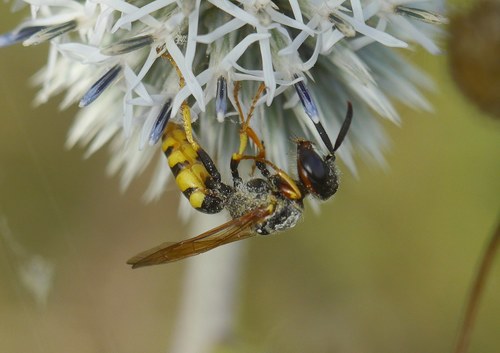
Common Spangle Gall Wasp

Common Spangle Gall Wasp

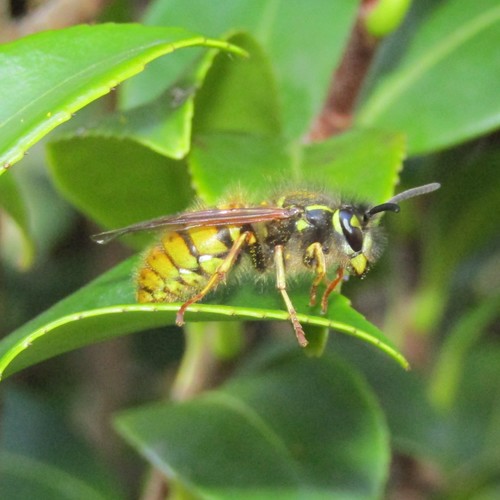
Neuroterus quercusbaccarum

Daily sighting probability <5% · Rare
at Rotterdam [The Hague]

In 3 days ~10% in a week ~30%

6 Verified sightings at Rotterdam [The Hague]
53 In all 4 parks From 2019 to 2026
December Best month
☀️ Diurnal When it's spotted

About the Common Spangle Gall Wasp

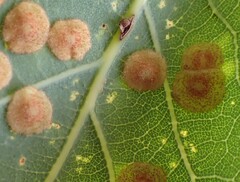
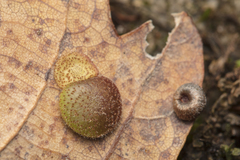
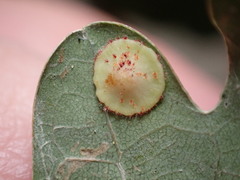
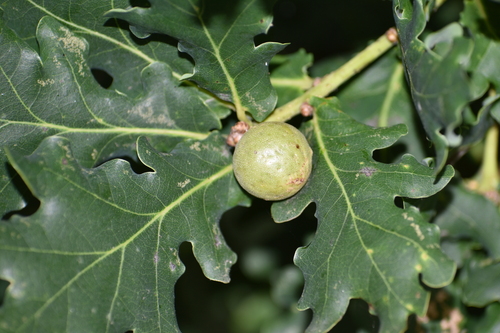
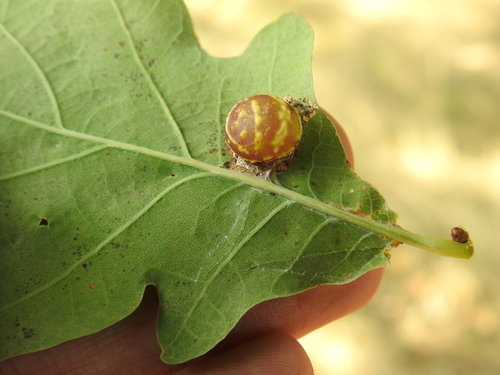
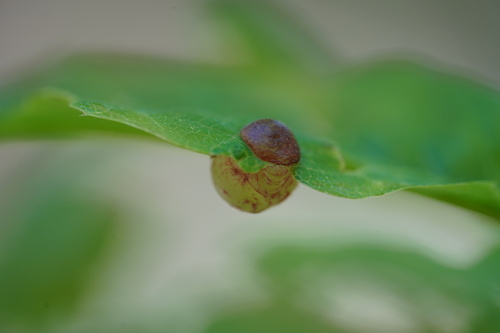
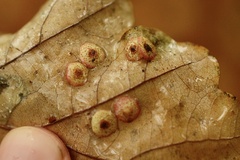
The common spangle gall on the underside of leaves and the currant gall on the male catkins or occasionally the leaves, develop as chemically induced distortions on pedunculate oak (Quercus robur), or sessile oak (Quercus petraea) trees, caused by the cynipid wasp Neuroterus quercusbaccarum which has both agamic and bisexual generations.

Previous names or synonyms for this species are Neuroterus baccarum, N. lenticularis, N. malpighii, Cynips lenticularis, C. quercus-baccarum, Spathegaster baccarum, S. varius, S. interruptor. The spangle gall generation on the underside of the oak leaves are flat discs, with a distinct central elevation, slightly hairy, yellow-green at first and reddish later, attached by a short stalk. These galls are up to 6 mm in diameter, unilocular, unilarval with a whitish or yellow undersurface; they mature in September, detach and fall to the ground before the leaves themselves. The larva continue to develop in the fallen spangle and, protected by the leaf layer, they overwinter. Any spangle galls that remain attached to the leaves dry and die.

The smooth surfaced currant gall generation appears in April and lay unfertilised eggs in the staminate... Wikipedia →
Global Distribution

Parks Where Found

# Park Country Daily sighting probability
1 Snowdonia National Park 🇬🇧 United Kingdom
~10%
2 Sierra de Guadarrama National Park 🇪🇸 Spain
~10%
3 Bavarian Forest National Park 🇩🇪 Germany
~10%
4 Cévennes National Park 🇫🇷 France
<5%

Cities Where Found

# City Country Daily sighting probability
1 Liverpool 🇬🇧 United Kingdom
~20%
2 London 🇬🇧 United Kingdom
~20%
3 Birmingham 🇬🇧 United Kingdom
~20%
4 Manchester 🇬🇧 United Kingdom
~10%
5 Istanbul 🇹🇷 Turkey
~10%
6 Berlin 🇩🇪 Germany
~10%
7 Leeds 🇬🇧 United Kingdom
~10%
8 Paris 🇫🇷 France
~10%
9 Kyiv 🇺🇦 Ukraine
~10%
10 Bucharest 🇷🇴 Romania
~10%

Before you go

What are the chances of seeing a Common Spangle Gall Wasp in Rotterdam [The Hague]?

Rare

Under 5% of wildlife watchers report a Common Spangle Gall Wasp sighting in Rotterdam [The Hague] on a given day, based on 6 verified sightings from GBIF citizen-science data. It is the 301st most-seen of the 355 insects we can rate there. Over three days the chance rises to about 10%, and over a week to about 30%, if each day is a fresh chance.

When is the best time to see a Common Spangle Gall Wasp in Rotterdam [The Hague]?

December

In that month about 20% of wildlife watchers report a Common Spangle Gall Wasp in Rotterdam [The Hague] on a given day, against under 5% in January–August and November, the lowest months.

What time of day is best to see a Common Spangle Gall Wasp?

Between 2 and 5 pm

Across all the parks we cover, that three-hour window holds the most Common Spangle Gall Wasp sightings with a recorded time, and about 9 in 10 of them come between 6 am and 6 pm: it is a daytime animal.

Is Rotterdam [The Hague] the best place to see a Common Spangle Gall Wasp?

15th of 21

Of the 21 cities where we can rate Common Spangle Gall Wasp sightings, Rotterdam [The Hague] ranks 15th at under 5%. The best odds are in Liverpool (United Kingdom, about 20%), London (United Kingdom, about 20%) and Birmingham (United Kingdom, about 20%).

Which relatives of the Common Spangle Gall Wasp live in Rotterdam [The Hague]?

Same family: Cynipidae

The closest relatives of the Common Spangle Gall Wasp that you can see in Rotterdam [The Hague] (family Cynipidae, Gall Wasps) are Oak Marble Gall Wasp (about 10%) and Knopper Gall Wasp (about 10%), with each one's daily chance of a sighting.

Where does the Common Spangle Gall Wasp sighting chance come from?

GBIF citizen-science records

It is estimated from how often the Common Spangle Gall Wasp is recorded against all the insects logged in Rotterdam [The Hague] (6 verified sightings), calibrated against known sighting rates. Figures are rounded to the nearest 10% because citizen-science data supports honest approximations, not decimals, and months with records from fewer than five people show "—". How it works.

← Back to Rotterdam [The Hague]