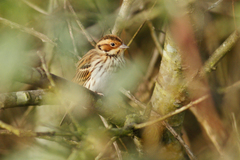
Little Bunting

Little Bunting

Emberiza pusilla

Silhouette: L. Shyamal · PhyloPic

LCLeast ConcernNTVUENCR
Daily sighting probability <5% · Rare
at Rotterdam [The Hague]

In 3 days <5% in a week ~10%

21 Verified sightings at Rotterdam [The Hague]
215 In all 7 parks From 2019 to 2026
January Best month
☀️ Diurnal When it's spotted

About the Little Bunting

The little bunting (Emberiza pusilla) is a passerine bird belonging to the bunting family (Emberizidae). First described by Peter Simon Pallas in 1776, the little bunting is a monotypic species, with no geographical variation across its extensive Palearctic range.

The genus name Emberiza is from Old German Embritz, a bunting. The specific pusilla is Latin for "very small". This is a small bunting, measuring only 12–14 cm (4.7–5.5 in) in length. It has white underparts with dark streaking on the breast and sides. With its chestnut face and white malar stripe, it resembles a small female reed bunting, but has black crown stripes, a white eye-ring, and a fine dark border to the rear of its chestnut cheeks. The sexes are similar.

The call is a distinctive zik, and the song is a rolling siroo-sir-sir-siroo. The little bunting breeds across the taiga of the far north-east of Europe and northern Eurosiberia to the Russian Far East. It is migratory, wintering in the subtropics in northern India, southern China and the northern parts of south-east Asia. The birds remain in their winter quarters for quite long; specimens were taken in Yunnan in late... Wikipedia →

Sounds

Song0:27

Norway · 2026

© Peter Zeller · XC1184649 · CC BY-NC-SA 4.0

Call0:16

Russian Federation · 2024

© Mikhail Nevsky · XC938236 · CC BY-NC-SA 4.0

Flight call0:26

France · 2022

© Stanislas Wroza · XC767847 · CC BY-NC-SA 4.0

Global Distribution

Parks Where Found

# Park Country Daily sighting probability
1 Gobi Gurvansaikhan National Park 🇲🇳 Mongolia
~10%
2 Manas National Park 🇮🇳 India
~10%
3 Cuc Phuong National Park 🇻🇳 Vietnam
<5%
4 Namdapha National Park 🇮🇳 India
<5%
5 Taroko National Park 🇹🇼 Taiwan
<5%
6 Wadden Sea National Park 🇩🇪 Germany
<5%
7 Jim Corbett National Park 🇮🇳 India
<5%

Cities Where Found

# City Country Daily sighting probability
1 Beijing 🇨🇳 China
~20%
2 Shijiazhuang 🇨🇳 China
~20%
3 Taiyuan 🇨🇳 China
~20%
4 Novosibirsk 🇷🇺 Russia
~10%
5 Nanchang 🇨🇳 China
~10%
6 Changsha 🇨🇳 China
~10%
7 Tianjin 🇨🇳 China
~10%
8 Jinhua 🇨🇳 China
~10%
9 Jinan 🇨🇳 China
~10%
10 Ulaanbaatar 🇲🇳 Mongolia
~10%

Zoos & Centres Where Found

# Zoo / Centre Country
1 Santillana Zoo 🇪🇸 Spain In captivity

Before you go

What are the chances of seeing a Little Bunting in Rotterdam [The Hague]?

Rare

Under 5% of wildlife watchers report a Little Bunting sighting in Rotterdam [The Hague] on a given day, based on 21 verified sightings from GBIF citizen-science data. It is the 143rd most-seen of the 175 birds we can rate there. Over three days the chance rises to under 5%, and over a week to about 10%, if each day is a fresh chance.

When is the best time to see a Little Bunting in Rotterdam [The Hague]?

Any time of year

In every month with enough records, under 5% of wildlife watchers report a Little Bunting in Rotterdam [The Hague] on a given day, so our monthly data shows no clear season.

What time of day is best to see a Little Bunting?

Between 7 and 10 am

Across all the parks we cover, that three-hour window holds the most Little Bunting sightings with a recorded time, and about 9 in 10 of them come between 6 am and 6 pm: it is a daytime animal.

Is Rotterdam [The Hague] the best place to see a Little Bunting?

22nd of 26

Of the 26 cities where we can rate Little Bunting sightings, Rotterdam [The Hague] ranks 22nd at under 5%. The best odds are in Beijing (China, about 20%), Shijiazhuang (China, about 20%) and Taiyuan (China, about 20%).

Where does the Little Bunting sighting chance come from?

GBIF citizen-science records

It is estimated from how often the Little Bunting is recorded against all the birds logged in Rotterdam [The Hague] (21 verified sightings), calibrated against known sighting rates. Figures are rounded to the nearest 10% because citizen-science data supports honest approximations, not decimals, and months with records from fewer than five people show "—". How it works.

← Back to Rotterdam [The Hague]