Eurasian Wren

Eurasian Wren

Troglodytes troglodytes

Silhouette: Anthony Caravaggi · PhyloPic

LCLeast ConcernNTVUENCR
Daily sighting probability ~50% · Likely
at Rotterdam [The Hague]

In 3 days ~80% in a week >90%

721 Verified sightings at Rotterdam [The Hague]
14,577 In all 33 parks From 2019 to 2026
March Best month
☀️ Diurnal When it's spotted

About the Eurasian Wren

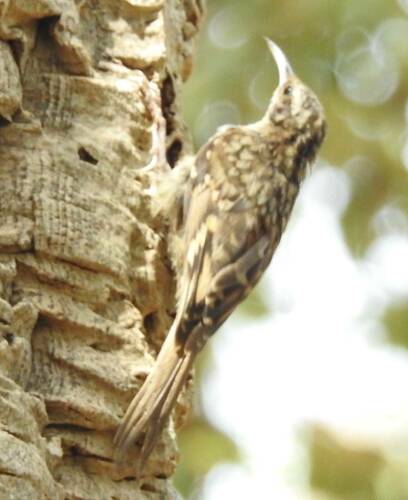
The Eurasian wren (Troglodytes troglodytes) is a very small insectivorous bird and the only member of the wren family found in the Old World, specifically in Eurasia and Africa (Maghreb). In Anglophone Europe, it is commonly known simply as the wren. It has a very short tail which is often held erect, a short neck and a relatively long thin bill. It is russet brown above, paler buff-brown below, overall finely barred darker, and has a cream buff supercilium. The sexes are alike.

The Eurasian wren occurs in Europe and across the Palearctic, including a belt of Asia from northern Iran and Afghanistan across to Japan. It is migratory in the northern (particularly northeastern), parts of its range, and sedentary in the west and south of its range. It is also highly polygynous, an unusual mating system for passerines. The species was formerly lumped together with winter wren (Troglodytes hiemalis) of eastern North America and Pacific wren (Troglodytes pacificus) of western North America under the merged name of northern wren.

The scientific name is taken from the Greek word "troglodytes" (from τρώγλη troglē "hole", and δῠ́ειν dyein, "creep"), meaning "hole-dweller", and refers to its habit of disappearing into cavities or crevices whilst hunting arthropods or to roost. The taxonomy of the genus Troglodytes is currently unresolved, as recent molecular studies have suggested that the genera Cistothorus and Thryorchilus are within the clade currently defined by Troglodytes. Wikipedia →

Sounds

Song1:12

France · 2026

© SWIFT Olivier · XC1156514 · CC BY-NC 4.0

Call0:30

France · 2021

© Stanislas Wroza · XC1075276 · CC BY-NC-SA 4.0

Dawn song1:00

Netherlands · 2025

© Susanne Kuijpers · XC1053191 · CC BY-NC-SA 4.0

Global Distribution

Parks Where Found

# Park Country Daily sighting probability
1 Białowieża National Park 🇵🇱 Poland
~60%
2 Cairngorms National Park 🇬🇧 United Kingdom
~60%
3 Tatra National Park 🇸🇰 Slovakia
~50%
4 Snowdonia National Park 🇬🇧 United Kingdom
~50%
5 Picos de Europa National Park 🇪🇸 Spain
~50%
6 Hohe Tauern National Park 🇦🇹 Austria
~50%
7 Bavarian Forest National Park 🇩🇪 Germany
~40%
8 Aigüestortes National Park 🇪🇸 Spain
~40%
9 Nikko National Park 🇯🇵 Japan
~40%
10 Monfragüe National Park 🇪🇸 Spain
~40%
11 Triglav National Park 🇸🇮 Slovenia
~30%
12 Ecrins National Park 🇫🇷 France
~30%
13 Plitvice Lakes National Park 🇭🇷 Croatia
~30%
14 Pyrénées National Park 🇫🇷 France
~30%
15 Mercantour National Park 🇫🇷 France
~30%
16 Wadden Sea National Park 🇩🇪 Germany
~30%
17 Sierra de Guadarrama National Park 🇪🇸 Spain
~30%
18 Cévennes National Park 🇫🇷 France
~30%
19 Ordesa y Monte Perdido National Park 🇪🇸 Spain
~30%
20 Biebrza National Park 🇵🇱 Poland
~30%
21 Vanoise National Park 🇫🇷 France
~20%
22 Taroko National Park 🇹🇼 Taiwan
~20%
23 Langtang National Park 🇳🇵 Nepal
~20%
24 Kiskunság National Park 🇭🇺 Hungary
~20%
25 Gauja National Park 🇱🇻 Latvia
~20%
26 Sierra Nevada National Park 🇪🇸 Spain
~20%
27 Jiuzhaigou National Park 🇨🇳 China
~20%
28 Vatnajokull National Park 🇮🇸 Iceland
~20%
29 Hemis National Park 🇮🇳 India
~20%
30 Hortobágy National Park 🇭🇺 Hungary
~10%
31 Doñana National Park 🇪🇸 Spain
~10%
32 Fertő-Hanság National Park 🇭🇺 Hungary
~10%
33 Camargue 🇫🇷 France
~10%

Cities Where Found

# City Country Daily sighting probability
1 Manchester 🇬🇧 United Kingdom
~80%
2 Liverpool 🇬🇧 United Kingdom
~70%
3 London 🇬🇧 United Kingdom
~60%
4 Brussels 🇧🇪 Belgium
~60%
5 Dublin 🇮🇪 Ireland
~60%
6 Birmingham 🇬🇧 United Kingdom
~60%
7 Hamburg 🇩🇪 Germany
~60%
8 Paris 🇫🇷 France
~50%
9 Porto 🇵🇹 Portugal
~50%
10 Amsterdam 🇳🇱 Netherlands
~50%

Zoos & Centres Where Found

# Zoo / Centre Country
1 AQUA Akvarium & Dyrepark 🇩🇰 Denmark In captivity

Before you go

What are the chances of seeing a Eurasian Wren in Rotterdam [The Hague]?

Likely

About 50% of wildlife watchers report a Eurasian Wren sighting in Rotterdam [The Hague] on a given day, based on 721 verified sightings from GBIF citizen-science data. It is the 19th most-seen of the 175 birds we can rate there. Over three days the chance rises to about 80%, and over a week to over 90%, if each day is a fresh chance.

When is the best time to see a Eurasian Wren in Rotterdam [The Hague]?

February to May

In those months about 60% of wildlife watchers report a Eurasian Wren in Rotterdam [The Hague] on a given day, against about 30% in January, August and October, the lowest months.

What time of day is best to see a Eurasian Wren?

Between 8 and 11 am

Across all the parks we cover, that three-hour window holds the most Eurasian Wren sightings with a recorded time, and about 9 in 10 of them come between 6 am and 6 pm: it is a daytime animal.

Is Rotterdam [The Hague] the best place to see a Eurasian Wren?

14th of 65

Of the 65 cities where we can rate Eurasian Wren sightings, Rotterdam [The Hague] ranks 14th at about 50%. The best odds are in Manchester (United Kingdom, about 80%), Liverpool (United Kingdom, about 70%) and London (United Kingdom, about 60%).

Which relatives of the Eurasian Wren live in Rotterdam [The Hague]?

Same order: Passeriformes

The closest relatives of the Eurasian Wren that you can see in Rotterdam [The Hague] (order Passeriformes, Perching Birds) are Carrion Crow (about 70%), Eurasian Jackdaw (about 70%) and Eurasian Magpie (about 70%), with each one's daily chance of a sighting.

Where does the Eurasian Wren sighting chance come from?

GBIF citizen-science records

It is estimated from how often the Eurasian Wren is recorded against all the birds logged in Rotterdam [The Hague] (721 verified sightings), calibrated against known sighting rates. Figures are rounded to the nearest 10% because citizen-science data supports honest approximations, not decimals, and months with records from fewer than five people show "—". How it works.

← Back to Rotterdam [The Hague]