Western Pygmy-Blue

Western Pygmy-Blue

Brephidium exilis

Daily sighting probability ~10% · With luck
at Salt Lake City

In 3 days ~20% in a week ~40%

47 Verified sightings at Salt Lake City
433 In all 10 parks From 2019 to 2026
October Best month
☀️ Diurnal When it's spotted

About the Western Pygmy-Blue

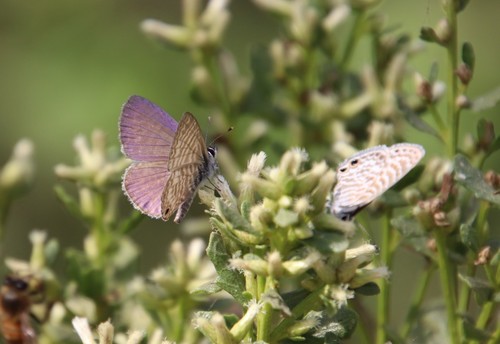
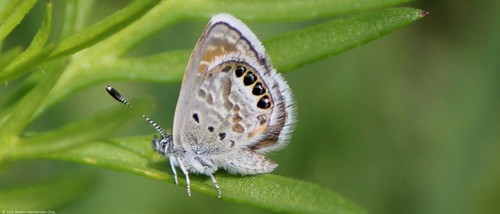
The western pygmy blue (Brephidium exilis or Brephidium exile) is one of the smallest butterflies in the world and the smallest in North America. It has reached Hawaii, as well as the Persian Gulf, including Kuwait, eastern Saudi Arabia, Bahrain and the United Arab Emirates.

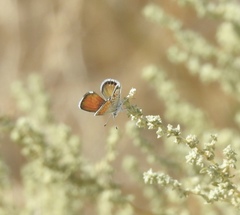
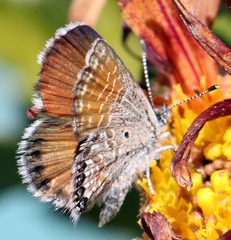
The upperside is copper brown with dull blue at the bases of both wings. The underside of the hindwing is copper brown with white at the base; the fringe mostly white, with 3 small black spots near base, and a row of black spots at outer margin. The wingspan is 12–20 mm.

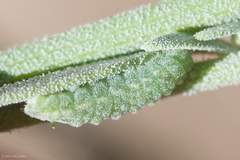
Males establish a territory in which they look for receptive females to mate with. After mating, females lay eggs on all parts of the host plant, oftenmost on the uppersides of leaves. The caterpillars eat all parts of the plant; host species include Pigweed (Chenopodium album), saltbush species (Atriplex), and others in the goosefoot family (Chenopodiaceae). Adult imagos appear in July–September in the north, while it appears year round in South Texas. Adults feed on nectar only.

This butterfly can be found in alkaline areas such as deserts, salt marshes, and barren areas. They are... Wikipedia →
Global Distribution

Parks Where Found

# Park Country Daily sighting probability
1 Death Valley National Park 🇺🇸 United States
~40%
2 Bahía de Loreto National Park 🇲🇽 Mexico
~30%
3 Joshua Tree National Park 🇺🇸 United States
~20%
4 Saguaro National Park 🇺🇸 United States
~10%
5 Ría Lagartos Biosphere Reserve 🇲🇽 Mexico
~10%
6 Channel Islands National Park 🇺🇸 United States
~10%
7 Big Bend National Park 🇺🇸 United States
~10%
8 Zion National Park 🇺🇸 United States
~10%
9 Grand Canyon National Park 🇺🇸 United States
~10%
10 Cumbres de Monterrey National Park 🇲🇽 Mexico
<5%

Cities Where Found

# City Country Daily sighting probability
1 Manama 🇧🇭 Bahrain
~30%
2 Abu Dhabi 🇦🇪 United Arab Emirates
~20%
3 Ciudad Juárez 🇲🇽 México
~20%
4 Dubai 🇦🇪 United Arab Emirates
~20%
5 Tijuana 🇲🇽 México
~20%
6 Kuwait City 🇰🇼 Kuwait
~20%
7 Torreón 🇲🇽 México
~20%
8 Mesa 🇺🇸 United States
~10%
9 Phoenix 🇺🇸 United States
~10%
10 Las Vegas 🇺🇸 United States
~10%

Before you go

What are the chances of seeing a Western Pygmy-Blue in Salt Lake City?

With luck

About 10% of wildlife watchers report a Western Pygmy-Blue sighting in Salt Lake City on a given day, based on 47 verified sightings from GBIF citizen-science data. It is the 55th most-seen of the 242 insects we can rate there. Over three days the chance rises to about 20%, and over a week to about 40%, if each day is a fresh chance.

When is the best time to see a Western Pygmy-Blue in Salt Lake City?

October

In that month about 30% of wildlife watchers report a Western Pygmy-Blue in Salt Lake City on a given day, against under 5% in December to July, the lowest months.

What time of day is best to see a Western Pygmy-Blue?

Between 11 am and 2 pm

Across all the parks we cover, that three-hour window holds the most Western Pygmy-Blue sightings with a recorded time, and nearly all of them come between 6 am and 6 pm: it is a daytime animal.

Is Salt Lake City the best place to see a Western Pygmy-Blue?

12th of 19

Of the 19 cities where we can rate Western Pygmy-Blue sightings, Salt Lake City ranks 12th at about 10%. The best odds are in Manama (Bahrain, about 30%), Abu Dhabi (United Arab Emirates, about 20%) and Ciudad Juárez (México, about 20%).

Where does the Western Pygmy-Blue sighting chance come from?

GBIF citizen-science records

It is estimated from how often the Western Pygmy-Blue is recorded against all the insects logged in Salt Lake City (47 verified sightings), calibrated against known sighting rates. Figures are rounded to the nearest 10% because citizen-science data supports honest approximations, not decimals, and months with records from fewer than five people show "—". How it works.

← Back to Salt Lake City