Grayish Baywing

Grayish Baywing

Agelaioides badius

Silhouette: Sheatherius · PhyloPic

LCLeast ConcernNTVUENCR
Daily sighting probability <5% · Rare
at Salvador

In 3 days ~10% in a week ~30%

30 Verified sightings at Salvador
1,026 In all 9 parks From 2019 to 2026
April Best month
☀️ Diurnal When it's spotted

About the Grayish Baywing

The greyish baywing (Agelaioides badius) is a species of bird in the family Icteridae, the oropendolas, New World orioles, and New World blackbirds. It is found in Argentina, Bolivia, Brazil, Paraguay, and Uruguay, and there are unconfirmed reports from Chile.

The greyish baywing was formally described in 1819 with the binomial Agelaius badius. It was later placed in genus Molothrus and spent most of the twentieth century there with the English name "bay-winged cowbird". After it was reassigned to its present genus Agelaioides many authors called it simply "baywing" because it had significant behavioral differences from the Molothrus cowbirds. At this time it included three subspecies. In the mid-2010s one of them, A. b. fringillarius, was recognized as a full species and named the pale baywing. The reduced A. badius, which includes the second subspecies A. b. bolivianus, was renamed the greyish baywing.

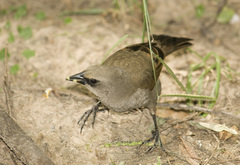
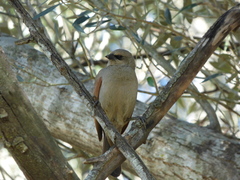
The greyish baywing is 19 cm (7 in) long. Males weigh an average of about 46 g (1.6 oz) and females average about 42 g (1.5 oz). Both sexes of both subspecies have the same plumage though A. b. bolivianus is larger than the nominate... Wikipedia →

Sounds

Call0:05

Argentina · 2025

© Marcos E. Sosa · XC1065678 · CC BY-NC-SA 4.0

Song1:07

Argentina · 2022

© Pablo Adrián Otero · XC749005 · CC BY-NC-SA 4.0

Alarm call0:17

Argentina · 2014

© Gabriele Magurno · XC202067 · CC BY-SA 4.0

Global Distribution

Parks Where Found

# Park Country Daily sighting probability
1 El Palmar National Park 🇦🇷 Argentina
~50%
2 El Impenetrable National Park 🇦🇷 Argentina
~50%
3 Iberá National Park 🇦🇷 Argentina
~30%
4 Chapada Diamantina National Park 🇧🇷 Brazil
~10%
5 Parque Estadual Encontro das Águas 🇧🇷 Brazil
~10%
6 Península Valdés 🇦🇷 Argentina
<5%
7 Iguaçu National Park 🇧🇷 Brazil
<5%
8 Iguazú National Park 🇦🇷 Argentina
<5%
9 Chapada dos Guimarães National Park 🇧🇷 Brazil
<5%

Cities Where Found

# City Country Daily sighting probability
1 Buenos Aires 🇦🇷 Argentina
~70%
2 Cochabamba 🇧🇴 Bolivia
~70%
3 Cordoba 🇦🇷 Argentina
~50%
4 Mendoza 🇦🇷 Argentina
~40%
5 Rosario 🇦🇷 Argentina
~30%
6 Porto Alegre 🇧🇷 Brazil
~20%
7 Asuncion 🇵🇾 Paraguay
~20%
8 Curitiba 🇧🇷 Brazil
~10%
9 Santa Cruz de la Sierra 🇧🇴 Bolivia
~10%
10 Salvador 🇧🇷 Brazil
<5%

Before you go

What are the chances of seeing a Grayish Baywing in Salvador?

Rare

Under 5% of wildlife watchers report a Grayish Baywing sighting in Salvador on a given day, based on 30 verified sightings from GBIF citizen-science data. It is the 67th most-seen of the 107 birds we can rate there. Over three days the chance rises to about 10%, and over a week to about 30%, if each day is a fresh chance.

When is the best time to see a Grayish Baywing in Salvador?

April–May and December

In those months about 10% of wildlife watchers report a Grayish Baywing in Salvador on a given day, against under 5% in January–March and June–November, the lowest months.

What time of day is best to see a Grayish Baywing?

Between 1 and 4 pm

Across all the parks we cover, that three-hour window holds the most Grayish Baywing sightings with a recorded time, and nearly all of them come between 6 am and 6 pm: it is a daytime animal.

Is Salvador the best place to see a Grayish Baywing?

10th of 12

Of the 12 cities where we can rate Grayish Baywing sightings, Salvador ranks 10th at under 5%. The best odds are in Buenos Aires (Argentina, about 70%), Cochabamba (Bolivia, about 70%) and Cordoba (Argentina, about 50%).

Where does the Grayish Baywing sighting chance come from?

GBIF citizen-science records

It is estimated from how often the Grayish Baywing is recorded against all the birds logged in Salvador (30 verified sightings), calibrated against known sighting rates. Figures are rounded to the nearest 10% because citizen-science data supports honest approximations, not decimals, and months with records from fewer than five people show "—". How it works.

← Back to Salvador