Eastern Whip-poor-will

Eastern Whip-poor-will

Antrostomus vociferus

Silhouette: Sheatherius · PhyloPic

LCNTNear ThreatenedVUENCR
Daily sighting probability <5% · Rare
at San Antonio

In 3 days <5%

8 Verified sightings at San Antonio
757 In all 6 parks From 2019 to 2026
October Best month
🌙 Nocturnal When it's spotted

About the Eastern Whip-poor-will

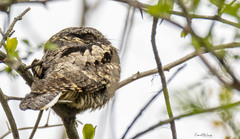
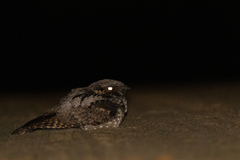
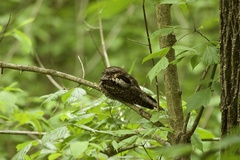
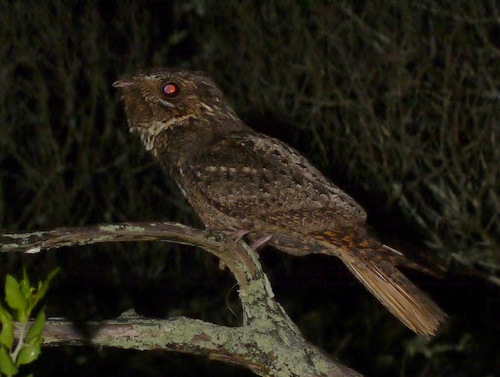
The eastern whip-poor-will (Antrostomus vociferus; also called "whip-o-will", "whip o' will", etc.) is a medium-sized (22–27 cm or 8.7–10.6 in) bird within the nightjar family, Caprimulgidae, from North America. The whip-poor-will is commonly heard within its range, but less often seen because of its camouflage. It is named onomatopoeically after its song.

This medium-sized nightjar measures 22–27 cm (8+1⁄2–10+1⁄2 in) in length, spans 45–50 cm (17+1⁄2–19+1⁄2 in) across the wings and weighs 42–69 g (1+1⁄2–2+7⁄16 oz). Further standard measurements are a wing chord of 14.7 to 16.9 cm (5+13⁄16 to 6+5⁄8 in), a tail of 10.5 to 12.8 cm (4+1⁄8 to 5+1⁄16 in), a bill of 1 to 1.4 cm (3⁄8 to 9⁄16 in) and a tarsus of 1.5 to 1.8 cm (9⁄16 to 11⁄16 in). Adults have mottled plumage: the upperparts are grey, black and brown; the lower parts are grey and black. They have a very short bill and a black throat. Males have a white patch below the throat and white tips on the outer tail feathers; in the female, these parts are light brown.

This bird is sometimes confused with the related chuck-will's-widow (Antrostomus carolinensis) which has a similar but lower-pitched and slower call.... Wikipedia →

Sounds

Song0:39

United States · 2023

© Sue Riffe · XC860759 · CC BY-NC-SA 4.0

Call0:44

United States · 2022

© Jorge de Leon Cardozo &amp; Susan Hochgraf · XC728665 · CC BY-NC-SA 4.0

Song0:58

United States · 2021

© Daniel Parker · XC734181 · CC BY-NC-SA 4.0

Global Distribution

Parks Where Found

# Park Country Daily sighting probability
1 Point Pelee National Park 🇨🇦 Canada
<5%
2 Great Smoky Mountains National Park 🇺🇸 United States
<5%
3 Everglades National Park 🇺🇸 United States
<5%
4 Shenandoah National Park 🇺🇸 United States
<5%
5 Big Cypress National Preserve 🇺🇸 United States
<5%
6 Merritt Island National Wildlife Refuge 🇺🇸 United States
<5%

Cities Where Found

# City Country Daily sighting probability
1 Chicago 🇺🇸 United States
<5%
2 Baltimore 🇺🇸 United States
<5%
3 Houston 🇺🇸 United States
<5%
4 Detroit 🇺🇸 United States
<5%
5 Miami 🇺🇸 United States
<5%
6 San Antonio 🇺🇸 United States
<5%
7 Toronto 🇨🇦 Canada
<5%
8 Washington 🇺🇸 United States
<5%
9 Austin 🇺🇸 United States
<5%
10 New York City 🇺🇸 United States
<5%

Before you go

What are the chances of seeing an Eastern Whip-poor-will in San Antonio?

Rare

Under 5% of wildlife watchers report an Eastern Whip-poor-will sighting in San Antonio on a given day, based on 8 verified sightings from GBIF citizen-science data. It is the 245th most-seen of the 255 birds we can rate there. Over three days the chance rises to under 5%, if each day is a fresh chance.

When is the best time to see an Eastern Whip-poor-will in San Antonio?

Any time of year

In every month with enough records, under 5% of wildlife watchers report an Eastern Whip-poor-will in San Antonio on a given day, so our monthly data shows no clear season.

What time of day is best to see an Eastern Whip-poor-will?

Between 8 and 11 pm

Across all the parks we cover, that three-hour window holds the most Eastern Whip-poor-will sightings with a recorded time, and about 9 in 10 of them come between 6 pm and 6 am: it is mostly seen at night.

Is San Antonio the best place to see an Eastern Whip-poor-will?

Among the best

Of the 11 cities where we can rate Eastern Whip-poor-will sightings, San Antonio ranks 6th at under 5%, level with the leaders once rounded. The best odds are in Chicago (United States, under 5%), Baltimore (United States, under 5%) and Houston (United States, under 5%).

Where does the Eastern Whip-poor-will sighting chance come from?

GBIF citizen-science records

It is estimated from how often the Eastern Whip-poor-will is recorded against all the birds logged in San Antonio (8 verified sightings), calibrated against known sighting rates. Figures are rounded to the nearest 10% because citizen-science data supports honest approximations, not decimals, and months with records from fewer than five people show "—". How it works.

← Back to San Antonio