
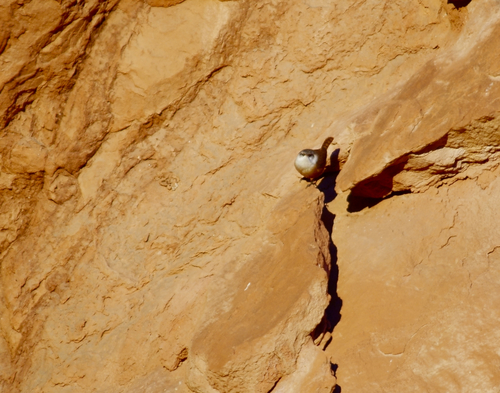


Marsh Wren

Marsh Wren

Cistothorus palustris

Silhouette: Matt Wilkins · PhyloPic

LCLeast ConcernNTVUENCR
Daily sighting probability <5% · Rare
at San Diego

In 3 days ~10% in a week ~20%

1,597 Verified sightings at San Diego
4,281 In all 26 parks From 2019 to 2026
February Best month
☀️ Diurnal When it's spotted

About the Marsh Wren

The marsh wren (Cistothorus palustris) is a small North American songbird of the wren family. It was formerly called the long-billed marsh wren to distinguish it from the sedge wren, then known as the short-billed marsh wren.

The marsh wren was described by the Scottish-American ornithologist Alexander Wilson in 1810 and given the binomial name Certhia palustris. The current genus Cistothorus was introduced by the German ornithologist Jean Cabanis in 1850. There are 15 recognised subspecies.

Etymology: from Greek 'κιστος' (cistos, "a shrub") and 'θουρος' (thouros, "leaping, or running through") and Latin 'palustris' ("marshy"). Adults have brown upperparts with a light brown belly and flanks and a white throat and breast. The back is black with white stripes. They have a dark cap with a white line over the eyes and a short thin bill.

The male's song is a loud gurgle used to declare ownership of territory; western males have a more varied repertoire. This little bird is native to Canada, Mexico, and the United States. Their breeding habitat is marshes with tall vegetation such as cattails across North America. In the western United States, some birds... Wikipedia →

Sounds

Call1:17

United States · 2025

© Greg Irving · XC1039179 · CC BY-NC-SA 4.0

Song0:44

United States · 2025

© Rory Nefdt · XC1034305 · CC BY-NC-SA 4.0

Subsong0:29

United States · 2023

© Bobby Wilcox · XC806281 · CC BY-NC-SA 4.0

Global Distribution

Parks Where Found

# Park Country Daily sighting probability
1 Death Valley National Park 🇺🇸 United States
~30%
2 Channel Islands National Park 🇺🇸 United States
~20%
3 El Vizcaíno Biosphere Reserve 🇲🇽 Mexico
~10%
4 Bahía de Loreto National Park 🇲🇽 Mexico
~10%
5 Riding Mountain National Park 🇨🇦 Canada
~10%
6 Redwood National Park 🇺🇸 United States
~10%
7 Point Pelee National Park 🇨🇦 Canada
~10%
8 Big Bend National Park 🇺🇸 United States
~10%
9 Elk Island National Park 🇨🇦 Canada
<5%
10 Voyageurs National Park 🇺🇸 United States
<5%
11 Merritt Island National Wildlife Refuge 🇺🇸 United States
<5%
12 Grand Teton National Park 🇺🇸 United States
<5%
13 Yellowstone National Park 🇺🇸 United States
<5%
14 Big Cypress National Preserve 🇺🇸 United States
<5%
15 Padre Island National Seashore 🇺🇸 United States
<5%
16 Olympic National Park 🇺🇸 United States
<5%
17 Saguaro National Park 🇺🇸 United States
<5%
18 Grand Canyon National Park 🇺🇸 United States
<5%
19 Banff National Park 🇨🇦 Canada
<5%
20 Everglades National Park 🇺🇸 United States
<5%
21 Pacific Rim National Park Reserve 🇨🇦 Canada
<5%
22 Cumbres de Monterrey National Park 🇲🇽 Mexico
<5%
23 Zion National Park 🇺🇸 United States
<5%
24 Acadia National Park 🇺🇸 United States
<5%
25 Rocky Mountain National Park 🇺🇸 United States
<5%
26 Great Smoky Mountains National Park 🇺🇸 United States
<5%

Cities Where Found

# City Country Daily sighting probability
1 Seattle 🇺🇸 United States
~20%
2 León 🇲🇽 México
~10%
3 San Francisco 🇺🇸 United States
~10%
4 Mexico City 🇲🇽 México
~10%
5 Mesa 🇺🇸 United States
~10%
6 Los Angeles 🇺🇸 United States
~10%
7 Toluca 🇲🇽 México
~10%
8 Vancouver 🇨🇦 Canada
~10%
9 Las Vegas 🇺🇸 United States
<5%
10 San Diego 🇺🇸 United States
<5%

Zoos & Centres Where Found

# Zoo / Centre Country
1 Ralph Perkins II Wildlife Center and Woods Garden 🇺🇸 United States In captivity

Before you go

What are the chances of seeing a Marsh Wren in San Diego?

Rare

Under 5% of wildlife watchers report a Marsh Wren sighting in San Diego on a given day, based on 1,597 verified sightings from GBIF citizen-science data. It is the 136th most-seen of the 386 birds we can rate there. Over three days the chance rises to about 10%, and over a week to about 20%, if each day is a fresh chance.

When is the best time to see a Marsh Wren in San Diego?

February and October–November

In those months about 10% of wildlife watchers report a Marsh Wren in San Diego on a given day, against under 5% in March–September and December–January, the lowest months. Those are among San Diego's wettest months, with about 30 mm of rain a month against almost none in July.

What time of day is best to see a Marsh Wren?

Between 8 and 11 am

Across all the parks we cover, that three-hour window holds the most Marsh Wren sightings with a recorded time, and about 9 in 10 of them come between 6 am and 6 pm: it is a daytime animal.

Is San Diego the best place to see a Marsh Wren?

10th of 34

Of the 34 cities where we can rate Marsh Wren sightings, San Diego ranks 10th at under 5%. The best odds are in Seattle (United States, about 20%), León (México, about 10%) and San Francisco (United States, about 10%).

Which relatives of the Marsh Wren live in San Diego?

Same family: Troglodytidae

The closest relatives of the Marsh Wren that you can see in San Diego (family Troglodytidae, Wrens) are Bewick's Wren (about 30%) and House Wren (about 20%), with each one's daily chance of a sighting.

Where does the Marsh Wren sighting chance come from?

GBIF citizen-science records

It is estimated from how often the Marsh Wren is recorded against all the birds logged in San Diego (1,597 verified sightings), calibrated against known sighting rates. Figures are rounded to the nearest 10% because citizen-science data supports honest approximations, not decimals, and months with records from fewer than five people show "—". How it works.

← Back to San Diego