Western Giant Swallowtail

Western Giant Swallowtail

Papilio rumiko

Daily sighting probability ~10% · With luck
at San Diego

In 3 days ~40% in a week ~70%

836 Verified sightings at San Diego
267 In all 6 parks From 2019 to 2026
September Best month
☀️ Diurnal When it's spotted

About the Western Giant Swallowtail

Papilio rumiko or western giant swallowtail is a species of swallowtail butterfly. It is found from the south-western United States, through Mexico, El Salvador, Honduras, Costa Rica to Panama. The northernmost record is north-eastern Colorado.

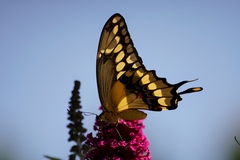
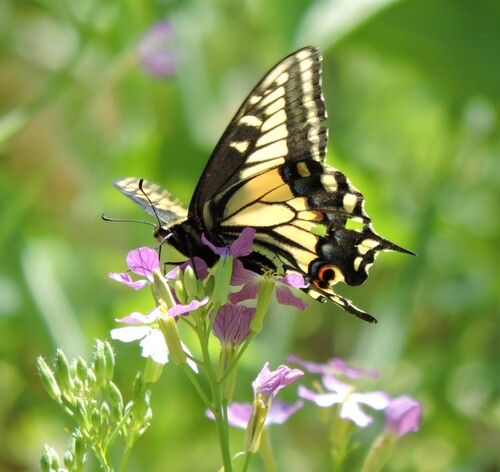
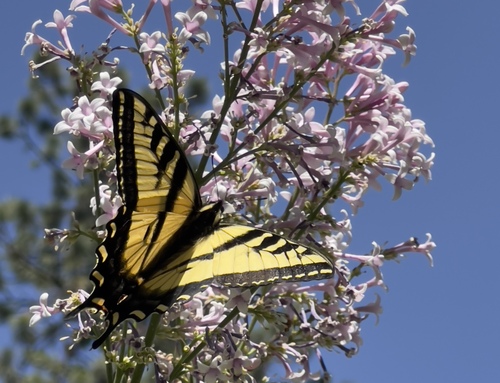
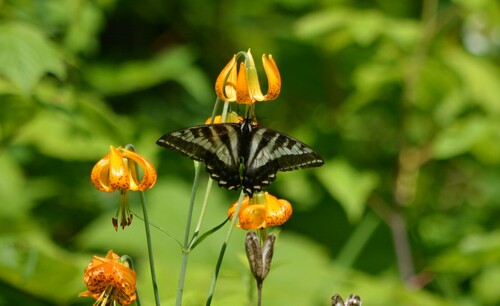
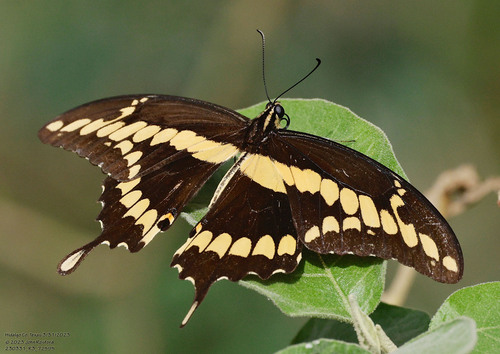
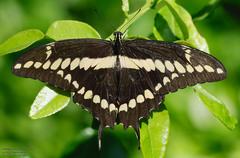
The length of the forewings is 50–58 mm. There are two maize-yellow bands on the forewings: a central band of nine spots from the apex to the basal third at the inner margin and a sub-marginal band of three to seven spots. There are several smaller maize-yellow spots near the costa at the end of the discal cell. There is a background-colored dark oval spot of variable size inside or at the anterior edge of the yellow central band spot, sometimes dividing the yellow spot into two. The marginal pale spots at the dips between the veins are small or almost absent. The hindwings have two maize-yellow bands extending from the forewings. There is a maroon-red to orange-red eyespot near the tornus with a blue crescent above. The center of the tail tip is yellow.

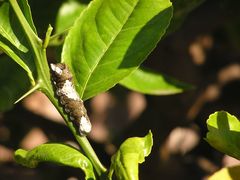
Eggs are laid singly on young leaves and shoots of Zanthoxylum fagara, Ptelea trifoliata, Amyris texana and Casimiroa greggii, Ruta graveolens and Citrus species. The colour of the egg is pale yellow when laid, gradually changing to dull orange-brown. First instar larvae are 3–5 mm in length with a yellow-brown head capsule. The body pattern resembles bird-droppings. The second instar is 5–11 mm with a uniformly brownish head. Third instars are 11–16 mm, fourth 16–30 mm and fifth instar 30–50 mm. When a late instar larva is startled, it lifts its head and inflates the thorax, revealing the eyespots on the meta-thorax. If disturbed further, it everts red osmeterium from behind the head. Early instar larva tends to use osmeterium right away when disturbed, and osmeterium of the first instar is yellowish.

Pupation takes place in a pupa of 26–36 mm in length. It is mottled pale to greyish and dark brown, resembling the surface of a tree or branch it is attached to. The darkness of a pupa is frequently determined by the color of the surface it rests on. Wikipedia →
Global Distribution

Parks Where Found

# Park Country Daily sighting probability
1 Cumbres de Monterrey National Park 🇲🇽 Mexico
~20%
2 Tortuguero National Park 🇨🇷 Costa Rica
~20%
3 Gandoca-Manzanillo Wildlife Refuge 🇨🇷 Costa Rica
~10%
4 Saguaro National Park 🇺🇸 United States
~10%
5 Big Bend National Park 🇺🇸 United States
~10%
6 La Amistad International Park (Panama) 🇵🇦 Panama
<5%

Cities Where Found

# City Country Daily sighting probability
1 Ciudad Juárez 🇲🇽 México
~30%
2 Torreón 🇲🇽 México
~30%
3 Tijuana 🇲🇽 México
~30%
4 Monterrey 🇲🇽 México
~20%
5 Los Angeles 🇺🇸 United States
~20%
6 San Luis Potosí 🇲🇽 México
~10%
7 San Pedro Sula 🇭🇳 Honduras
~10%
8 Mesa 🇺🇸 United States
~10%
9 San Diego 🇺🇸 United States
~10%
10 Phoenix 🇺🇸 United States
~10%

Before you go

What are the chances of seeing a Western Giant Swallowtail in San Diego?

With luck

About 10% of wildlife watchers report a Western Giant Swallowtail sighting in San Diego on a given day, based on 836 verified sightings from GBIF citizen-science data. It is the 11th most-seen of the 693 insects we can rate there. Over three days the chance rises to about 40%, and over a week to about 70%, if each day is a fresh chance.

When is the best time to see a Western Giant Swallowtail in San Diego?

September

In that month about 30% of wildlife watchers report a Western Giant Swallowtail in San Diego on a given day, against under 5% in January and February, the lowest months. That is one of San Diego's driest months, with about 5 mm of rain against 55 mm in February.

What time of day is best to see a Western Giant Swallowtail?

Between 10 am and 1 pm

Across all the parks we cover, that three-hour window holds the most Western Giant Swallowtail sightings with a recorded time, and about 9 in 10 of them come between 6 am and 6 pm: it is a daytime animal.

Is San Diego the best place to see a Western Giant Swallowtail?

9th of 19

Of the 19 cities where we can rate Western Giant Swallowtail sightings, San Diego ranks 9th at about 10%. The best odds are in Ciudad Juárez (México, about 30%), Torreón (México, about 30%) and Tijuana (México, about 30%).

Which relatives of the Western Giant Swallowtail live in San Diego?

Same genus: Papilio

The closest relatives of the Western Giant Swallowtail that you can see in San Diego (genus Papilio, Common Swallowtails) are Anise Swallowtail (about 10%) and Western Tiger Swallowtail (about 10%), with each one's daily chance of a sighting.

Where does the Western Giant Swallowtail sighting chance come from?

GBIF citizen-science records

It is estimated from how often the Western Giant Swallowtail is recorded against all the insects logged in San Diego (836 verified sightings), calibrated against known sighting rates. Figures are rounded to the nearest 10% because citizen-science data supports honest approximations, not decimals, and months with records from fewer than five people show "—". How it works.

← Back to San Diego