Emerald Swift

Emerald Swift

Sceloporus malachiticus

Silhouette: SeismicShrimp · PhyloPic

LCLeast ConcernNTVUENCR
Daily sighting probability ~30% · Possible
at San Salvador

In 3 days ~60% in a week ~90%

61 Verified sightings at San Salvador
1,235 In all 8 parks From 2019 to 2026
July Best month
☀️ Diurnal When it's spotted

About the Emerald Swift

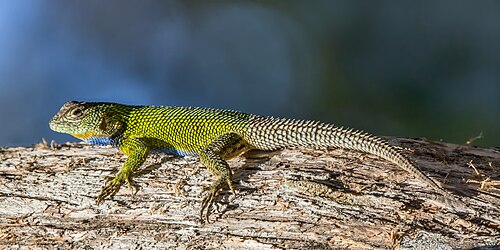
Sceloporus malachiticus, the emerald swift or green spiny lizard, is a species of small lizard in the Phrynosomatidae family, native to Central America. Emerald swifts are distinctly bright green in color, with males typically being more striking than females, having bright blue patches on either side of the belly. They grow from 6–8 inches (15–20 cm) in length. Like other species in the genus Sceloporus, their scales tend to be fairly stiff and heavily keeled, giving them a spiny texture.

Emerald swifts are diurnal, arboreal lizards. In the early morning, they forage for insects, and then spend much of the day basking in the sun. They will retreat to a burrow, or under a rock or log if the temperature becomes too high or to sleep. Their life spans are believed to be between three and five years. Unlike most iguanid lizards, emerald swifts are ovoviviparous, giving birth to six to fifteen young yearly.

The emerald swift is found from Mexico's Yucatan region, to Belize, Guatemala, Honduras, El Salvador, Nicaragua, Costa Rica, and Panama. The species was, for a time, considered to be a subspecies of the Mexican... Wikipedia →
Global Distribution

Parks Where Found

# Park Country Daily sighting probability
1 Los Quetzales National Park 🇨🇷 Costa Rica
~70%
2 Irazú Volcano National Park 🇨🇷 Costa Rica
~50%
3 Tapantí-Macizo de la Muerte National Park 🇨🇷 Costa Rica
~50%
4 Chirripó National Park 🇨🇷 Costa Rica
~50%
5 Volcán Barú National Park 🇵🇦 Panama
~40%
6 Monteverde Cloud Forest Reserve 🇨🇷 Costa Rica
~40%
7 La Amistad International Park (Panama) 🇵🇦 Panama
~20%
8 Braulio Carrillo National Park 🇨🇷 Costa Rica
~10%

Cities Where Found

# City Country Daily sighting probability
1 San José 🇨🇷 Costa Rica
~30%
2 San Salvador 🇸🇻 El Salvador
~30%

Zoos & Centres Where Found

# Zoo / Centre Country
1 Tierpark Berlin 🇩🇪 Germany In captivity
2 Zoo Miami 🇺🇸 United States In captivity
3 National Zoo of Malaysia 🇲🇾 Malaysia In captivity
4 Zoo Neuwied 🇩🇪 Germany In captivity
5 Reserva Zoológica Oasys MiniHollywood 🇪🇸 Spain In captivity
6 Reptile Gardens 🇺🇸 United States In captivity
7 Exotarium Sosnowiec 🇵🇱 Poland In captivity
8 Sea Life Bangkok Ocean World 🇹🇭 Thailand In captivity

Before you go

What are the chances of seeing an Emerald Swift in San Salvador?

Possible

About 30% of wildlife watchers report an Emerald Swift sighting in San Salvador on a given day, based on 61 verified sightings from GBIF citizen-science data. It is the most-seen of the 11 reptiles we can rate there. Over three days the chance rises to about 60%, and over a week to about 90%, if each day is a fresh chance.

When is the best time to see an Emerald Swift in San Salvador?

July

In that month about 50% of wildlife watchers report an Emerald Swift in San Salvador on a given day, against about 20% in March–April and September–October, the lowest months. That is one of San Salvador's wettest months, with about 200 mm of rain against almost none in January.

What time of day is best to see an Emerald Swift?

Between 11 am and 2 pm

Across all the parks we cover, that three-hour window holds the most Emerald Swift sightings with a recorded time, and about 9 in 10 of them come between 6 am and 6 pm: it is a daytime animal.

Is San Salvador the best place to see an Emerald Swift?

Among the best

Of the 2 cities where we can rate Emerald Swift sightings, San Salvador ranks 2nd at about 30%, level with the leaders once rounded. The best odds are in San José (Costa Rica, about 30%).

Where does the Emerald Swift sighting chance come from?

GBIF citizen-science records

It is estimated from how often the Emerald Swift is recorded against all the reptiles logged in San Salvador (61 verified sightings), calibrated against known sighting rates. Figures are rounded to the nearest 10% because citizen-science data supports honest approximations, not decimals, and months with records from fewer than five people show "—". How it works.

← Back to San Salvador