


Completed


Brown Basilisk
Basiliscus vittatus
Silhouette: Jose Carlos Arenas-Monroy · PhyloPic
- KingdomAnimalia (Animals)
- PhylumChordata (Chordates)
- ClassSquamata
- FamilyCorytophanidae (Helmeted Lizards)
- GenusBasiliscus (Basilisks)
- SpeciesBasiliscus vittatus (Brown Basilisk)
In 3 days ~40% in a week ~70%
18 Verified sightings at San Salvador
1,511 In all 22 parks From 2019 to 2026
July Best month
☀️ Diurnal When it's spotted
About the Brown Basilisk
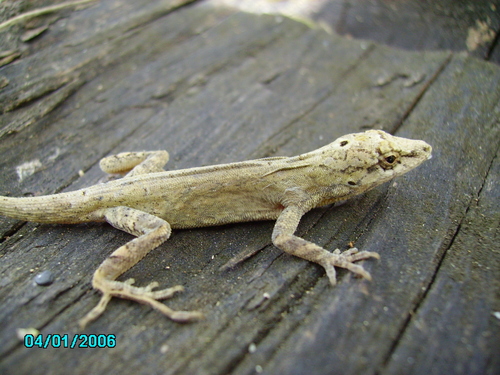
The brown basilisk (Basiliscus vittatus), also commonly referred to as the striped basilisk, is a species of basilisk lizard in the family Corytophanidae. The species is native to Mexico, Central America and adjacent northwestern Colombia, and has been introduced into the U.S. state of Florida as an invasive species. The brown basilisk has large hind feet with narrow flaps of skin on the distal edge of each toe. The fact that it moves quickly across water gives it the appearance of "walking on water".
The male brown basilisk can reach 61 centimetres (24 in) in total length (including tail), but the female is somewhat smaller. It has a three-part dorsal crest on the head, along the back, and along the tail. Coloration is brown or olive brown with black crossbands. The crossbands are usually only on the flanks and on the dorsal crest. There is also a white stripe, which extends from the eyes to the rear legs. The male has a larger crest than the female. The brown basilisk weighs 200–600 g (0.44–1.32 lb). It has long toes with sharp claws.
The brown basilisk's generic name Basiliscus is taken from the creature of Greek mythology made up of... Wikipedia →
Recent sightings of Brown Basilisk in San Salvador
LIVEiNaturalistGlobal Distribution
Parks Where Found
| # | Park | Country | Daily sighting probability |
|---|---|---|---|
| 1 | Pico Bonito National Park | 🇭🇳 Honduras | |
| 2 | Tortuguero National Park | 🇨🇷 Costa Rica | |
| 3 | Cockscomb Basin Wildlife Sanctuary | 🇧🇿 Belize | |
| 4 | Bastimentos Island National Marine Park | 🇵🇦 Panama | |
| 5 | Biotopo Cerro Cahuí | 🇬🇹 Guatemala | |
| 6 | Gandoca-Manzanillo Wildlife Refuge | 🇨🇷 Costa Rica | |
| 7 | Lago de Yojoa | 🇭🇳 Honduras | |
| 8 | Arrecifes de Cozumel National Park | 🇲🇽 Mexico | |
| 9 | Cahuita National Park | 🇨🇷 Costa Rica | |
| 10 | Cerro Azul Meámbar National Park | 🇭🇳 Honduras | |
| 11 | Calakmul Biosphere Reserve | 🇲🇽 Mexico | |
| 12 | Braulio Carrillo National Park | 🇨🇷 Costa Rica | |
| 13 | Montes Azules Biosphere Reserve | 🇲🇽 Mexico | |
| 14 | La Amistad International Park (Panama) | 🇵🇦 Panama | |
| 15 | Cusuco National Park | 🇭🇳 Honduras | |
| 16 | Celaque National Park | 🇭🇳 Honduras | |
| 17 | Sian Ka'an Biosphere Reserve | 🇲🇽 Mexico | |
| 18 | Arenal Volcano National Park | 🇨🇷 Costa Rica | |
| 19 | Tikal National Park | 🇬🇹 Guatemala | |
| 20 | Cañón del Sumidero National Park | 🇲🇽 Mexico | |
| 21 | Everglades National Park | 🇺🇸 United States | |
| 22 | Big Cypress National Preserve | 🇺🇸 United States |
Cities Where Found
| # | City | Country | Daily sighting probability |
|---|---|---|---|
| 1 | San Pedro Sula | 🇭🇳 Honduras | |
| 2 | Miami | 🇺🇸 United States | |
| 3 | San Salvador | 🇸🇻 El Salvador |
Zoos & Centres Where Found
| # | Zoo / Centre | Country | |
|---|---|---|---|
| 1 | Burgers' Ocean | 🇳🇱 Netherlands | |
| 2 | Royal Burgers' Zoo | 🇳🇱 Netherlands | |
| 3 | Budapest Zoo & Botanical Garden | 🇭🇺 Hungary | |
| 4 | Plock Zoo | 🇵🇱 Poland | |
| 5 | African Village | 🇦🇪 United Arab Emirates | |
| 6 | Kazan Zoo & Botanical Garden | 🇷🇺 Russia | |
| 7 | Ripley's Aquarium of the Smokies | 🇺🇸 United States | |
| 8 | Universeum | 🇸🇪 Sweden | |
| 9 | Acuario de Sevilla | 🇪🇸 Spain |
Closest Relatives at San Salvador
No species of the same family or order lives in San Salvador, so these are its closest relatives here: other reptiles.




Before you go
What are the chances of seeing a Brown Basilisk in San Salvador?
With luck
About 10% of wildlife watchers report a Brown Basilisk sighting in San Salvador on a given day, based on 18 verified sightings from GBIF citizen-science data. It is the 6th most-seen of the 11 reptiles we can rate there. Over three days the chance rises to about 40%, and over a week to about 70%, if each day is a fresh chance.
When is the best time to see a Brown Basilisk in San Salvador?
July
In that month about 30% of wildlife watchers report a Brown Basilisk in San Salvador on a given day, against under 5% in January–March and November, the lowest months. That is one of San Salvador's wettest months, with about 200 mm of rain against almost none in January.
What time of day is best to see a Brown Basilisk?
Between 10 am and 1 pm
Across all the parks we cover, that three-hour window holds the most Brown Basilisk sightings with a recorded time, and about 9 in 10 of them come between 6 am and 6 pm: it is a daytime animal.
Is San Salvador the best place to see a Brown Basilisk?
3rd of 3
Of the 3 cities where we can rate Brown Basilisk sightings, San Salvador ranks 3rd at about 10%. The best odds are in San Pedro Sula (Honduras, about 40%) and Miami (United States, about 40%).
Where does the Brown Basilisk sighting chance come from?
GBIF citizen-science records
It is estimated from how often the Brown Basilisk is recorded against all the reptiles logged in San Salvador (18 verified sightings), calibrated against known sighting rates. Figures are rounded to the nearest 10% because citizen-science data supports honest approximations, not decimals, and months with records from fewer than five people show "—". How it works.
