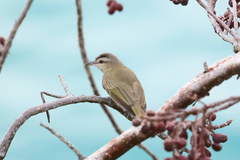
Black-whiskered Vireo

Black-whiskered Vireo

Vireo altiloquus

Silhouette: Caleb Gordon · PhyloPic

LCLeast ConcernNTVUENCR
Daily sighting probability ~50% · Likely
at Santo Domingo

In 3 days ~90% in a week >90%

526 Verified sightings at Santo Domingo
1,259 In all 7 parks From 2019 to 2026
May Best month
☀️ Diurnal When it's spotted

About the Black-whiskered Vireo

The black-whiskered vireo (Vireo altiloquus) is a small passerine bird in the family Vireonidae, the vireos, greenlets, and shrike-babblers. It is found in Florida, the Bahamas, many Caribbean islands, and northern and Amazonian South America.

The black-whiskered vireo was originally described in 1808 as Muscicapa altiloqua, mistakenly placing it in the Old World flycatcher family. It was at various times also called Vireosylva altiloqua and Vireo calidris. The black-whiskered vireo has these six subspecies:

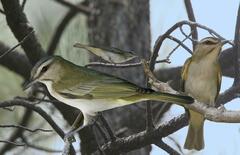
The nominate subspecies V. a. altiloquus weighs an average of 18 g (0.63 oz). The sexes have the same plumage. Adults of the nominate subspecies have a bluish gray forehead and crown with a buff-olive tinge, a buffy whitish supercilium from the bill past the eye, a wide dusky stripe through the eye, and the eponymous black "whisker" on the sides of the throat... Wikipedia →

Sounds

Song0:11

France · 2022

© Denis Dujardin · XC1056101 · CC BY-NC-SA 4.0

Alarm call0:08

French Guiana · 2023

© Julien Piolain · XC838298 · CC BY-NC-SA 4.0

Call1:00

United States · 2013

© Paul Marvin · XC145770 · CC BY-NC-SA 3.0

Global Distribution

Parks Where Found

# Park Country Daily sighting probability
1 Los Haitises National Park 🇩🇴 Dominican Republic
~70%
2 Blue and John Crow Mountains National Park 🇯🇲 Jamaica
~20%
3 Jaragua National Park 🇩🇴 Dominican Republic
~20%
4 Ciénaga de Zapata 🇨🇺 Cuba
~10%
5 Everglades National Park 🇺🇸 United States
<5%
6 Arrecifes de Cozumel National Park 🇲🇽 Mexico
<5%
7 Tayrona National Natural Park 🇨🇴 Colombia
<5%

Cities Where Found

# City Country Daily sighting probability
1 Santo Domingo 🇩🇴 Dominican Republic
~50%
2 Havana 🇨🇺 Cuba
~10%
3 Miami 🇺🇸 United States
<5%
4 Lima 🇵🇪 Peru
<5%
5 Houston 🇺🇸 United States
<5%

Before you go

What are the chances of seeing a Black-whiskered Vireo in Santo Domingo?

Likely

About 50% of wildlife watchers report a Black-whiskered Vireo sighting in Santo Domingo on a given day, based on 526 verified sightings from GBIF citizen-science data. It is the 19th most-seen of the 110 birds we can rate there. Over three days the chance rises to about 90%, and over a week to over 90%, if each day is a fresh chance.

When is the best time to see a Black-whiskered Vireo in Santo Domingo?

February and May

In those months about 60% of wildlife watchers report a Black-whiskered Vireo in Santo Domingo on a given day, against about 30% in July, the lowest month.

What time of day is best to see a Black-whiskered Vireo?

Between 8 and 11 am

Across all the parks we cover, that three-hour window holds the most Black-whiskered Vireo sightings with a recorded time, and about 9 in 10 of them come between 6 am and 6 pm: it is a daytime animal.

Is Santo Domingo the best place to see a Black-whiskered Vireo?

Yes

Of the 5 cities where we can rate Black-whiskered Vireo sightings, Santo Domingo has the highest daily chance: about 50%. Next come Havana (Cuba, about 10%) and Miami (United States, under 5%).

Where does the Black-whiskered Vireo sighting chance come from?

GBIF citizen-science records

It is estimated from how often the Black-whiskered Vireo is recorded against all the birds logged in Santo Domingo (526 verified sightings), calibrated against known sighting rates. Figures are rounded to the nearest 10% because citizen-science data supports honest approximations, not decimals, and months with records from fewer than five people show "—". How it works.

← Back to Santo Domingo