
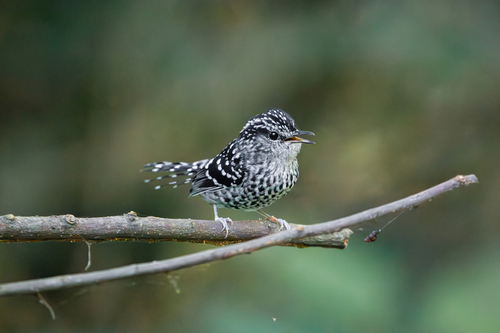

White-shouldered Fire-eye

White-shouldered Fire-eye

Pyriglena leucoptera

Silhouette: Sheatherius · PhyloPic

LCLeast ConcernNTVUENCR
Daily sighting probability <5% · Rare
at Santos

In 3 days <5% in a week ~10%

24 Verified sightings at Santos
3,080 In all 7 parks From 2019 to 2026
September Best month
☀️ Diurnal When it's spotted

About the White-shouldered Fire-eye

The white-shouldered fire-eye (Pyriglena leucoptera) is a species of bird in subfamily Thamnophilinae of family Thamnophilidae, the "typical antbirds". It is found in Argentina, Brazil, and Paraguay. The white-shouldered fire-eye was described by the French ornithologist Louis Pierre Vieillot in 1818 and given the binomial name Turdus leucopterus. The specific name is from the Ancient Greek leukopteros meaning "white-winged". The current genus Pyriglena was introduced by the German ornithologist Jean Cabanis in 1847. The species at times has been treated as conspecific with the fringe-backed fire-eye (P. atra) and what was at the time the white-backed fire-eye (P. leuconata); the latter has since been split into several species.

The white-shouldered fire-eye is monotypic. The white-shouldered fire-eye is 16 to 18 cm (6.3 to 7.1 in) long and weighs 25 to 34 g (0.88 to 1.2 oz). Adults of both sexes have bright red irises. Males are mostly glossy black. They have a white patch between their scapulars, white lesser wing coverts, white-tipped median and greater wing coverts, and blackish gray underwing coverts. Females have yellowish brown... Wikipedia →

Sounds

Call0:59

Argentina · 2026

© Marcos E. Sosa · XC1104554 · CC BY-NC-SA 4.0

Song1:00

Brazil · 2025

© Joost van Bruggen · XC1050662 · CC BY-NC-ND 4.0

Recording0:20

Argentina · 2025

© Sabrina Andrea Rendon Anaya · XC981843 · CC BY-NC-SA 4.0

Global Distribution

Parks Where Found

# Park Country Daily sighting probability
1 Itatiaia National Park 🇧🇷 Brazil
~30%
2 Serra dos Órgãos National Park 🇧🇷 Brazil
~30%
3 Iguazú National Park 🇦🇷 Argentina
~30%
4 Iguaçu National Park 🇧🇷 Brazil
~20%
5 Chapada Diamantina National Park 🇧🇷 Brazil
~20%
6 Serra da Canastra National Park 🇧🇷 Brazil
~10%
7 Tijuca National Park 🇧🇷 Brazil
<5%

Cities Where Found

# City Country Daily sighting probability
1 Santos 🇧🇷 Brazil
<5%
2 Rio de Janeiro 🇧🇷 Brazil
<5%
3 Belo Horizonte 🇧🇷 Brazil
<5%
4 São Paulo 🇧🇷 Brazil
<5%

Before you go

What are the chances of seeing a White-shouldered Fire-eye in Santos?

Rare

Under 5% of wildlife watchers report a White-shouldered Fire-eye sighting in Santos on a given day, based on 24 verified sightings from GBIF citizen-science data. It is the 123rd most-seen of the 203 birds we can rate there. Over three days the chance rises to under 5%, and over a week to about 10%, if each day is a fresh chance.

When is the best time to see a White-shouldered Fire-eye in Santos?

Any time of year

In every month with enough records, under 5% of wildlife watchers report a White-shouldered Fire-eye in Santos on a given day, so our monthly data shows no clear season.

What time of day is best to see a White-shouldered Fire-eye?

Between 8 and 11 am

Across all the parks we cover, that three-hour window holds the most White-shouldered Fire-eye sightings with a recorded time, and about 9 in 10 of them come between 6 am and 6 pm: it is a daytime animal.

Is Santos the best place to see a White-shouldered Fire-eye?

Yes

Of the 4 cities where we can rate White-shouldered Fire-eye sightings, Santos has the highest daily chance: under 5%. Next come Rio de Janeiro (Brazil, under 5%) and Belo Horizonte (Brazil, under 5%).

Which relatives of the White-shouldered Fire-eye live in Santos?

Same family: Thamnophilidae

The closest relatives of the White-shouldered Fire-eye that you can see in Santos (family Thamnophilidae, Typical Antbirds) are Rufous-margined Antwren (about 10%) and Variable Antshrike (about 10%), with each one's daily chance of a sighting.

Where does the White-shouldered Fire-eye sighting chance come from?

GBIF citizen-science records

It is estimated from how often the White-shouldered Fire-eye is recorded against all the birds logged in Santos (24 verified sightings), calibrated against known sighting rates. Figures are rounded to the nearest 10% because citizen-science data supports honest approximations, not decimals, and months with records from fewer than five people show "—". How it works.

← Back to Santos