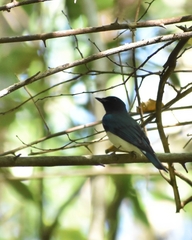
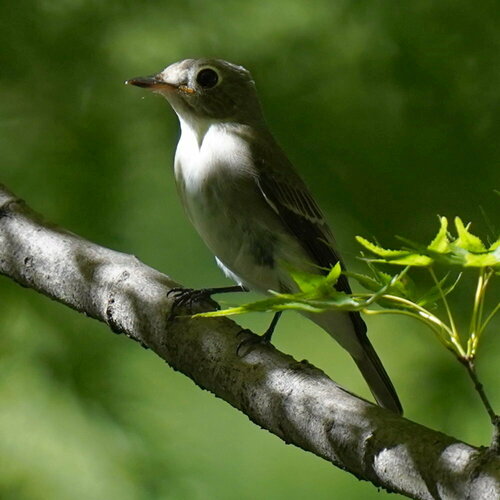
Blue-and-white Flycatcher

Blue-and-white Flycatcher

Cyanoptila cyanomelana

Silhouette: Martin Bulla, based on François Desbordes' illustration · PhyloPic

LCLeast ConcernNTVUENCR
Daily sighting probability ~10% · With luck
at Sapporo

In 3 days ~20% in a week ~30%

17 Verified sightings at Sapporo
373 In all 9 parks From 2019 to 2026
May Best month
☀️ Diurnal When it's spotted

About the Blue-and-white Flycatcher

The blue-and-white flycatcher (Cyanoptila cyanomelana) is a migratory songbird in the Old World flycatcher family Muscicapidae. The species is also known as the Japanese flycatcher. It breeds in Japan, Korea, and in parts of north eastern China and the Russian Far East. It winters in South East Asia, especially in Vietnam, Cambodia, Thailand, Sumatra and Borneo. This species has been recorded as a vagrant from the Sinharaja Rainforest in Sri Lanka in 2014.

The species was first described in 1829 by Coenraad Jacob Temminck under the binomial name Muscicapa cyanomelana, and was transferred to its own genus Cyanoptila by Edward Blyth in 1847, on the basis of structural differences from other flycatchers, including its wing length and bill dimensions.

The genus name comes from ancient Greek; "kuanos" meaning dark blue, and "ptilon", plumage. The specific cyanomelana also comes from "kuanos", paired with melas, melanos meaning dark, black. Wikipedia →

Sounds

Song1:10

South Korea · 2019

© Se-Jun Choi · XC1152878 · CC BY-NC-ND 4.0

Subsong0:35

Japan · 2026

© Ding Li Yong · XC1140026 · CC BY-NC-ND 4.0

Call0:10

China · 2024

© Feather V · XC992728 · CC BY-NC-SA 4.0

Global Distribution

Parks Where Found

# Park Country Daily sighting probability
1 Nikko National Park 🇯🇵 Japan
~20%
2 Kinabalu Park 🇲🇾 Malaysia
~10%
3 Sepilok 🇲🇾 Malaysia
<5%
4 Khao Luang National Park 🇹🇭 Thailand
<5%
5 Khao Yai National Park 🇹🇭 Thailand
<5%
6 Cat Tien National Park 🇻🇳 Vietnam
<5%
7 Kaeng Krachan National Park 🇹🇭 Thailand
<5%
8 Danum Valley Conservation Area 🇲🇾 Malaysia
<5%
9 Kinabatangan Wildlife Sanctuary 🇲🇾 Malaysia
<5%

Cities Where Found

# City Country Daily sighting probability
1 Daejeon 🇰🇷 South Korea
~10%
2 Sendai 🇯🇵 Japan
~10%
3 Busan 🇰🇷 South Korea
~10%
4 Sapporo 🇯🇵 Japan
~10%
5 Nanjing 🇨🇳 China
<5%
6 Xiamen City 🇨🇳 China
<5%
7 Fukuoka 🇯🇵 Japan
<5%
8 Osaka 🇯🇵 Japan
<5%
9 Wuhan 🇨🇳 China
<5%
10 Suzhou 🇨🇳 China
<5%

Zoos & Centres Where Found

# Zoo / Centre Country
1 Ueno Zoo 🇯🇵 Japan In captivity
2 Ueno Zoological Gardens (West Garden) 🇯🇵 Japan In captivity

Before you go

What are the chances of seeing a Blue-and-white Flycatcher in Sapporo?

With luck

About 10% of wildlife watchers report a Blue-and-white Flycatcher sighting in Sapporo on a given day, based on 17 verified sightings from GBIF citizen-science data. It is the 41st most-seen of the 72 birds we can rate there. Over three days the chance rises to about 20%, and over a week to about 30%, if each day is a fresh chance.

When is the best time to see a Blue-and-white Flycatcher in Sapporo?

May

In that month about 20% of wildlife watchers report a Blue-and-white Flycatcher in Sapporo on a given day, against under 5% in June to April, the lowest months.

What time of day is best to see a Blue-and-white Flycatcher?

Between 9 am and noon

Across all the parks we cover, that three-hour window holds the most Blue-and-white Flycatcher sightings with a recorded time, and about 9 in 10 of them come between 6 am and 6 pm: it is a daytime animal.

Is Sapporo the best place to see a Blue-and-white Flycatcher?

Among the best

Of the 19 cities where we can rate Blue-and-white Flycatcher sightings, Sapporo ranks 4th at about 10%, level with the leaders once rounded. The best odds are in Daejeon (South Korea, about 10%), Sendai (Japan, about 10%) and Busan (South Korea, about 10%).

Which relatives of the Blue-and-white Flycatcher live in Sapporo?

Same family: Muscicapidae

The closest relatives of the Blue-and-white Flycatcher that you can see in Sapporo (family Muscicapidae, Old World Flycatchers, Robins, and Chats) are Narcissus Flycatcher (about 10%) and Asian Brown Flycatcher (about 10%), with each one's daily chance of a sighting.

Where does the Blue-and-white Flycatcher sighting chance come from?

GBIF citizen-science records

It is estimated from how often the Blue-and-white Flycatcher is recorded against all the birds logged in Sapporo (17 verified sightings), calibrated against known sighting rates. Figures are rounded to the nearest 10% because citizen-science data supports honest approximations, not decimals, and months with records from fewer than five people show "—". How it works.

← Back to Sapporo