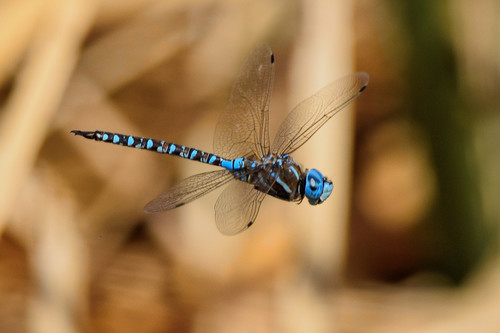
Common Whitetail

Common Whitetail

Plathemis lydia

Daily sighting probability ~10% · With luck
at Seattle

In 3 days ~20% in a week ~40%

123 Verified sightings at Seattle
512 In all 12 parks From 2019 to 2026
July Best month
☀️ Diurnal When it's spotted

About the Common Whitetail

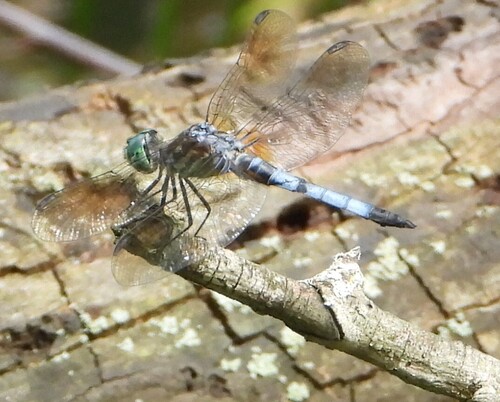
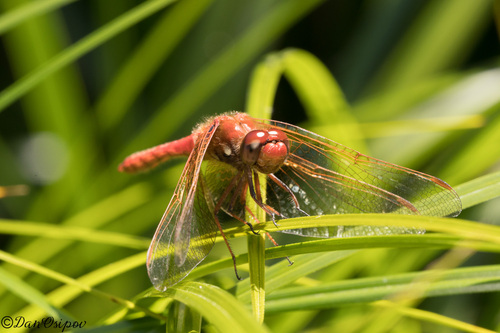
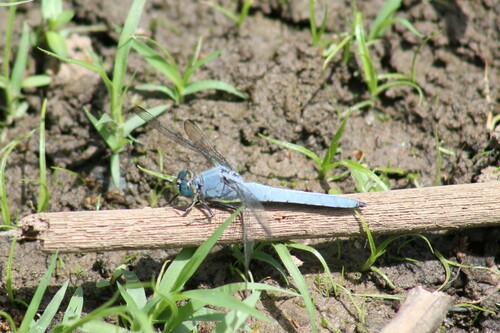
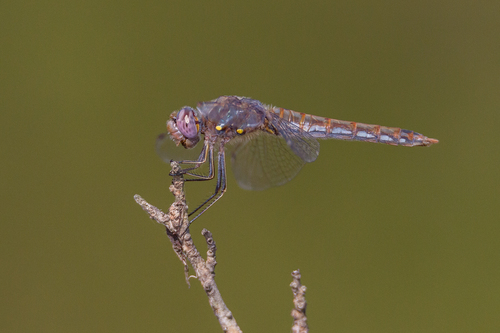
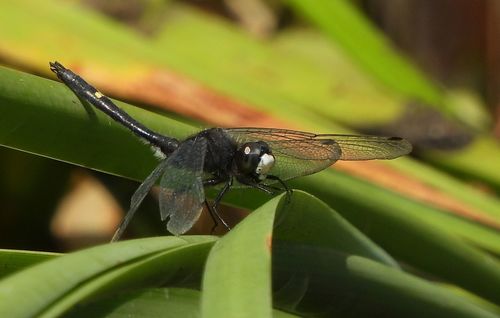
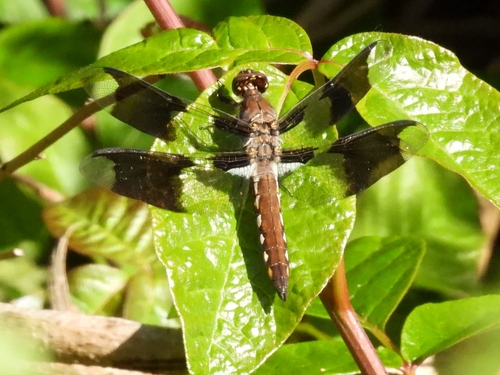
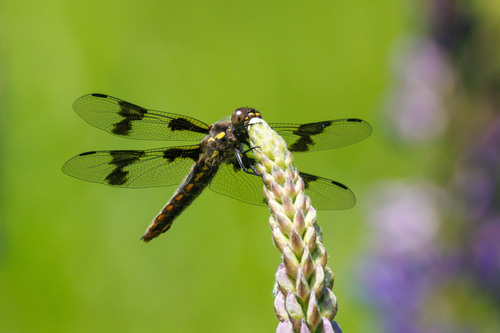
The common whitetail or long-tailed skimmer (Plathemis lydia) is a common dragonfly across much of North America, with a striking and unusual appearance. The male's chunky white body (about 5 cm (2.0 in) long), combined with the brownish-black bands on its otherwise translucent wings, give it a checkered look. Females have a brown body and a different pattern of wing spots, closely resembling that of female Libellula pulchella, the twelve-spotted skimmer. Whitetail females can be distinguished by their smaller size, shorter bodies, and white zigzag abdominal stripes; the abdominal stripes of L. puchella are straight and yellow.

The common whitetail can be seen hawking for mosquitoes and other small flying insects over ponds, marshes, and slow-moving rivers in most regions except the higher mountain regions. Periods of activity vary between regions; for example in California, the adults are active from April to September.

Like all perchers, common whitetails often rest on objects near the water, and sometimes on the ground. Males are territorial, holding a 10-to-30-meter stretch (30 to 100 ft) of the water's edge, and patrolling it to drive off other males. The white pruinescence on the abdomen, found only in mature males, is displayed to other males as a territorial threat.

The nymphs are dark green or brown, but are usually found covered in algae. They feed on aquatic invertebrates such as mayfly larvae and small crayfish, and also on small aquatic vertebrates such as tadpoles and minnows. Because of their abundance, whitetail naiads are in turn an important food source for various fish, frogs, and birds, and also for other aquatic insects.

Some authorities classify the whitetails, including the common whitetail, in genus Libellula rather than Plathemis. This matter has been debated at least since the end of the nineteenth century. Recent molecular systematic evidence suggests that separation of the whitetails from the rest of Libellula may be appropriate. Wikipedia →
Global Distribution

Parks Where Found

# Park Country Daily sighting probability
1 Congaree National Park 🇺🇸 United States
~20%
2 Isle Royale National Park 🇺🇸 United States
~20%
3 Great Smoky Mountains National Park 🇺🇸 United States
~20%
4 Shenandoah National Park 🇺🇸 United States
~10%
5 Yellowstone National Park 🇺🇸 United States
~10%
6 Acadia National Park 🇺🇸 United States
~10%
7 Redwood National Park 🇺🇸 United States
~10%
8 Point Pelee National Park 🇨🇦 Canada
~10%
9 Yosemite National Park 🇺🇸 United States
~10%
10 Big Bend National Park 🇺🇸 United States
~10%
11 Olympic National Park 🇺🇸 United States
<5%
12 Great Bear Rainforest 🇨🇦 Canada
<5%

Cities Where Found

# City Country Daily sighting probability
1 Austin 🇺🇸 United States
~20%
2 Washington 🇺🇸 United States
~20%
3 Portland 🇺🇸 United States
~20%
4 Dallas 🇺🇸 United States
~20%
5 Houston 🇺🇸 United States
~10%
6 Toronto 🇨🇦 Canada
~10%
7 Denver 🇺🇸 United States
~10%
8 Boston 🇺🇸 United States
~10%
9 Minneapolis [Saint Paul] 🇺🇸 United States
~10%
10 Baltimore 🇺🇸 United States
~10%

Before you go

What are the chances of seeing a Common Whitetail in Seattle?

With luck

About 10% of wildlife watchers report a Common Whitetail sighting in Seattle on a given day, based on 123 verified sightings from GBIF citizen-science data. It is the 47th most-seen of the 428 insects we can rate there. Over three days the chance rises to about 20%, and over a week to about 40%, if each day is a fresh chance.

When is the best time to see a Common Whitetail in Seattle?

July

In that month about 20% of wildlife watchers report a Common Whitetail in Seattle on a given day, against under 5% in September to April, the lowest months. That is one of Seattle's driest months, with about 20 mm of rain against 190 mm in November.

What time of day is best to see a Common Whitetail?

Between 10 am and 1 pm

Across all the parks we cover, that three-hour window holds the most Common Whitetail sightings with a recorded time, and nearly all of them come between 6 am and 6 pm: it is a daytime animal.

Is Seattle the best place to see a Common Whitetail?

18th of 20

Of the 20 cities where we can rate Common Whitetail sightings, Seattle ranks 18th at about 10%. The best odds are in Austin (United States, about 20%), Washington (United States, about 20%) and Portland (United States, about 20%).

Which relatives of the Common Whitetail live in Seattle?

Same family: Libellulidae

The closest relatives of the Common Whitetail that you can see in Seattle (family Libellulidae, Skimmers) are Eight-Spotted Skimmer (about 20%), Blue Dasher (about 10%) and Cardinal Meadowhawk (about 10%), with each one's daily chance of a sighting.

Where does the Common Whitetail sighting chance come from?

GBIF citizen-science records

It is estimated from how often the Common Whitetail is recorded against all the insects logged in Seattle (123 verified sightings), calibrated against known sighting rates. Figures are rounded to the nearest 10% because citizen-science data supports honest approximations, not decimals, and months with records from fewer than five people show "—". How it works.

← Back to Seattle