Painted Turtle

Painted Turtle

Chrysemys picta

Silhouette: PhyloPic

LCLeast ConcernNTVUENCR
Daily sighting probability ~10% · With luck
at Seattle

In 3 days ~30% in a week ~50%

161 Verified sightings at Seattle
732 In all 7 parks From 2019 to 2026
April Best month
☀️ Diurnal When it's spotted

About the Painted Turtle

The painted turtle (Chrysemys picta) is the most widespread native turtle of North America. This turtle is a member of the genus Chrysemys, which is part of the pond turtle family Emydidae. Fossils show that the painted turtle existed 15 million years ago. Three regionally based subspecies (the eastern, midland, and western) evolved during the last ice age. The southern painted turtle (C. dorsalis) is alternately considered the only other species in Chrysemys, or another subspecies of C. picta.

It lives in relatively slow-moving fresh waters, from southern Canada to northern Mexico, and from the Atlantic to the Pacific. They have been shown to prefer large wetlands with long periods of inundation and emergent vegetation.

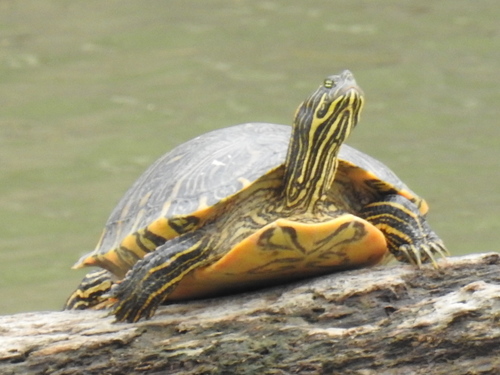
The adult painted turtle is 13–25 cm (5.1–9.8 in) long; the male is smaller than the female. The turtle's top shell is dark and smooth, without a ridge. Its skin is olive to black with red, orange, or yellow stripes on its extremities. The subspecies can be distinguished by their shells: the eastern has straight-aligned top shell segments; the midland has a large gray mark on the bottom shell; the western has a red pattern on the bottom shell.

The turtle eats aquatic vegetation, algae, and small water creatures including insects, crustaceans, and fish. Painted turtles primarily feed while in water and are able to locate and subdue prey even in heavily clouded conditions. Although they are frequently consumed as eggs or hatchlings by rodents, canines, and snakes, the adult turtles' hard shells protect them from most predators. However, they are still preyed on by animals such as foxes, raccoons, coyotes, and otters.

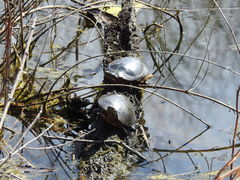
Reliant on warmth from its surroundings, the painted turtle is active only during the day when it basks for hours on logs or rocks. During winter, the turtle brumates, usually in the mud at the bottom of water bodies. This species is one of the few that is specially adapted to tolerate freezing temperatures for extended periods of time due to an antifreeze-like substance in their blood that keeps their cells from freezing.

The turtles mate in spring and autumn. Females dig nests on land and lay eggs between late spring and mid-summer. Hatched turtles grow until sexual maturity: 2–9 years for males, 6–16 for females. In the traditional tales of Algonquian tribes, the colorful turtle played the part of a trickster. In modern times, four U.S. states (Colorado, Illinois, Michigan, and Vermont) have named the painted turtle their official reptile. Wikipedia →

Sounds

Recording0:10

United States · 2026

© Cindy Wulff · iNaturalist · CC BY-NC 4.0

Global Distribution

Parks Where Found

# Park Country Daily sighting probability
1 Point Pelee National Park 🇨🇦 Canada
~70%
2 Voyageurs National Park 🇺🇸 United States
~60%
3 Isle Royale National Park 🇺🇸 United States
~40%
4 Acadia National Park 🇺🇸 United States
~30%
5 Badlands National Park 🇺🇸 United States
~20%
6 Riding Mountain National Park 🇨🇦 Canada
~10%
7 Shenandoah National Park 🇺🇸 United States
~10%

Cities Where Found

# City Country Daily sighting probability
1 Minneapolis [Saint Paul] 🇺🇸 United States
~40%
2 Washington 🇺🇸 United States
~30%
3 Detroit 🇺🇸 United States
~30%
4 Montreal 🇨🇦 Canada
~30%
5 Boston 🇺🇸 United States
~30%
6 Toronto 🇨🇦 Canada
~30%
7 Philadelphia 🇺🇸 United States
~20%
8 Denver 🇺🇸 United States
~20%
9 Chicago 🇺🇸 United States
~20%
10 Baltimore 🇺🇸 United States
~10%

Zoos & Centres Where Found

# Zoo / Centre Country
1 Natura Artis Magistra 🇳🇱 Netherlands In captivity
2 Barcelona Zoo 🇪🇸 Spain In captivity
3 Ecomuseum Zoo 🇨🇦 Canada In captivity
4 Toronto Zoo 🇨🇦 Canada In captivity
5 Omaha’s Henry Doorly Zoo and Aquarium 🇺🇸 United States In captivity
6 Shubenacadie Wildlife Park 🇨🇦 Canada In captivity
7 Toledo Zoo 🇺🇸 United States In captivity
8 Cape May County Park & Zoo 🇺🇸 United States In captivity
9 Oklahoma City Zoo and Botanical Garden 🇺🇸 United States In captivity
10 Oregon Zoo 🇺🇸 United States In captivity
11 Zoo Knoxville 🇺🇸 United States In captivity
12 Maine Wildlife Park 🇺🇸 United States In captivity
13 Bison Prairie 🇺🇸 United States In captivity
14 El Paso Zoo 🇺🇸 United States In captivity
15 Aquarama Barcelona 🇪🇸 Spain In captivity
16 Henry Vilas Zoo 🇺🇸 United States In captivity
17 Mystic Aquarium & Institute for Exploration 🇺🇸 United States In captivity
18 Willowbank Wildlife Reserve 🇳🇿 New Zealand In captivity
19 Reptile Gardens 🇺🇸 United States In captivity
20 Trailside Museum & Zoo 🇺🇸 United States In captivity
21 Salisbury Zoo 🇺🇸 United States In captivity
22 Turtle Bay Exploration Park 🇺🇸 United States In captivity
23 North Carolina Aquarium on Roanoke Island 🇺🇸 United States In captivity
24 Great Lakes Aquarium 🇺🇸 United States In captivity
25 National Aquarium 🇺🇸 United States In captivity
26 Terrariet 🇩🇰 Denmark In captivity
27 Bird Kingdom 🇨🇦 Canada In captivity
28 Tennessee Aquarium 🇺🇸 United States In captivity
29 Belle Isle Nature Center 🇨🇦 Canada In captivity
30 Bird Alliance of Oregon 🇺🇸 United States In captivity
31 Key West Butterfly and Nature Conservatory 🇺🇸 United States In captivity
32 Scales Nature Park 🇨🇦 Canada In captivity
33 Dream Catcher Stables 🇺🇸 United States In captivity
34 Greater Cleveland Aquarium 🇺🇸 United States In captivity
35 Montreal Biodome 🇨🇦 Canada In captivity
36 Museum of Life and Science 🇺🇸 United States In captivity
37 Portland Aquarium 🇺🇸 United States In captivity
38 Zoológico La Era de las aves 🇪🇸 Spain In captivity
39 Zoológico Miguél Álvarez del Toro 🇲🇽 Mexico In captivity

Before you go

What are the chances of seeing a Painted Turtle in Seattle?

With luck

About 10% of wildlife watchers report a Painted Turtle sighting in Seattle on a given day, based on 161 verified sightings from GBIF citizen-science data. It is the 3rd most-seen of the 10 reptiles we can rate there. Over three days the chance rises to about 30%, and over a week to about 50%, if each day is a fresh chance.

When is the best time to see a Painted Turtle in Seattle?

April

In that month about 20% of wildlife watchers report a Painted Turtle in Seattle on a given day, against under 5% in November to February, the lowest months.

What time of day is best to see a Painted Turtle?

Between noon and 3 pm

Across all the parks we cover, that three-hour window holds the most Painted Turtle sightings with a recorded time, and about 9 in 10 of them come between 6 am and 6 pm: it is a daytime animal.

Is Seattle the best place to see a Painted Turtle?

12th of 15

Of the 15 cities where we can rate Painted Turtle sightings, Seattle ranks 12th at about 10%. The best odds are in Minneapolis [Saint Paul] (United States, about 40%), Washington (United States, about 30%) and Detroit (United States, about 30%).

Where does the Painted Turtle sighting chance come from?

GBIF citizen-science records

It is estimated from how often the Painted Turtle is recorded against all the reptiles logged in Seattle (161 verified sightings), calibrated against known sighting rates. Figures are rounded to the nearest 10% because citizen-science data supports honest approximations, not decimals, and months with records from fewer than five people show "—". How it works.

← Back to Seattle