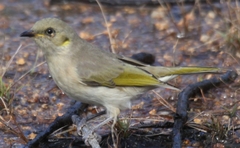
Fuscous Honeyeater

Fuscous Honeyeater

Ptilotula fusca

Silhouette: PhyloPic

LCLeast ConcernNTVUENCR Endemic
Daily sighting probability <5% · Rare
at Sydney

In 3 days <5%

5 Verified sightings at Sydney
135 In all 6 parks From 2019 to 2026
July Best month
☀️ Diurnal When it's spotted

About the Fuscous Honeyeater

The fuscous honeyeater (Ptilotula fusca) is a species of bird in the family Meliphagidae. It is endemic to eastern Australia, where it inhabits subtropical and tropical dry forests. The fuscous honeyeater was previously placed in the genus Lichenostomus, but was moved to Ptilotula after a molecular phylogenetic analysis, published in 2011, showed that the original genus was polyphyletic.

The fuscous honeyeater is dull grey-brown to olive-brown above with buffy-grey underparts. The bill is black and the eye-ring dark. It has a small black and yellow plume formed by the rear edge of the ear coverts. Similar species include grey-fronted honeyeater, yellow-plumed honeyeater and white-plumed honeyeater.

They have numerous calls, notably a distinctive rollicking arig arig a taw taw, a clear flutey cheer tor cheer and an incessant chip contact call. Fuscous honeyeaters live in colonies in dry eucalypt forest and woodland, mostly inland of the Great Dividing Range, but in New South Wales and Queensland also in coastal heathy forest. They are sometimes also found in gardens, and in patches of remnant forest on farms.

They are mostly sedentary... Wikipedia →

Sounds

Song0:13

Australia · 2023

© Peter Boesman · XC860136 · CC BY-NC-ND 4.0

Call1:12

Australia · 2018

© Ken George · XC857990 · CC BY-NC-SA 4.0

Call0:16

Australia · 2006

© Craig Robertson · XC589239 · CC BY-NC-SA 4.0

Global Distribution

Parks Where Found

# Park Country Daily sighting probability
1 Kosciuszko National Park 🇦🇺 Australia
~10%
2 Booderee National Park 🇦🇺 Australia
~10%
3 Grampians National Park 🇦🇺 Australia
<5%
4 Royal National Park 🇦🇺 Australia
<5%
5 Blue Mountains National Park 🇦🇺 Australia
<5%
6 Daintree National Park 🇦🇺 Australia
<5%

Cities Where Found

# City Country Daily sighting probability
1 Sydney 🇦🇺 Australia
<5%

Before you go

What are the chances of seeing a Fuscous Honeyeater in Sydney?

Rare

Under 5% of wildlife watchers report a Fuscous Honeyeater sighting in Sydney on a given day, based on 5 verified sightings from GBIF citizen-science data. It is the 242nd most-seen of the 243 birds we can rate there. Over three days the chance rises to under 5%, if each day is a fresh chance.

When is the best time to see a Fuscous Honeyeater in Sydney?

Any time of year

In every month with enough records, under 5% of wildlife watchers report a Fuscous Honeyeater in Sydney on a given day, so our monthly data shows no clear season.

What time of day is best to see a Fuscous Honeyeater?

Between noon and 3 pm

Across all the parks we cover, that three-hour window holds the most Fuscous Honeyeater sightings with a recorded time, and about 9 in 10 of them come between 6 am and 6 pm: it is a daytime animal.

Where else can you see a Fuscous Honeyeater?

Only Sydney, in our data

Sydney is the only city on Wallace's Line with enough records to rate Fuscous Honeyeater sightings: under 5% of wildlife watchers there report one on a given day.

Where does the Fuscous Honeyeater sighting chance come from?

GBIF citizen-science records

It is estimated from how often the Fuscous Honeyeater is recorded against all the birds logged in Sydney (5 verified sightings), calibrated against known sighting rates. Figures are rounded to the nearest 10% because citizen-science data supports honest approximations, not decimals, and months with records from fewer than five people show "—". How it works.

← Back to Sydney