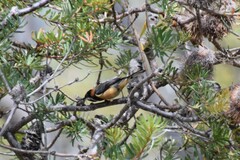
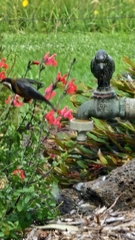
Eastern Spinebill

Eastern Spinebill

Acanthorhynchus tenuirostris

Silhouette: Michael Scroggie · PhyloPic

LCLeast ConcernNTVUENCR Endemic
Daily sighting probability ~10% · With luck
at Sydney

In 3 days ~20% in a week ~40%

1,480 Verified sightings at Sydney
10,646 In all 13 parks From 2019 to 2026
August Best month
☀️ Diurnal When it's spotted

About the Eastern Spinebill

The eastern spinebill (Acanthorhynchus tenuirostris) is a species of honeyeater found in eastern Australia from Queensland to Tasmania in forest and woodland areas, as well as gardens in urban areas. It is around 15 cm long, and has a distinctive black, white and chestnut plumage, a red eye, and a long downcurved bill.

Originally described as Certhia tenuirostris by the English ornithologist John Latham in 1801, it is a member of the small genus Acanthorhynchus with one other, the western spinebill of Western Australia. The generic name is derived from the Greek translation of spinebill, namely acantho-/ακανθο- 'spine' and rhynchos/ρυνχος 'bill'. Its specific epithet is from Latin tenuis 'narrow' and rostrum 'bill'. Other English names include spine-billed honeyeater and awl-bird or cobbler's awl bird.

The eastern spinebill forms a superspecies with the closely related western spinebill. Scientists believe the two sister species are descended from a shared ancestor whose once widespread populations were... Wikipedia →

Sounds

Song0:08

Australia · 2026

© Marc Anderson · XC1186719 · CC BY-NC-ND 4.0

Song and call1:07

Australia · 2023

© Peter Boesman · XC859611 · CC BY-NC-ND 4.0

Call0:24

Australia · 2022

© Phil Gregory · XC758069 · CC BY-NC-SA 4.0

Global Distribution

Parks Where Found

# Park Country Daily sighting probability
1 Blue Mountains National Park 🇦🇺 Australia
~70%
2 Booderee National Park 🇦🇺 Australia
~50%
3 Grampians National Park 🇦🇺 Australia
~50%
4 Royal National Park 🇦🇺 Australia
~50%
5 Wilsons Promontory National Park 🇦🇺 Australia
~40%
6 Lamington National Park 🇦🇺 Australia
~40%
7 Freycinet National Park 🇦🇺 Australia
~40%
8 Great Otway National Park 🇦🇺 Australia
~40%
9 Maria Island National Park 🇦🇺 Australia
~30%
10 Flinders Chase 🇦🇺 Australia
~30%
11 Springbrook National Park 🇦🇺 Australia
~20%
12 Kosciuszko National Park 🇦🇺 Australia
~20%
13 Cradle Mountain-Lake St Clair National Park 🇦🇺 Australia
~10%

Cities Where Found

# City Country Daily sighting probability
1 Hobart 🇦🇺 Australia
~20%
2 Melbourne 🇦🇺 Australia
~10%
3 Sydney 🇦🇺 Australia
~10%
4 Brisbane 🇦🇺 Australia
<5%

Zoos & Centres Where Found

# Zoo / Centre Country
1 Featherdale Sydney Wildlife Park 🇦🇺 Australia In captivity

Before you go

What are the chances of seeing an Eastern Spinebill in Sydney?

With luck

About 10% of wildlife watchers report an Eastern Spinebill sighting in Sydney on a given day, based on 1,480 verified sightings from GBIF citizen-science data. It is the 67th most-seen of the 243 birds we can rate there. Over three days the chance rises to about 20%, and over a week to about 40%, if each day is a fresh chance.

When is the best time to see an Eastern Spinebill in Sydney?

Any time of year

In every month with enough records, about 10% of wildlife watchers report an Eastern Spinebill in Sydney on a given day, so our monthly data shows no clear season.

What time of day is best to see an Eastern Spinebill?

Between noon and 3 pm

Across all the parks we cover, that three-hour window holds the most Eastern Spinebill sightings with a recorded time, and nearly all of them come between 6 am and 6 pm: it is a daytime animal.

Is Sydney the best place to see an Eastern Spinebill?

3rd of 4

Of the 4 cities where we can rate Eastern Spinebill sightings, Sydney ranks 3rd at about 10%. The best odds are in Hobart (Australia, about 20%) and Melbourne (Australia, about 10%).

Which relatives of the Eastern Spinebill live in Sydney?

Same family: Meliphagidae

The closest relatives of the Eastern Spinebill that you can see in Sydney (family Meliphagidae, Honeyeaters) are Noisy Miner (about 90%), Red Wattlebird (about 30%) and New Holland Honeyeater (about 20%), with each one's daily chance of a sighting.

Where does the Eastern Spinebill sighting chance come from?

GBIF citizen-science records

It is estimated from how often the Eastern Spinebill is recorded against all the birds logged in Sydney (1,480 verified sightings), calibrated against known sighting rates. Figures are rounded to the nearest 10% because citizen-science data supports honest approximations, not decimals, and months with records from fewer than five people show "—". How it works.

← Back to Sydney