Hadda Beetle

Hadda Beetle

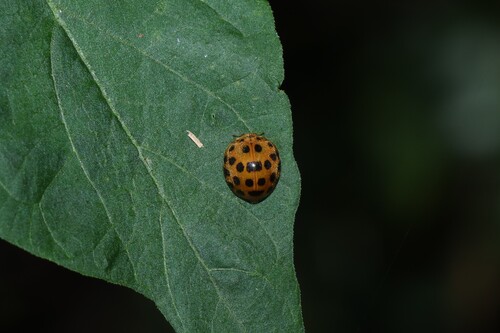
Henosepilachna vigintioctopunctata

Daily sighting probability ~20% · Possible
at Tasikmalaya

In 3 days ~50% in a week ~80%

16 Verified sightings at Tasikmalaya
43 In all 5 parks From 2019 to 2026
November Best month
☀️ Diurnal When it's spotted

About the Hadda Beetle

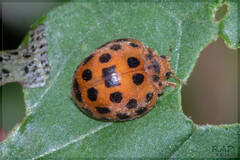
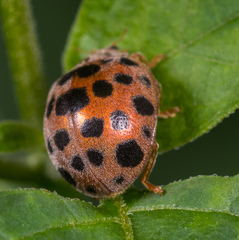
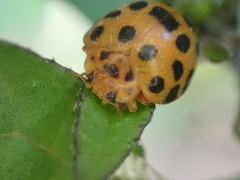
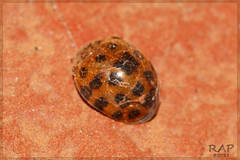
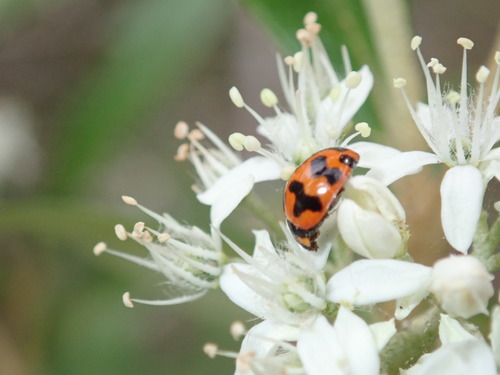
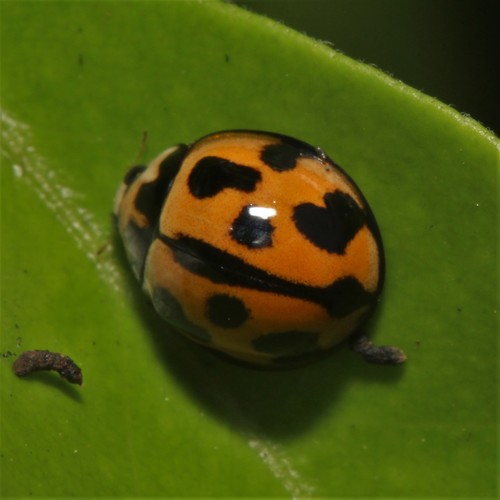
Henosepilachna vigintioctopunctata is a species of beetle in the family Coccinellidae. It is commonly known as the 28-spotted potato ladybird or the Hadda beetle. It feeds on the foliage of potatoes and other solanaceous crops. It was previously called Epilachna vigintioctopunctata and is a cryptic species complex. It is very often confused with a closely related species, Henosepilachna vigintioctomaculata, which occurs in Russia, China, Japan, and Korea, and is given the same "common name".

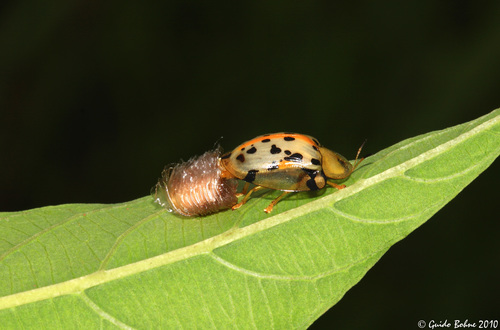
Temperature and humidity strongly influence the seasonal abundance of this species; the population increases with increased minimum temperature, and higher relative humidity. However, this species has two natural enemies, Tetrastichus sp. and Pediobius foveolatus, that suppress the beetle population by parasitizing their larval and pupal stages.

This species is native to southeastern Asia, primarily India, but has been accidentally introduced to other parts of the world, including Australia and New Zealand. It has also been recorded from Brazil and Argentina, beginning in 1996.

This species causes damage... Wikipedia →
Global Distribution

Parks Where Found

# Park Country Daily sighting probability
1 Lamington National Park 🇦🇺 Australia
~10%
2 Springbrook National Park 🇦🇺 Australia
~10%
3 Royal National Park 🇦🇺 Australia
~10%
4 Blue Mountains National Park 🇦🇺 Australia
~10%
5 Tijuca National Park 🇧🇷 Brazil
<5%

Cities Where Found

# City Country Daily sighting probability
1 Auckland 🇳🇿 New Zealand
~20%
2 Tasikmalaya 🇮🇩 Indonesia
~20%
3 Brisbane 🇦🇺 Australia
~20%
4 Yogyakarta 🇮🇩 Indonesia
~10%
5 Buenos Aires 🇦🇷 Argentina
~10%
6 Bandung 🇮🇩 Indonesia
~10%
7 Nagoya 🇯🇵 Japan
~10%
8 Sydney 🇦🇺 Australia
~10%
9 Prayagraj 🇮🇳 India
~10%
10 Maceió 🇧🇷 Brazil
~10%

Before you go

What are the chances of seeing a Hadda Beetle in Tasikmalaya?

Possible

About 20% of wildlife watchers report a Hadda Beetle sighting in Tasikmalaya on a given day, based on 16 verified sightings from GBIF citizen-science data. It is the 18th most-seen of the 76 insects we can rate there. Over three days the chance rises to about 50%, and over a week to about 80%, if each day is a fresh chance.

When is the best time to see a Hadda Beetle in Tasikmalaya?

November

In that month about 40% of wildlife watchers report a Hadda Beetle in Tasikmalaya on a given day, against under 5% in January–April and June–August, the lowest months. That is one of Tasikmalaya's wettest months, with about 360 mm of rain against 50 mm in August.

What time of day is best to see a Hadda Beetle?

Between 11 am and 2 pm

Across all the parks we cover, that three-hour window holds the most Hadda Beetle sightings with a recorded time, and about 9 in 10 of them come between 6 am and 6 pm: it is a daytime animal.

Is Tasikmalaya the best place to see a Hadda Beetle?

Among the best

Of the 24 cities where we can rate Hadda Beetle sightings, Tasikmalaya ranks 2nd at about 20%, level with the leaders once rounded. The best odds are in Auckland (New Zealand, about 20%).

Where does the Hadda Beetle sighting chance come from?

GBIF citizen-science records

It is estimated from how often the Hadda Beetle is recorded against all the insects logged in Tasikmalaya (16 verified sightings), calibrated against known sighting rates. Figures are rounded to the nearest 10% because citizen-science data supports honest approximations, not decimals, and months with records from fewer than five people show "—". How it works.

← Back to Tasikmalaya