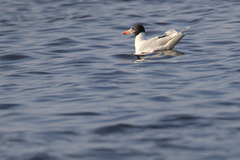
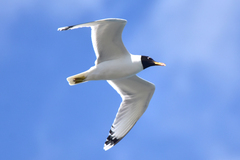
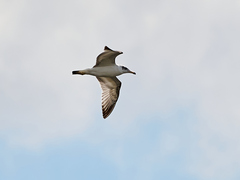
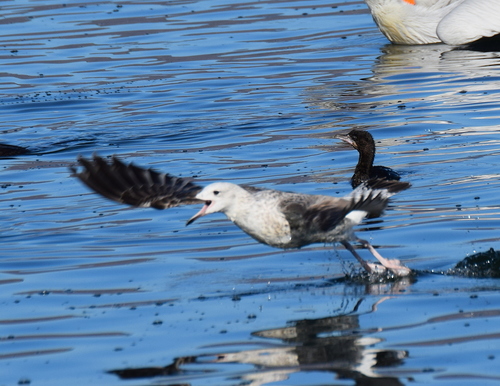
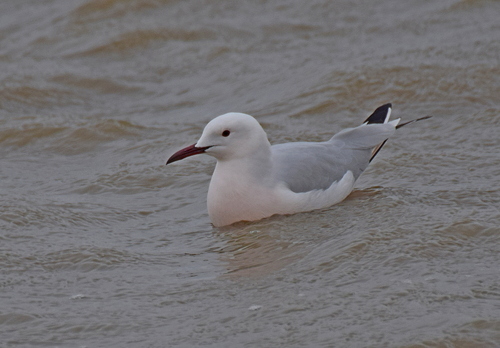
Pallas's Gull

Pallas's Gull

Ichthyaetus ichthyaetus

Silhouette: Sheatherius · PhyloPic

Daily sighting probability <5% · Rare
at Tel Aviv

In 3 days ~10% in a week ~20%

133 Verified sightings at Tel Aviv
85 In all 4 parks From 2019 to 2026
February Best month
☀️ Diurnal When it's spotted

About the Pallas's Gull

Pallas's gull (Ichthyaetus ichthyaetus), also known as the great black-headed gull, is a large bird species. As is the case with many gulls, it has traditionally been placed in the genus Larus. The scientific name is from Ancient Greek. Ichthyaetus is from ikhthus, "fish", and aetos, "eagle".

This species breeds in colonies in marshes and islands from southern Russia to Mongolia. It is migratory, wintering in the eastern Mediterranean, Arabia and India. This gull nests on the ground, laying between two and four eggs.

It occurs in western Europe only as a vagrant. In Great Britain a recent review left a single occurrence in 1859 as the only acceptable record of this bird. The species also occurs as a vagrant in differing parts of the Indian Ocean, south of its normal range, and along the northern and eastern coasts of Africa, where it visits annually on an irregular basis.

This is a very large gull, being easily the world's largest black-headed gull and the third largest species of gull in the world, after the great black-backed gull and the glaucous gull. It measures 55–72 cm (22–28 in) in length with a 142 to 170 cm (56 to 67 in) wingspan. Weight... Wikipedia →

Sounds

Call0:35

Kazakhstan · 2023

© Peter Boesman · XC813430 · CC BY-NC-ND 4.0

Flight call0:04

Mongolia · 2022

© Stanislas Wroza · XC766055 · CC BY-NC-SA 4.0

Song0:57

China · 2018

© Terry Townshend · XC419041 · CC BY-NC-SA 4.0

Global Distribution

Parks Where Found

# Park Country Daily sighting probability
1 Chitwan National Park 🇳🇵 Nepal
<5%
2 Ranthambore National Park 🇮🇳 India
<5%
3 Sundarbans National Park 🇮🇳 India
<5%
4 Keoladeo National Park 🇮🇳 India
<5%

Cities Where Found

# City Country Daily sighting probability
1 Lanzhou 🇨🇳 China
~40%
2 Novosibirsk 🇷🇺 Russia
~10%
3 Kuwait City 🇰🇼 Kuwait
~10%
4 Jaipur 🇮🇳 India
~10%
5 Yekaterinburg 🇷🇺 Russia
<5%
6 Tel Aviv 🇮🇱 Israel
<5%
7 Agra 🇮🇳 India
<5%
8 Ponnani 🇮🇳 India
<5%
9 Abu Dhabi 🇦🇪 United Arab Emirates
<5%
10 Kochi 🇮🇳 India
<5%

Zoos & Centres Where Found

# Zoo / Centre Country
1 Moscow Zoo 🇷🇺 Russia In captivity
2 西宁野生动物园 🇨🇳 China In captivity

Before you go

What are the chances of seeing a Pallas's Gull in Tel Aviv?

Rare

Under 5% of wildlife watchers report a Pallas's Gull sighting in Tel Aviv on a given day, based on 133 verified sightings from GBIF citizen-science data. It is the 92nd most-seen of the 232 birds we can rate there. Over three days the chance rises to about 10%, and over a week to about 20%, if each day is a fresh chance.

When is the best time to see a Pallas's Gull in Tel Aviv?

February

In that month about 20% of wildlife watchers report a Pallas's Gull in Tel Aviv on a given day, against under 5% in March to December, the lowest months. That is one of Tel Aviv's wettest months, with about 60 mm of rain against almost none in August.

What time of day is best to see a Pallas's Gull?

Between noon and 3 pm

Across all the parks we cover, that three-hour window holds the most Pallas's Gull sightings with a recorded time, and about 9 in 10 of them come between 6 am and 6 pm: it is a daytime animal.

Is Tel Aviv the best place to see a Pallas's Gull?

6th of 17

Of the 17 cities where we can rate Pallas's Gull sightings, Tel Aviv ranks 6th at under 5%. The best odds are in Lanzhou (China, about 40%), Novosibirsk (Russia, about 10%) and Kuwait City (Kuwait, about 10%).

Where does the Pallas's Gull sighting chance come from?

GBIF citizen-science records

It is estimated from how often the Pallas's Gull is recorded against all the birds logged in Tel Aviv (133 verified sightings), calibrated against known sighting rates. Figures are rounded to the nearest 10% because citizen-science data supports honest approximations, not decimals, and months with records from fewer than five people show "—". How it works.

← Back to Tel Aviv