Sardinian Warbler

Sardinian Warbler

Curruca melanocephala

Silhouette: Alexis Lours · PhyloPic

LCLeast ConcernNTVUENCR
Daily sighting probability ~60% · Likely
at Tunis

In 3 days >90%

102 Verified sightings at Tunis
7,075 In all 9 parks From 2019 to 2026
November Best month
🌅 Crepuscular When it's spotted

About the Sardinian Warbler

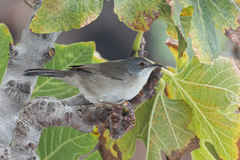
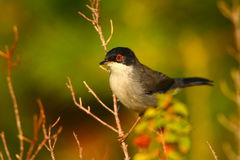
The Sardinian warbler (Curruca melanocephala) is a common and widespread Sylviidae warbler from the Mediterranean region. Like most Curruca species, it has distinct male and female plumages. The adult male has a grey back, whitish underparts, black head, white throat and red eyes. Plumages are somewhat variable even in the same locality, with the intensity of a reddish hue on upper- and/or underside that varies from absent to (in some subspecies) pronounced. The female is mainly brown above and buff below, with a grey head. The Sardinian warbler's song is fast and rattling, and is very characteristic of the Mediterranean areas where this bird breeds.

The Sardinian warbler was formally described in 1789 by the German naturalist Johann Friedrich Gmelin in his revised and expanded edition of Carl Linnaeus's Systema Naturae. He placed it with the wagtails in the genus Motacilla and coined the binomial name Motacilla melanocephala. Gmelin based his entry on a description by the Italian zoologist Francesco Cetti in his book Gli uccelli di Sardegna (The Birds of Sardinia) that was published in 1776. This was the second volume of his Storia naturale di Sardegna... Wikipedia →

Sounds

Song1:27

Morocco · 2026

© Jonas Nordin · XC1138957 · CC BY-NC-SA 4.0

Call1:14

Italy · 2025

© Francesco Sottile · XC994430 · CC BY-NC-SA 4.0

Recording1:29

Spain · 2024

© Jacobo Ramil Millarengo · XC911254 · CC BY-NC-SA 4.0

Global Distribution

Parks Where Found

# Park Country Daily sighting probability
1 Monfragüe National Park 🇪🇸 Spain
~50%
2 Sierra Nevada National Park 🇪🇸 Spain
~50%
3 Doñana National Park 🇪🇸 Spain
~50%
4 Camargue 🇫🇷 France
~40%
5 Sierra de Guadarrama National Park 🇪🇸 Spain
~10%
6 Cévennes National Park 🇫🇷 France
~10%
7 Pyrénées National Park 🇫🇷 France
<5%
8 Ordesa y Monte Perdido National Park 🇪🇸 Spain
<5%
9 Picos de Europa National Park 🇪🇸 Spain
<5%

Cities Where Found

# City Country Daily sighting probability
1 Ramallah 🇵🇸 Palestine
~80%
2 Tunis 🇹🇳 Tunisia
~60%
3 Barcelona 🇪🇸 Spain
~60%
4 Jerusalem 🇮🇱 Israel
~60%
5 Beirut 🇱🇧 Lebanon
~60%
6 Lisbon 🇵🇹 Portugal
~50%
7 Valencia 🇪🇸 Spain
~40%
8 Athens 🇬🇷 Greece
~40%
9 Marrakesh 🇲🇦 Morocco
~40%
10 Rabat 🇲🇦 Morocco
~40%

Zoos & Centres Where Found

# Zoo / Centre Country
1 Reid Park Zoo 🇺🇸 United States In captivity

Before you go

What are the chances of seeing a Sardinian Warbler in Tunis?

Likely

About 60% of wildlife watchers report a Sardinian Warbler sighting in Tunis on a given day, based on 102 verified sightings from GBIF citizen-science data. It is the 5th most-seen of the 86 birds we can rate there. Over three days the chance rises to over 90%, if each day is a fresh chance.

When is the best time to see a Sardinian Warbler in Tunis?

November

In that month about 80% of wildlife watchers report a Sardinian Warbler in Tunis on a given day, against about 50% in April and June–July, the lowest months. August has too few records to rate.

What time of day is best to see a Sardinian Warbler?

Between 7 and 10 am

Across all the parks we cover, that three-hour window holds the most Sardinian Warbler sightings with a recorded time, and about 7 in 10 of them come between 6 am and 6 pm: it is most active around dawn and dusk.

Is Tunis the best place to see a Sardinian Warbler?

2nd of 24

Of the 24 cities where we can rate Sardinian Warbler sightings, Tunis ranks 2nd at about 60%. The best odds are in Ramallah (Palestine, about 80%).

Where does the Sardinian Warbler sighting chance come from?

GBIF citizen-science records

It is estimated from how often the Sardinian Warbler is recorded against all the birds logged in Tunis (102 verified sightings), calibrated against known sighting rates. Figures are rounded to the nearest 10% because citizen-science data supports honest approximations, not decimals, and months with records from fewer than five people show "—". How it works.

← Back to Tunis