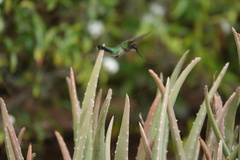
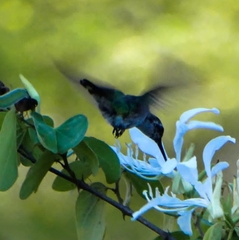
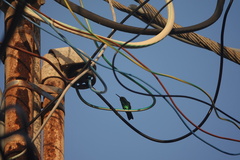

Blue-tailed Emerald

Blue-tailed Emerald

Chlorostilbon mellisugus

Silhouette: Ferran Sayol · PhyloPic

LCLeast ConcernNTVUENCR
Daily sighting probability <5% · Rare
at Valencia, Venezuela

In 3 days <5% in a week ~10%

14 Verified sightings at Valencia, Venezuela
811 In all 8 parks From 2019 to 2026
July Best month
☀️ Diurnal When it's spotted

About the Blue-tailed Emerald

The blue-tailed emerald (Chlorostilbon mellisugus) is a hummingbird in the "emeralds", tribe Trochilini of subfamily Trochilinae. It is found in tropical and subtropical South America east of the Andes from Colombia east to the Guianas and Trinidad, and south to northern Bolivia and central Brazil.

The blue-tailed emerald was formally described by the Swedish naturalist Carl Linnaeus in 1758 in the tenth edition of his Systema Naturae under the binomial name Trochilus mellisugus. The specific epithet combines the Latin mel meaning "honey" and sugere meaning "to suck". Linnaeus's description was typically brief and it was unclear which species he was describing. When he updated his Systema Naturae for the twelfth edition in 1766 Linnaeus added citations including one to the "all-green humming-bird" that had been described and illustrated by the English naturalist George Edwards in his Gleanings of Natural History. The identity still remained uncertain but in 1950 the American ornithologist John T. Zimmer argued that the species Trochilus mellisugus described by Linnaeus could only have been the blue-tailed emerald. This has been generally accepted. Zimmer... Wikipedia →

Sounds

Call0:32

French Guiana · 2024

© Wim Jacobs · XC926587 · CC BY-NC-SA 4.0

Song0:26

Venezuela · 2023

© Francisco contreras · XC844102 · CC BY-NC-SA 4.0

Flight call0:15

Brazil · 2016

© GABRIEL LEITE · XC328488 · CC BY-NC-SA 4.0

Global Distribution

Parks Where Found

# Park Country Daily sighting probability
1 Manu National Park 🇵🇪 Peru
~20%
2 Amacayacu National Natural Park 🇨🇴 Colombia
<5%
3 Sierra de la Macarena National Park 🇨🇴 Colombia
<5%
4 Henri Pittier National Park 🇻🇪 Venezuela
<5%
5 Cuyabeno Wildlife Reserve 🇪🇨 Ecuador
<5%
6 Yasuní National Park 🇪🇨 Ecuador
<5%
7 Tambopata National Reserve 🇵🇪 Peru
<5%
8 Podocarpus National Park 🇪🇨 Ecuador
<5%

Cities Where Found

# City Country Daily sighting probability
1 Maracaibo 🇻🇪 Venezuela
~10%
2 Valencia 🇻🇪 Venezuela
<5%
3 Caracas 🇻🇪 Venezuela
<5%

Before you go

What are the chances of seeing a Blue-tailed Emerald in Valencia, Venezuela?

Rare

Under 5% of wildlife watchers report a Blue-tailed Emerald sighting in Valencia, Venezuela on a given day, based on 14 verified sightings from GBIF citizen-science data. It is the 121st most-seen of the 186 birds we can rate there. Over three days the chance rises to under 5%, and over a week to about 10%, if each day is a fresh chance.

When is the best time to see a Blue-tailed Emerald in Valencia, Venezuela?

July

In that month about 10% of wildlife watchers report a Blue-tailed Emerald in Valencia, Venezuela on a given day, against under 5% in August to June, the lowest months. That is one of Valencia, Venezuela's wettest months, with about 110 mm of rain against 5 mm in February.

What time of day is best to see a Blue-tailed Emerald?

Between 9 am and noon

Across all the parks we cover, that three-hour window holds the most Blue-tailed Emerald sightings with a recorded time, and about 9 in 10 of them come between 6 am and 6 pm: it is a daytime animal.

Is Valencia, Venezuela the best place to see a Blue-tailed Emerald?

2nd of 3

Of the 3 cities where we can rate Blue-tailed Emerald sightings, Valencia, Venezuela ranks 2nd at under 5%. The best odds are in Maracaibo (Venezuela, about 10%).

Where does the Blue-tailed Emerald sighting chance come from?

GBIF citizen-science records

It is estimated from how often the Blue-tailed Emerald is recorded against all the birds logged in Valencia, Venezuela (14 verified sightings), calibrated against known sighting rates. Figures are rounded to the nearest 10% because citizen-science data supports honest approximations, not decimals, and months with records from fewer than five people show "—". How it works.

← Back to Valencia, Venezuela