Paddyfield Warbler

Paddyfield Warbler

Acrocephalus agricola

Silhouette: Yves Hoebeke · PhyloPic

LCLeast ConcernNTVUENCR
Daily sighting probability ~20% · Possible
at Vasai-Virar

In 3 days ~40% in a week ~70%

210 Verified sightings at Vasai-Virar
66 In all 6 parks From 2019 to 2026
February Best month
☀️ Diurnal When it's spotted

About the Paddyfield Warbler

The paddyfield warbler (Acrocephalus agricola) is a species of marsh warbler (family Acrocephalidae). It was formerly included in the "Old World warbler" assemblage. The Manchurian reed warbler (A. tangorum) was (and sometimes still is) included in A. agricola as a subspecies.

The genus name Acrocephalus is from Ancient Greek akros, "highest", and kephale, "head". It is possible that Naumann and Naumann thought akros meant "sharp-pointed". The specific agricola is from Latin and means "farmer".

It breeds in the temperate central Palearctic. It is migratory, wintering in Bangladesh, India and Pakistan. It is a rare vagrant to western Europe although there are small breeding populations along the western shores of the Black Sea around the border between Bulgaria and Romania. This passerine bird is a species found in low vegetation such as long grass, reeds and rice. 4–5 eggs are laid in a nest in grass.

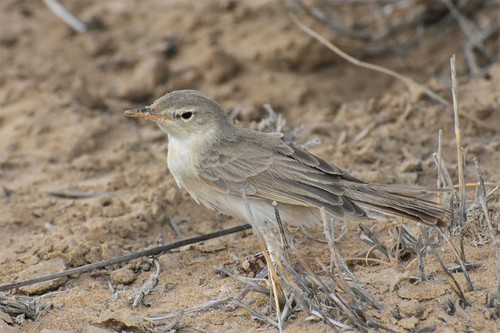
At 13 cm (5.1 in) long with a wingspan of 15–17.5 cm (5.9–6.9 in), the paddyfield warbler is close in size to the Eurasian reed warbler but with shorter bill and wingspan. The adult has an unstreaked pale brown back and buff underparts, with a warm brown rump. There is a clearer whitish supercilium and the bill is short and pointed. The sexes are identical, as with most warblers, but young birds are richer buff below. Like most warblers, it is insectivorous.

The song is fast and similar to marsh warbler, with much mimicry and typically acrocephaline whistles added. Its song is weaker and more rhythmic than that of its relative. Wikipedia →

Sounds

Imitation0:15

Russian Federation · 2023

© Albert Lastukhin · XC819878 · CC BY-NC-ND 4.0

Song1:03

Kazakhstan · 2023

© Peter Boesman · XC813201 · CC BY-NC-ND 4.0

Call0:10

Mongolia · 2022

© Stanislas Wroza · XC765663 · CC BY-NC-SA 4.0

Global Distribution

Parks Where Found

# Park Country Daily sighting probability
1 Gobi Gurvansaikhan National Park 🇲🇳 Mongolia
<5%
2 Keoladeo National Park 🇮🇳 India
<5%
3 Manas National Park 🇮🇳 India
<5%
4 Chitwan National Park 🇳🇵 Nepal
<5%
5 Kaziranga National Park 🇮🇳 India
<5%
6 Kanha National Park 🇮🇳 India
<5%

Cities Where Found

# City Country Daily sighting probability
1 Vasai-Virar 🇮🇳 India
~20%
2 Novosibirsk 🇷🇺 Russia
~10%
3 Kolkata 🇮🇳 India
<5%
4 Kalyan-Dombivli 🇮🇳 India
<5%
5 Kozhikode 🇮🇳 India
<5%
6 Coimbatore 🇮🇳 India
<5%
7 Tamluk 🇮🇳 India
<5%
8 Dhaka 🇧🇩 Bangladesh
<5%
9 Mumbai 🇮🇳 India
<5%
10 Pune 🇮🇳 India
<5%

Before you go

What are the chances of seeing a Paddyfield Warbler in Vasai-Virar?

Possible

About 20% of wildlife watchers report a Paddyfield Warbler sighting in Vasai-Virar on a given day, based on 210 verified sightings from GBIF citizen-science data. It is the 64th most-seen of the 217 birds we can rate there. Over three days the chance rises to about 40%, and over a week to about 70%, if each day is a fresh chance.

When is the best time to see a Paddyfield Warbler in Vasai-Virar?

January–February and November

In those months about 30% of wildlife watchers report a Paddyfield Warbler in Vasai-Virar on a given day, against under 5% in April–June and August–September, the lowest months. Those are among Vasai-Virar's driest months, with about 5 mm of rain a month against 840 mm in July.

What time of day is best to see a Paddyfield Warbler?

Between 7 and 10 am

Across all the parks we cover, that three-hour window holds the most Paddyfield Warbler sightings with a recorded time, and about 8 in 10 of them come between 6 am and 6 pm: it is a daytime animal.

Is Vasai-Virar the best place to see a Paddyfield Warbler?

Yes

Of the 19 cities where we can rate Paddyfield Warbler sightings, Vasai-Virar has the highest daily chance: about 20%. Next come Novosibirsk (Russia, about 10%) and Kolkata (India, under 5%).

Which relatives of the Paddyfield Warbler live in Vasai-Virar?

Same genus: Acrocephalus

The closest relatives of the Paddyfield Warbler that you can see in Vasai-Virar (genus Acrocephalus, Reed Warblers) are Clamorous Reed Warbler (about 40%) and Blyth's Reed Warbler (about 40%), with each one's daily chance of a sighting.

Where does the Paddyfield Warbler sighting chance come from?

GBIF citizen-science records

It is estimated from how often the Paddyfield Warbler is recorded against all the birds logged in Vasai-Virar (210 verified sightings), calibrated against known sighting rates. Figures are rounded to the nearest 10% because citizen-science data supports honest approximations, not decimals, and months with records from fewer than five people show "—". How it works.

← Back to Vasai-Virar