

Bee-Eating Beetle

Bee-Eating Beetle

Trichodes apiarius

Daily sighting probability ~10% · With luck
at Vienna

In 3 days ~30% in a week ~60%

251 Verified sightings at Vienna
256 In all 14 parks From 2019 to 2026
July Best month
☀️ Diurnal When it's spotted

About the Bee-Eating Beetle

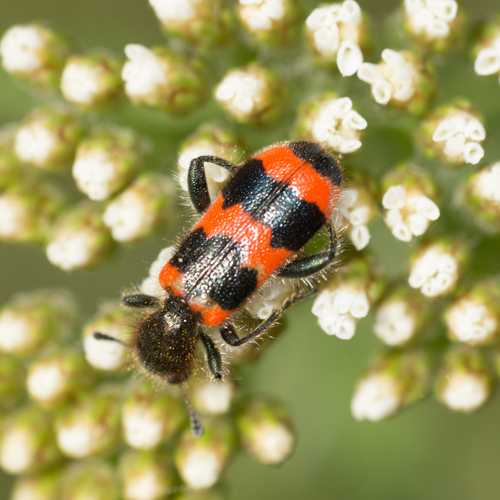
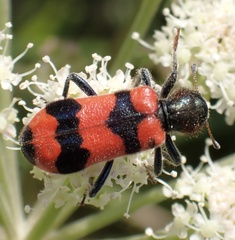
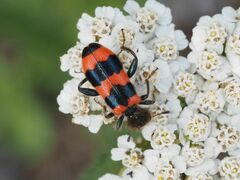
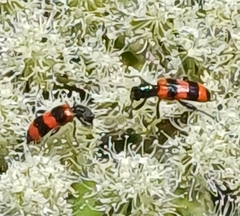
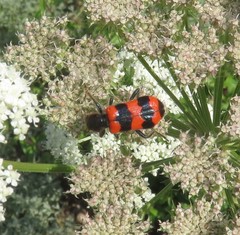
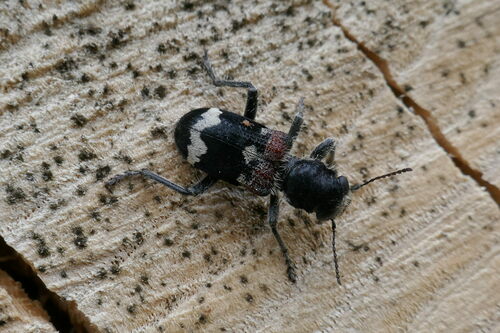
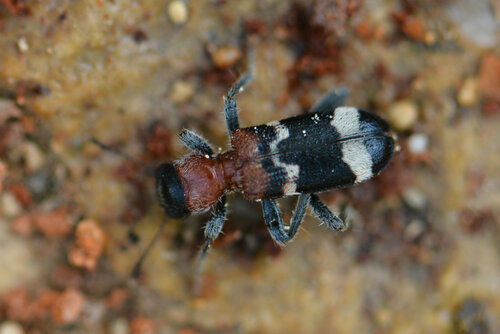
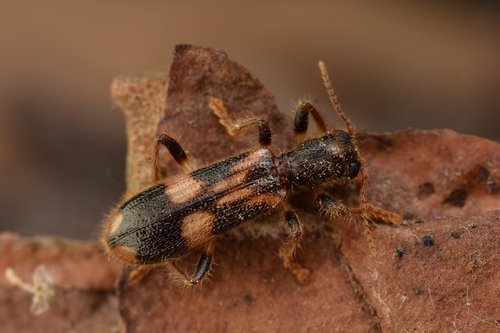
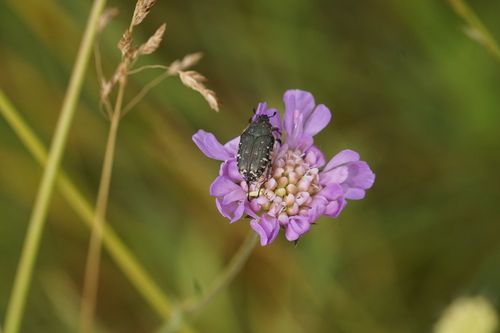
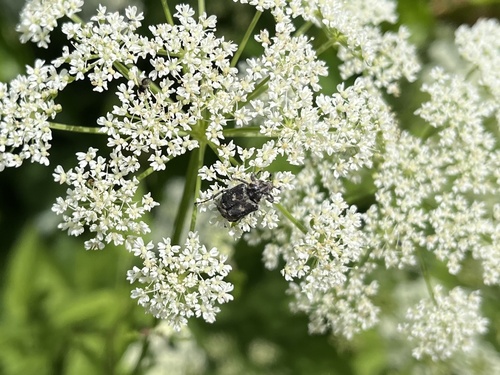
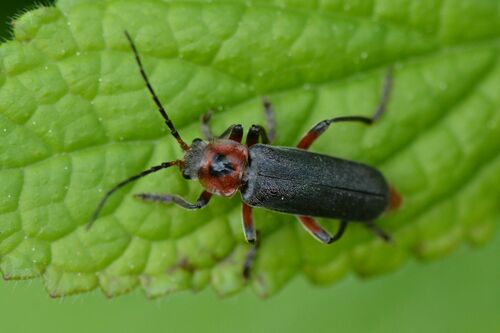
Trichodes apiarius is a beetle species of checkered beetles belonging to the family Cleridae, subfamily Clerinae. It is found in most of Europe, in the eastern Palearctic realm, and in North Africa. The adult is a hairy, small beetle with shining blue or black head and scutellum. The elongated elytra (wing cases) are bright red with black bands. This species can easily be distinguished from Trichodes alvearius for the black terminal band reaching the apex of the elytra. Adults grow up to 9–16 millimetres (0.35–0.63 in) and can be encountered from May through June on the flowers, mainly Apiaceae, feeding on the pollen. They also actively hunt small insects.

The larvae are parasites of bees (hence the name “apiarius”), as the adults lay the eggs in the nests of solitary bees (Osmia and Megachile species) or in hives of honey bees, eating larvae and nymphs. Wikipedia →

Global Distribution

Parks Where Found

# Park Country Daily sighting probability
1 Triglav National Park 🇸🇮 Slovenia
~30%
2 Aigüestortes National Park 🇪🇸 Spain
~20%
3 Kiskunság National Park 🇭🇺 Hungary
~20%
4 Vanoise National Park 🇫🇷 France
~20%
5 Tatra National Park 🇸🇰 Slovakia
~20%
6 Biebrza National Park 🇵🇱 Poland
~20%
7 Mercantour National Park 🇫🇷 France
~10%
8 Białowieża National Park 🇵🇱 Poland
~10%
9 Bavarian Forest National Park 🇩🇪 Germany
~10%
10 Cévennes National Park 🇫🇷 France
~10%
11 Hohe Tauern National Park 🇦🇹 Austria
~10%
12 Ecrins National Park 🇫🇷 France
~10%
13 Fertő-Hanság National Park 🇭🇺 Hungary
~10%
14 Pyrénées National Park 🇫🇷 France
~10%

Cities Where Found

# City Country Daily sighting probability
1 Budapest 🇭🇺 Hungary
~20%
2 Vienna 🇦🇹 Austria
~10%
3 Kharkiv 🇺🇦 Ukraine
~10%
4 Lyon 🇫🇷 France
~10%
5 Warsaw 🇵🇱 Poland
~10%
6 Prague 🇨🇿 Czechia
~10%
7 Kyiv 🇺🇦 Ukraine
~10%
8 Turin 🇮🇹 Italy
~10%
9 Milan 🇮🇹 Italy
~10%
10 Bucharest 🇷🇴 Romania
~10%

Before you go

What are the chances of seeing a Bee-Eating Beetle in Vienna?

With luck

About 10% of wildlife watchers report a Bee-Eating Beetle sighting in Vienna on a given day, based on 251 verified sightings from GBIF citizen-science data. It is the 44th most-seen of the 1406 insects we can rate there. Over three days the chance rises to about 30%, and over a week to about 60%, if each day is a fresh chance.

When is the best time to see a Bee-Eating Beetle in Vienna?

July

In that month about 30% of wildlife watchers report a Bee-Eating Beetle in Vienna on a given day, against under 5% in September to April, the lowest months. That is one of Vienna's wettest months, with about 90 mm of rain against 40 mm in February.

What time of day is best to see a Bee-Eating Beetle?

Between 10 am and 1 pm

Across all the parks we cover, that three-hour window holds the most Bee-Eating Beetle sightings with a recorded time, and about 9 in 10 of them come between 6 am and 6 pm: it is a daytime animal.

Is Vienna the best place to see a Bee-Eating Beetle?

2nd of 20

Of the 20 cities where we can rate Bee-Eating Beetle sightings, Vienna ranks 2nd at about 10%. The best odds are in Budapest (Hungary, about 20%).

Where does the Bee-Eating Beetle sighting chance come from?

GBIF citizen-science records

It is estimated from how often the Bee-Eating Beetle is recorded against all the insects logged in Vienna (251 verified sightings), calibrated against known sighting rates. Figures are rounded to the nearest 10% because citizen-science data supports honest approximations, not decimals, and months with records from fewer than five people show "—". How it works.

← Back to Vienna