About the Marbled White
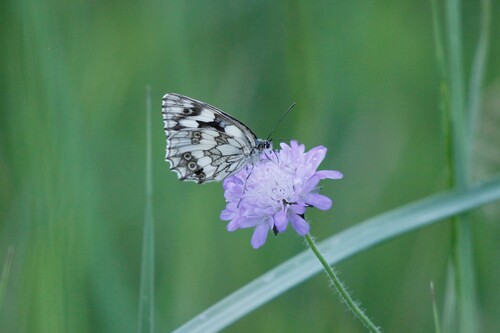
Melanargia galathea, the marbled white, is a medium-sized butterfly in the family Nymphalidae. The marbled white was described in 1666 by C Merrett, and in 1695 James Petiver found a specimen in a wood near Hampstead and called it Papilio leucomelanus, our half-Mourner, to distinguish it from the Bath White, which Vernon (1702) had called the half-Mourner. It was also known as The Marmoris by Benjamin Wilkes and The Marmoress by Moses Harris. The butterfly was, also described in 1758, by the Swedish biologist and physician, Carl Linnaeus who formalised binomial nomenclature. Despite its common name and appearance, this butterfly is one of the "browns", of the subfamily Satyrinae.
This species can be found across most of Europe, southern Russia, Asia Minor and Iran. It is found in forest clearings and edges, meadows and steppe where it occurs up to 1,500–1,700 metres (4,900–5,600 ft) above sea level. The caterpillars feed on various grasses.
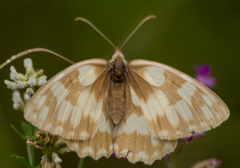
Melanargia galathea has a wingspan of 46–56 millimetres (1.8–2.2 in). In these medium-sized butterflies the upper side of the wings is decorated with white and gray-black or dark brown markings, but it is always gray-black... Wikipedia →