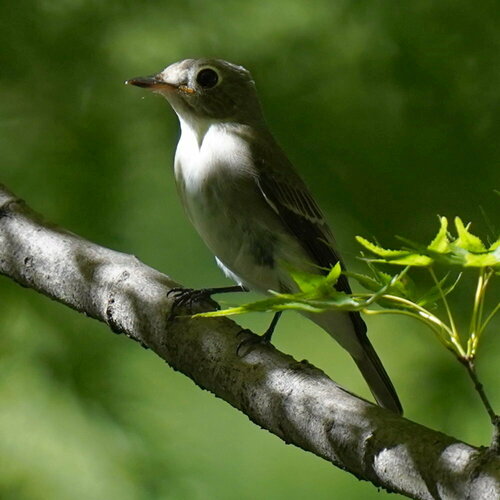
Korean Flycatcher

Korean Flycatcher

Ficedula zanthopygia

Silhouette: Rachael Joakim · PhyloPic

LCLeast ConcernNTVUENCR
Daily sighting probability <5% · Rare
at Cuc Phuong National Park

In 3 days ~10% in a week ~30%

17 Verified sightings at Cuc Phuong National Park From 2019 to 2026
567 In all 9 parks
April Best month
☀️ Diurnal When it's spotted

About the Korean Flycatcher

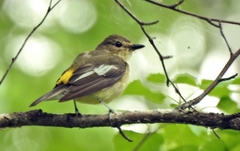
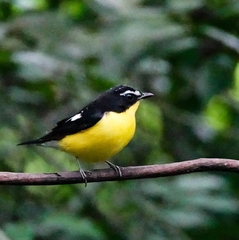
The yellow-rumped flycatcher (Ficedula zanthopygia), also known as Korean flycatcher or tricolor flycatcher, is a species of flycatcher found in eastern Asia. A distinctive species with almost no look-alike other than the narcissus flycatcher. It breeds in eastern Asia including parts of Mongolia, Transbaikal, southern China, Korea and western Japan. They winter in parts of the Malay Peninsula and South Asia.

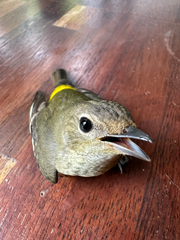
In all plumages the yellow rump is distinctive. The white supercilium of the male is distinctive, separating it from the narcissus flycatcher and the green-backed flycatcher. Females and first year males are olive grey above with blackish tail.

Hartert (1910) treated this species as a member of the narcissina group. Some individuals with yellow supercilium have been considered as hybrids with the narcissus flycatcher. Included in this species complex was the species called Elise's flycatcher, usually treated as a subspecies of the narcissus flycatcher. Both elisae and zanthopygia have been observed to breed separately in the same area of oak forest near Peking strengthening the case for their distinctness. There are also clear call and morphological differences... Wikipedia →

Sounds

Song1:04

China · 2026

© Peter Boesman · XC1147528 · CC BY-NC-ND 4.0

Call0:20

Singapore · 2026

© Étienne Leroy · XC1076998 · CC BY-NC-SA 4.0

Alarm call0:08

Malaysia · 2021

© Lim Ying Hien · XC626195 · CC BY-NC-ND 4.0

Global Distribution

Parks Where Found

# Park Country Daily sighting probability
1 Khao Luang National Park 🇹🇭 Thailand
~10%
2 Way Kambas National Park 🇮🇩 Indonesia
~10%
3 Kaeng Krachan National Park 🇹🇭 Thailand
~10%
4 Khao Sok National Park 🇹🇭 Thailand
<5%
5 Cuc Phuong National Park 🇻🇳 Vietnam
<5%
6 Gunung Leuser National Park 🇮🇩 Indonesia
<5%
7 Taman Negara National Park 🇲🇾 Malaysia
<5%
8 Bali Barat National Park 🇮🇩 Indonesia
<5%
9 Khao Yai National Park 🇹🇭 Thailand
<5%

Cities Where Found

# City Country Daily sighting probability
1 Hefei 🇨🇳 China
~20%
2 Jinhua 🇨🇳 China
~10%
3 Daejeon 🇰🇷 South Korea
~10%
4 Hangzhou 🇨🇳 China
~10%
5 Wuhan 🇨🇳 China
~10%
6 Nanjing 🇨🇳 China
~10%
7 Kuala Lumpur 🇲🇾 Malaysia
<5%
8 Busan 🇰🇷 South Korea
<5%
9 Singapore 🇸🇬 Singapore
<5%
10 Seoul 🇰🇷 South Korea
<5%

Zoos & Centres Where Found

# Zoo / Centre Country
1 Hong Kong Zoological and Botanical Gardens 🇨🇳 China In captivity
2 Edward Youde Aviary 🇭🇰 Hong Kong SAR China In captivity

Before you go

What are the chances of seeing a Korean Flycatcher in Cuc Phuong National Park?

Rare

Under 5% of wildlife watchers report a Korean Flycatcher sighting in Cuc Phuong National Park on a given day, based on 17 verified sightings from GBIF citizen-science data from 2019 to 2026. It is the 102nd most-seen of the 159 birds we can rate there. Over three days the chance rises to about 10%, and over a week to about 30%, if each day is a fresh chance.

When is the best time to see a Korean Flycatcher in Cuc Phuong National Park?

April

In that month about 20% of wildlife watchers report a Korean Flycatcher in Cuc Phuong National Park on a given day, against under 5% in June and September–March, the lowest months. July has too few records to rate.

What time of day is best to see a Korean Flycatcher?

Between 9 am and noon

Across all the parks we cover, that three-hour window holds the most Korean Flycatcher sightings with a recorded time, and about 8 in 10 of them come between 6 am and 6 pm: it is a daytime animal.

Where does the Korean Flycatcher sighting chance come from?

GBIF citizen-science records

It is estimated from how often the Korean Flycatcher is recorded against all the birds logged in Cuc Phuong National Park (17 verified sightings from 2019 to 2026), calibrated against known sighting rates. Figures are rounded to the nearest 10% because citizen-science data supports honest approximations, not decimals, and months with records from fewer than five people show "—". How it works.

← Back to Cuc Phuong National Park