Cinereous Tinamou

Cinereous Tinamou

Crypturellus cinereus

Silhouette: J. N. Wiegers · PhyloPic

LCLeast ConcernNTVUENCR
Daily sighting probability ~10% · With luck
at Cuyabeno Wildlife Reserve

In 3 days ~30% in a week ~50%

66 Verified sightings at Cuyabeno Wildlife Reserve From 2019 to 2026
2,807 In all 8 parks
June Best month
☀️ Diurnal When it's spotted

About the Cinereous Tinamou

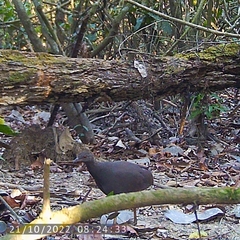
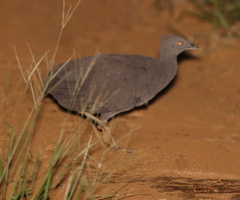
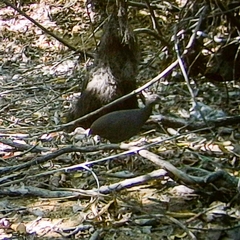
The cinereous tinamou (Crypturellus cinereus), also known as brushland tinamou, is a type of ground bird found in swamp and lowland forests in northern South America. They have some localized names that have been used by the indigenous people such as in Amazonas where they are called inambu-pixuna, and in Pará, Brazil where they are called nambu-sujo. Also, throughout their range they are called inhambu-preto. Cinereous tinamous have been around for many centuries. They are part of the oldest families of the world today and have fossils discovered dating back tens of millions of years. Their quick reflexes play a role in their ability to survive.

The cinereous tinamou was formally described in 1789 by the German naturalist Johann Friedrich Gmelin in his revised and expanded edition of Carl Linnaeus's Systema Naturae. He placed it with all the grouse like birds in the genus Tetrao and coined the binomial name Tetrao cinereus. Gmelin based his description on "Le tinamou cendré" from French Guiana that had been described in 1778 by the French polymath Georges-Louis Leclerc, Comte de Buffon in his Histoire Naturelle des Oiseaux. The cinereous tinamou is now placed with around... Wikipedia →

Sounds

Song0:47

Brazil · 2026

© JAYRSON ARAUJO DE OLIVEIRA · XC1183120 · CC BY-NC-SA 4.0

Call0:31

Ecuador · 2025

© Marco Andrés Urvina Alejandro · XC984820 · CC BY-NC-SA 4.0

Advertising call1:20

Peru · 2018

© Rolf A. de By · XC463658 · CC BY-NC-SA 4.0

Global Distribution

Parks Where Found

# Park Country Daily sighting probability
1 Sierra de la Macarena National Park 🇨🇴 Colombia
~30%
2 Manu National Park 🇵🇪 Peru
~30%
3 Yasuní National Park 🇪🇨 Ecuador
~20%
4 Amacayacu National Natural Park 🇨🇴 Colombia
~20%
5 Tambopata National Reserve 🇵🇪 Peru
~10%
6 Cuyabeno Wildlife Reserve 🇪🇨 Ecuador
~10%
7 Brownsberg Nature Park 🇸🇷 Suriname
<5%
8 Chapada dos Guimarães National Park 🇧🇷 Brazil
<5%

Before you go

What are the chances of seeing a Cinereous Tinamou in Cuyabeno Wildlife Reserve?

With luck

About 10% of wildlife watchers report a Cinereous Tinamou sighting in Cuyabeno Wildlife Reserve on a given day, based on 66 verified sightings from GBIF citizen-science data from 2019 to 2026. It is the 109th most-seen of the 328 birds we can rate there. Over three days the chance rises to about 30%, and over a week to about 50%, if each day is a fresh chance.

When is the best time to see a Cinereous Tinamou in Cuyabeno Wildlife Reserve?

March and June

In those months about 20% of wildlife watchers report a Cinereous Tinamou in Cuyabeno Wildlife Reserve on a given day, against under 5% in February and November, the lowest months.

What time of day is best to see a Cinereous Tinamou?

Between 6 and 9 am

Across all the parks we cover, that three-hour window holds the most Cinereous Tinamou sightings with a recorded time, and about 8 in 10 of them come between 6 am and 6 pm: it is a daytime animal.

Where does the Cinereous Tinamou sighting chance come from?

GBIF citizen-science records

It is estimated from how often the Cinereous Tinamou is recorded against all the birds logged in Cuyabeno Wildlife Reserve (66 verified sightings from 2019 to 2026), calibrated against known sighting rates. Figures are rounded to the nearest 10% because citizen-science data supports honest approximations, not decimals, and months with records from fewer than five people show "—". How it works.


← Back to Cuyabeno Wildlife Reserve