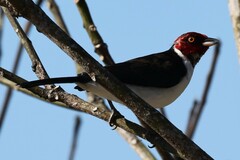

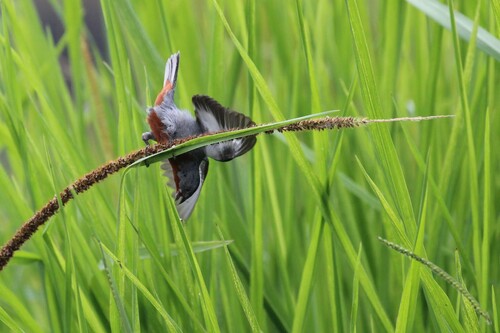
Red-capped Cardinal

Red-capped Cardinal

Paroaria gularis

Silhouette: Sheatherius · PhyloPic

LCLeast ConcernNTVUENCR
Daily sighting probability ~60% · Likely
at Cuyabeno Wildlife Reserve

In 3 days >90%

502 Verified sightings at Cuyabeno Wildlife Reserve From 2019 to 2026
3,527 In all 8 parks
October Best month
☀️ Diurnal When it's spotted

About the Red-capped Cardinal

The red-capped cardinal (Paroaria gularis) is a small species of bird in the tanager family Thraupidae. It is found in South America. In 1760 the French zoologist Mathurin Jacques Brisson included a description of the red-capped cardinal in the supplement to his Ornithologie based on a specimen collected in "America". He used the French name Le cardinal d'Amérique and the Latin name Cardinalis americanis. Although Brisson coined Latin names, these do not conform to the binomial system and are not recognised by the International Commission on Zoological Nomenclature. When in 1766 the Swedish naturalist Carl Linnaeus updated his Systema Naturae for the twelfth edition he added 240 species that had been previously described by Brisson in his Ornithologie. One of these was the red-capped cardinal. Linnaeus included a terse description, coined the binomial name Tanagra gularis and cited Brisson's work. The specific name gularis is Latin for "of the throat". The type locality has been restricted to French Guiana. This species is now placed in the genus Paroaria that was introduced by the French ornithologist Charles Lucien Bonaparte in 1832.

The genus Paroaria is classified... Wikipedia →

Sounds

Call0:18

Brazil · 2025

© JAYRSON ARAUJO DE OLIVEIRA · XC1045196 · CC BY-NC-SA 4.0

Song0:11

Colombia · 2021

© Mauricio Cuellar Ramirez (@Birding.travel) · XC636111 · CC BY-NC-SA 4.0

Song0:29

Brazil · 2016

© GABRIEL LEITE · XC340168 · CC BY-NC-SA 4.0

Global Distribution

Parks Where Found

# Park Country Daily sighting probability
1 Cuyabeno Wildlife Reserve 🇪🇨 Ecuador
~60%
2 Manu National Park 🇵🇪 Peru
~40%
3 Yasuní National Park 🇪🇨 Ecuador
~30%
4 Anavilhanas National Park 🇧🇷 Brazil
~20%
5 Tambopata National Reserve 🇵🇪 Peru
~10%
6 Amacayacu National Natural Park 🇨🇴 Colombia
<5%
7 Sierra de la Macarena National Park 🇨🇴 Colombia
<5%
8 Parque Estadual Encontro das Águas 🇧🇷 Brazil
<5%

Cities Where Found

# City Country Daily sighting probability
1 Santa Cruz de la Sierra 🇧🇴 Bolivia
~10%
2 Lima 🇵🇪 Peru
~10%
3 Manaus 🇧🇷 Brazil
<5%

Zoos & Centres Where Found

# Zoo / Centre Country
1 North Carolina Zoo 🇺🇸 United States In captivity
2 Brookfield Zoo 🇺🇸 United States In captivity
3 Sedgwick County Zoo 🇺🇸 United States In captivity
4 Louisville Zoo 🇺🇸 United States In captivity
5 Woodland Park Zoo 🇺🇸 United States In captivity
6 Memphis Zoo 🇺🇸 United States In captivity
7 Houston Zoo 🇺🇸 United States In captivity
8 San Antonio Zoo 🇺🇸 United States In captivity
9 Sapporo Maruyama Zoo 🇯🇵 Japan In captivity
10 Lincoln Park Zoo 🇺🇸 United States In captivity
11 Topeka Zoo 🇺🇸 United States In captivity
12 Henry Vilas Zoo 🇺🇸 United States In captivity
13 Reid Park Zoo 🇺🇸 United States In captivity
14 Tracy Aviary 🇺🇸 United States In captivity
15 Texas State Aquarium 🇺🇸 United States In captivity
16 National Aquarium 🇺🇸 United States In captivity

Before you go

What are the chances of seeing a Red-capped Cardinal in Cuyabeno Wildlife Reserve?

Likely

About 60% of wildlife watchers report a Red-capped Cardinal sighting in Cuyabeno Wildlife Reserve on a given day, based on 502 verified sightings from GBIF citizen-science data from 2019 to 2026. It is the 5th most-seen of the 328 birds we can rate there. Over three days the chance rises to over 90%, if each day is a fresh chance.

When is the best time to see a Red-capped Cardinal in Cuyabeno Wildlife Reserve?

October

In that month about 80% of wildlife watchers report a Red-capped Cardinal in Cuyabeno Wildlife Reserve on a given day, against about 50% in November, the lowest month.

What time of day is best to see a Red-capped Cardinal?

Between 3 and 6 pm

Across all the parks we cover, that three-hour window holds the most Red-capped Cardinal sightings with a recorded time, and about 9 in 10 of them come between 6 am and 6 pm: it is a daytime animal.

Is Cuyabeno Wildlife Reserve the best place to see a Red-capped Cardinal?

Yes

Of the 8 parks where we can rate Red-capped Cardinal sightings, Cuyabeno Wildlife Reserve has the highest daily chance: about 60%. Next come Manu National Park (Peru, about 40%) and Yasuní National Park (Ecuador, about 30%). All parks ranked.

Which relatives of the Red-capped Cardinal live in Cuyabeno Wildlife Reserve?

Same family: Thraupidae

The closest relatives of the Red-capped Cardinal that you can see in Cuyabeno Wildlife Reserve (family Thraupidae, Tanagers and Allies) are Blue-gray Tanager (about 30%), Palm Tanager (about 20%) and Masked Crimson Tanager (about 10%), with each one's daily chance of a sighting.

Where does the Red-capped Cardinal sighting chance come from?

GBIF citizen-science records

It is estimated from how often the Red-capped Cardinal is recorded against all the birds logged in Cuyabeno Wildlife Reserve (502 verified sightings from 2019 to 2026), calibrated against known sighting rates. Figures are rounded to the nearest 10% because citizen-science data supports honest approximations, not decimals, and months with records from fewer than five people show "—". How it works.

← Back to Cuyabeno Wildlife Reserve