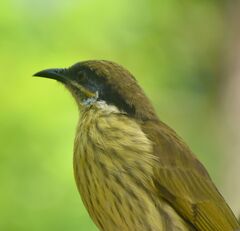
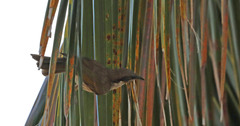
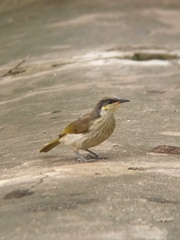
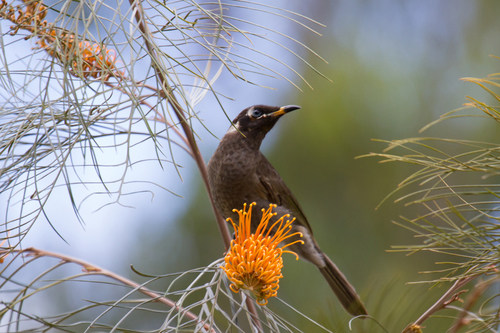
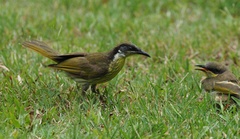
Varied Honeyeater

Varied Honeyeater

Gavicalis versicolor

Silhouette: Rachael Joakim · PhyloPic

LCLeast ConcernNTVUENCR
Daily sighting probability <5% · Rare
at Daintree National Park

In 3 days <5%

8 Verified sightings at Daintree National Park From 2019 to 2026
253 In all 2 parks
September Best month
☀️ Diurnal When it's spotted

About the Varied Honeyeater

The varied honeyeater (Gavicalis versicolor) is a species of bird in the family Meliphagidae. It is found in coastal areas of New Guinea and eastern Cape York Peninsula in Queensland, Australia. Its natural habitat is subtropical or tropical mangrove forests.

The varied honeyeater was previously placed in the genus Lichenostomus, but was moved to Gavicalis after molecular phylogenetic analysis, published in 2011, showed that the original genus was polyphyletic. The varied honeyeater has two accepted subspecies which are distributed as follows:

G. v. sonoroides - Raja Ampat Island (northwest of New Guinea), Yapen (Geelvink Bay island, northwest New Guinea), coastal New Guinea (except southwest) through northern New Guinea and Milne Bay islands, and D'Entrecasteaux Archipelago (east of southeast New Guinea).

G. v. versicolor - coastal southern New Guinea, Torres Strait islands and northeast Cape York Peninsula, northeast Queensland (far northeast Australia). Wikipedia →

Sounds

Song0:12

Australia · 2025

© Étienne Leroy · XC1070743 · CC BY-NC-SA 4.0

Song and call0:14

Australia · 2025

© Peter Boesman · XC1066568 · CC BY-NC-ND 4.0

Dawn song1:14

Indonesia · 2022

© Panji Gusti Akbar · XC756652 · CC BY-NC-SA 4.0

Global Distribution

Parks Where Found

# Park Country Daily sighting probability
1 Raja Ampat 🇮🇩 Indonesia
~20%
2 Daintree National Park 🇦🇺 Australia
<5%

Before you go

What are the chances of seeing a Varied Honeyeater in Daintree National Park?

Rare

Under 5% of wildlife watchers report a Varied Honeyeater sighting in Daintree National Park on a given day, based on 8 verified sightings from GBIF citizen-science data from 2019 to 2026. It is the 183rd most-seen of the 208 birds we can rate there. Over three days the chance rises to under 5%, if each day is a fresh chance.

When is the best time to see a Varied Honeyeater in Daintree National Park?

Any time of year

In every month with enough records, under 5% of wildlife watchers report a Varied Honeyeater in Daintree National Park on a given day, so our monthly data shows no clear season.

What time of day is best to see a Varied Honeyeater?

Between 7 and 10 am

Across all the parks we cover, that three-hour window holds the most Varied Honeyeater sightings with a recorded time, and about 8 in 10 of them come between 6 am and 6 pm: it is a daytime animal.

Is Daintree National Park the best place to see a Varied Honeyeater?

2nd of 2

Of the 2 parks where we can rate Varied Honeyeater sightings, Daintree National Park ranks 2nd at under 5%. The best odds are in Raja Ampat (Indonesia, about 20%).

Which relatives of the Varied Honeyeater live in Daintree National Park?

Same family: Meliphagidae

The closest relatives of the Varied Honeyeater that you can see in Daintree National Park (family Meliphagidae, Honeyeaters) are Helmeted Friarbird (about 50%), Yellow-spotted Honeyeater (about 50%) and Hornbill Friarbird (about 30%), with each one's daily chance of a sighting.

Where does the Varied Honeyeater sighting chance come from?

GBIF citizen-science records

It is estimated from how often the Varied Honeyeater is recorded against all the birds logged in Daintree National Park (8 verified sightings from 2019 to 2026), calibrated against known sighting rates. Figures are rounded to the nearest 10% because citizen-science data supports honest approximations, not decimals, and months with records from fewer than five people show "—". How it works.

← Back to Daintree National Park