



Completed


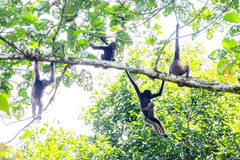

North Bornean Gray Gibbon
Hylobates funereus
Silhouette: Kai R. Caspar · PhyloPic
- KingdomAnimalia (Animals)
- PhylumChordata (Chordates)
- ClassMammalia (Mammals)
- OrderPrimates
- FamilyHylobatidae (Gibbons)
- GenusHylobates (Dwarf Gibbons)
- SpeciesHylobates funereus (North Bornean Gray Gibbon)
In 3 days ~70% in a week >90%
85 Verified sightings at Danum Valley Conservation Area From 2019 to 2026
226 In all 3 parks
January Best month
🌙 Nocturnal When it's spotted
About the North Bornean Gray Gibbon
The eastern grey gibbon or northern grey gibbon (Hylobates funereus) is a primate in the gibbon family, Hylobatidae. Formerly, the eastern grey gibbon and western grey gibbon (H. abbotti) were considered conspecific with the southern grey gibbon (H. muelleri), but more recent studies indicate that all three are distinct species, and both the IUCN Red List and the American Society of Mammalogists consider them such. However, they can still hybridize with one another where their ranges meet.
It is endemic to northeastern Borneo, and is found in Kalimantan, Sarawak, and Brunei. It ranges from Sabah south to the Mahakam River in East Kalimantan, and west to Baram in Sarawak. As with the other two grey gibbons, this species is thought to be endangered due to heavy deforestation in Borneo, as well as increases in forest fires exacerbated by El Niño events. It is also threatened by illegal hunting and capture for the pet trade. Wikipedia →
Recent sightings of North Bornean Gray Gibbon in Danum Valley Conservation Area
LIVEiNaturalistGlobal Distribution
Parks Where Found
| # | Park | Country | Daily sighting probability |
|---|---|---|---|
| 1 | Danum Valley Conservation Area | 🇲🇾 Malaysia | |
| 2 | Sepilok | 🇲🇾 Malaysia | |
| 3 | Kinabatangan Wildlife Sanctuary | 🇲🇾 Malaysia |
Closest Relatives at Danum Valley Conservation Area



Before you go
What are the chances of seeing a North Bornean Gray Gibbon in Danum Valley Conservation Area?
Likely
About 40% of wildlife watchers report a North Bornean Gray Gibbon sighting in Danum Valley Conservation Area on a given day, based on 85 verified sightings from GBIF citizen-science data from 2019 to 2026. It is the 12th most-seen of the 26 mammals we can rate there. Over three days the chance rises to about 70%, and over a week to over 90%, if each day is a fresh chance.
When is the best time to see a North Bornean Gray Gibbon in Danum Valley Conservation Area?
January
In that month about 70% of wildlife watchers report a North Bornean Gray Gibbon in Danum Valley Conservation Area on a given day, against under 5% in September and December, the lowest months.
What time of day is best to see a North Bornean Gray Gibbon?
Between 1 and 4 am
Across all the parks we cover, that three-hour window holds the most North Bornean Gray Gibbon sightings with a recorded time, and about 8 in 10 of them come between 6 pm and 6 am: it is mostly seen at night.
Is Danum Valley Conservation Area the best place to see a North Bornean Gray Gibbon?
Yes
Of the 3 parks where we can rate North Bornean Gray Gibbon sightings, Danum Valley Conservation Area has the highest daily chance: about 40%. Next come Sepilok (Malaysia, about 30%) and Kinabatangan Wildlife Sanctuary (Malaysia, about 20%).
Which relatives of the North Bornean Gray Gibbon live in Danum Valley Conservation Area?
Same order: Primates
The closest relatives of the North Bornean Gray Gibbon that you can see in Danum Valley Conservation Area (order Primates) are Maroon Leaf Monkey (about 80%), Bornean Orangutan (about 50%) and Horsfield's Tarsier (about 40%), with each one's daily chance of a sighting.
Where does the North Bornean Gray Gibbon sighting chance come from?
GBIF citizen-science records
It is estimated from how often the North Bornean Gray Gibbon is recorded against all the mammals logged in Danum Valley Conservation Area (85 verified sightings from 2019 to 2026), calibrated against known sighting rates. Figures are rounded to the nearest 10% because citizen-science data supports honest approximations, not decimals, and months with records from fewer than five people show "—". How it works.
