


Completed


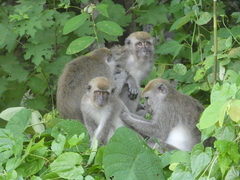

Crab-eating Macaque
Macaca fascicularis
Silhouette: Jamie Whitehouse · PhyloPic
- KingdomAnimalia (Animals)
- PhylumChordata (Chordates)
- ClassMammalia (Mammals)
- OrderPrimates
- FamilyCercopithecidae (Old World Monkeys)
- GenusMacaca (Macaques)
- SpeciesMacaca fascicularis (Crab-eating Macaque)
In 3 days ~70% in a week >90%
92 Verified sightings at Danum Valley Conservation Area From 2019 to 2026
1,797 In all 15 parks
January Best month
🌅 Crepuscular When it's spotted


Completed
About the Crab-eating Macaque
Macaca fascicularis, variously known by common names such as crab-eating macaque, long-tailed macaque, or cynomolgus monkey, is a macaque species native to Southeast Asia. As a synanthropic species, the crab-eating macaque thrives near human settlements and in secondary forests. The crab-eating macaque has developed a variety of cultural perceptions, from being smart and adaptive, to being sacred, to even being pests in some cases.
The crab-eating macaque is omnivorous and frugivorous. It lives in matrilineal groups ranging from 10 to 85 individuals, with groups exhibiting female philopatry and males emigrating from natal group at puberty. The crab-eating macaque is the only old-world monkey known to use stone tools in their daily foraging, and it engages in a robbing and bartering behavior in some tourist locations.
The crab-eating macaque is the most traded primate species and also the most popular species used in scientific research. Due to these threats, the crab-eating macaque was listed as Endangered on the IUCN Red List in 2022.
Macaca comes from the Portuguese word macaco, which was derived from makaku, a word in Ibinda, a language of Central Africa (kaku means... Wikipedia →
Recent sightings of Crab-eating Macaque in Danum Valley Conservation Area
LIVEiNaturalistGlobal Distribution
Parks Where Found
| # | Park | Country | Daily sighting probability |
|---|---|---|---|
| 1 | Tanjung Puting National Park | 🇮🇩 Indonesia | |
| 2 | Gunung Leuser National Park | 🇮🇩 Indonesia | |
| 3 | Khao Sok National Park | 🇹🇭 Thailand | |
| 4 | Kinabatangan Wildlife Sanctuary | 🇲🇾 Malaysia | |
| 5 | Bako National Park | 🇲🇾 Malaysia | |
| 6 | Bali Barat National Park | 🇮🇩 Indonesia | |
| 7 | Komodo National Park | 🇮🇩 Indonesia | |
| 8 | Way Kambas National Park | 🇮🇩 Indonesia | |
| 9 | Taman Negara National Park | 🇲🇾 Malaysia | |
| 10 | Danum Valley Conservation Area | 🇲🇾 Malaysia | |
| 11 | Cat Tien National Park | 🇻🇳 Vietnam | |
| 12 | Sepilok | 🇲🇾 Malaysia | |
| 13 | Khao Yai National Park | 🇹🇭 Thailand | |
| 14 | Kerinci Seblat National Park | 🇮🇩 Indonesia | |
| 15 | Kinabalu Park | 🇲🇾 Malaysia |
Zoos & Centres Where Found
Closest Relatives at Danum Valley Conservation Area



Before you go
What are the chances of seeing a Crab-eating Macaque in Danum Valley Conservation Area?
Likely
About 40% of wildlife watchers report a Crab-eating Macaque sighting in Danum Valley Conservation Area on a given day, based on 92 verified sightings from GBIF citizen-science data from 2019 to 2026. It is the 13th most-seen of the 26 mammals we can rate there. Over three days the chance rises to about 70%, and over a week to over 90%, if each day is a fresh chance.
When is the best time to see a Crab-eating Macaque in Danum Valley Conservation Area?
January
In that month about 60% of wildlife watchers report a Crab-eating Macaque in Danum Valley Conservation Area on a given day, against under 5% in September and December, the lowest months.
What time of day is best to see a Crab-eating Macaque?
Between 4 and 7 am
Across all the parks we cover, that three-hour window holds the most Crab-eating Macaque sightings with a recorded time, and about half of them come between 6 am and 6 pm: it is most active around dawn and dusk.
Is Danum Valley Conservation Area the best place to see a Crab-eating Macaque?
10th of 15
Of the 15 parks where we can rate Crab-eating Macaque sightings, Danum Valley Conservation Area ranks 10th at about 40%. The best odds are in Tanjung Puting National Park (Indonesia, about 70%), Gunung Leuser National Park (Indonesia, about 70%) and Khao Sok National Park (Thailand, about 70%). All parks ranked.
Where does the Crab-eating Macaque sighting chance come from?
GBIF citizen-science records
It is estimated from how often the Crab-eating Macaque is recorded against all the mammals logged in Danum Valley Conservation Area (92 verified sightings from 2019 to 2026), calibrated against known sighting rates. Figures are rounded to the nearest 10% because citizen-science data supports honest approximations, not decimals, and months with records from fewer than five people show "—". How it works.
