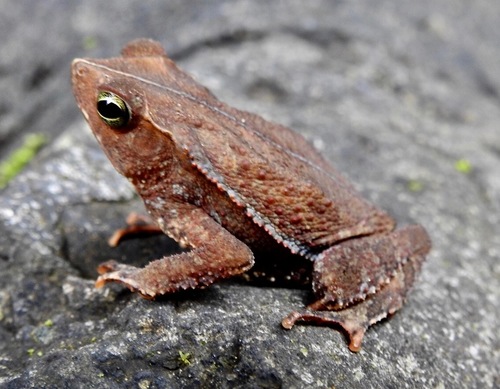
Leaf Litter Toad

Leaf Litter Toad

Rhaebo haematiticus

Silhouette: Michael Scroggie, from original photograph by Gary M. Stolz, USFWS (original photograph in public domain). · PhyloPic

LCLeast ConcernNTVUENCR
Daily sighting probability ~30% · Possible
at Darién National Park

In 3 days ~70% in a week ~90%

10 Verified sightings at Darién National Park From 2019 to 2026
729 In all 11 parks
August Best month
🌅 Crepuscular When it's spotted

About the Leaf Litter Toad

Rhaebo haematiticus (formerly Bufo haematiticus) is a species of toad in the family Bufonidae. It is found in eastern Honduras, Nicaragua, Costa Rica, Panama, Colombia, northwestern Venezuela (Serranía del Perijá), and northwestern Ecuador. Its altitudinal range is from sea level to 1,300 m (4,300 ft) asl. Its natural habitats are primary tropical moist forest and submontane humid forest. It is a nocturnal, leaf-litter species that during the breeding seasons is found along small streams and large rivers. It tolerates some habitat degradation but only occurs close to forest. Threats to it are habitat loss caused by agriculture, wood extraction, and cattle ranching, and locally oil pollution and dams. Wikipedia →

Sounds

Recording0:16

Panama · 2021

© Emily Hjalmarson · iNaturalist · CC BY-NC 4.0

Recording1:14

Panama · 2019

© Oliver Komar · iNaturalist · CC BY-NC 4.0

Recording0:27

Panama · 2026

© Chris Harrison · iNaturalist · CC BY-NC 4.0

Global Distribution

Parks Where Found

# Park Country Daily sighting probability
1 Braulio Carrillo National Park 🇨🇷 Costa Rica
~60%
2 Darién National Park 🇵🇦 Panama
~30%
3 Arenal Volcano National Park 🇨🇷 Costa Rica
~30%
4 Soberanía National Park 🇵🇦 Panama
~20%
5 Tenorio Volcano National Park 🇨🇷 Costa Rica
~20%
6 Piedras Blancas National Park 🇨🇷 Costa Rica
~20%
7 Carara National Park 🇨🇷 Costa Rica
~20%
8 Tortuguero National Park 🇨🇷 Costa Rica
~10%
9 Farallones de Cali National Natural Park 🇨🇴 Colombia
~10%
10 Tapantí-Macizo de la Muerte National Park 🇨🇷 Costa Rica
~10%
11 La Amistad International Park (Panama) 🇵🇦 Panama
~10%

Zoos & Centres Where Found

# Zoo / Centre Country
1 La Paz Waterfall Gardens 🇨🇷 Costa Rica In captivity

Before you go

What are the chances of seeing a Leaf Litter Toad in Darién National Park?

Possible

About 30% of wildlife watchers report a Leaf Litter Toad sighting in Darién National Park on a given day, based on 10 verified sightings from GBIF citizen-science data from 2019 to 2026. It is the 3rd most-seen of the 6 amphibians we can rate there. Over three days the chance rises to about 70%, and over a week to about 90%, if each day is a fresh chance.

When is the best time to see a Leaf Litter Toad in Darién National Park?

August and November–December

In those months about 40% of wildlife watchers report a Leaf Litter Toad in Darién National Park on a given day, against about 10% in April–July and October, the lowest months. September has too few records to rate.

What time of day is best to see a Leaf Litter Toad?

Between 6 and 9 pm

Across all the parks we cover, that three-hour window holds the most Leaf Litter Toad sightings with a recorded time, and about 6 in 10 of them come between 6 pm and 6 am: it is most active around dawn and dusk.

Is Darién National Park the best place to see a Leaf Litter Toad?

2nd of 11

Of the 11 parks where we can rate Leaf Litter Toad sightings, Darién National Park ranks 2nd at about 30%. The best odds are in Braulio Carrillo National Park (Costa Rica, about 60%). All parks ranked.

Which relatives of the Leaf Litter Toad live in Darién National Park?

Same family: Bufonidae

The closest relatives of the Leaf Litter Toad that you can see in Darién National Park (family Bufonidae, True Toads) are Forest Toad (about 30%), Giant Marine Toad (about 30%) and Pirri Harlequin Frog (about 10%), with each one's daily chance of a sighting.

Where does the Leaf Litter Toad sighting chance come from?

GBIF citizen-science records

It is estimated from how often the Leaf Litter Toad is recorded against all the amphibians logged in Darién National Park (10 verified sightings from 2019 to 2026), calibrated against known sighting rates. Figures are rounded to the nearest 10% because citizen-science data supports honest approximations, not decimals, and months with records from fewer than five people show "—". How it works.

← Back to Darién National Park