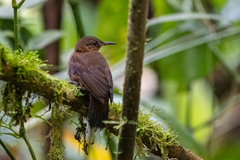
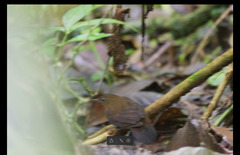

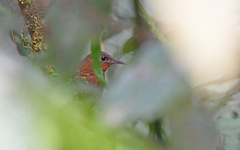

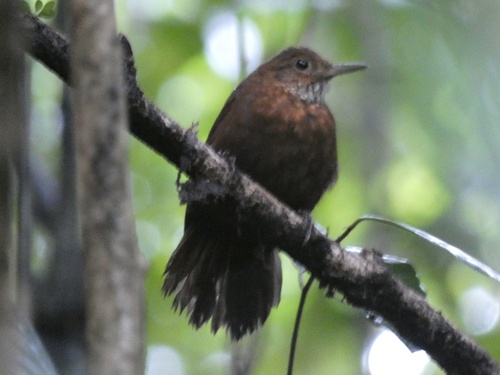
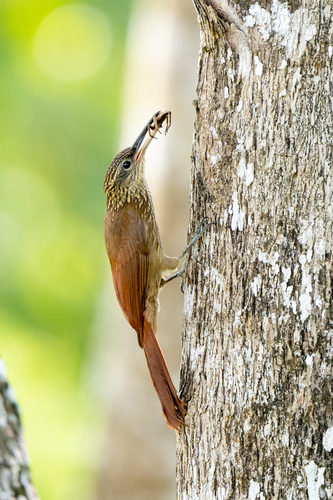
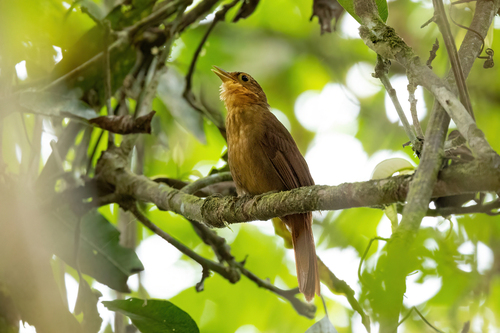
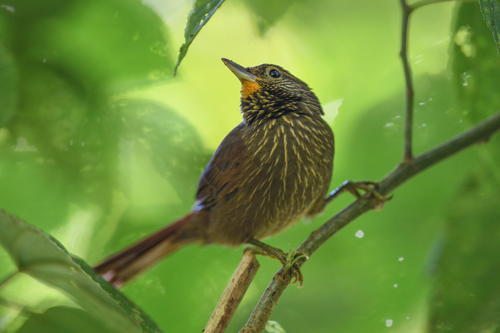
Tawny-throated Leaftosser

Tawny-throated Leaftosser

Sclerurus mexicanus

Silhouette: Sheatherius · PhyloPic

LCLeast ConcernNTVUENCR
Daily sighting probability <5% · Rare
at Darién National Park

In 3 days ~10% in a week ~20%

13 Verified sightings at Darién National Park From 2019 to 2026
837 In all 14 parks
March Best month
☀️ Diurnal When it's spotted

About the Tawny-throated Leaftosser

The tawny-throated leaftosser (Sclerurus mexicanus) is a tropical American bird species in subfamily Sclerurinae, the leaftossers and miners, of the ovenbird family Furnariidae. It is also known as the Middle American leaftosser and less frequently as tawny-throated leafscraper, Mexican leaftosser or Mexican leafscraper. It is found from Mexico to Panama.

The tawny-throated leaftosser's taxonomy is unsettled. The North American Classification Committee of the AOS and BirdLife International's Handbook of the Birds of the World (HBW) retain an older treatment. They include these five subspecies with the other two:

The South American Classification Committee of the American Ornithological Society (AOS), the IOC, and Clements treat these five as belonging to a separate species, Sclerurus obscurior, that they variously call the dusky... Wikipedia →

Sounds

Recording0:21

Guatemala · 2024

© Brendan Sloan · XC1028807 · CC BY-NC-ND 4.0

Song0:25

Costa Rica · 2019

© Johan Chaves · XC486640 · CC BY-NC-SA 4.0

Call0:38

Panama · 2016

© Hans Matheve · XC361712 · CC BY-NC-ND 4.0

Global Distribution

Parks Where Found

# Park Country Daily sighting probability
1 El Triunfo 🇲🇽 Mexico
~20%
2 La Tigra National Park 🇭🇳 Honduras
<5%
3 Darién National Park 🇵🇦 Panama
<5%
4 Cusuco National Park 🇭🇳 Honduras
<5%
5 Tapantí-Macizo de la Muerte National Park 🇨🇷 Costa Rica
<5%
6 Monteverde Cloud Forest Reserve 🇨🇷 Costa Rica
<5%
7 Arenal Volcano National Park 🇨🇷 Costa Rica
<5%
8 Chirripó National Park 🇨🇷 Costa Rica
<5%
9 Pico Bonito National Park 🇭🇳 Honduras
<5%
10 Poás Volcano National Park 🇨🇷 Costa Rica
<5%
11 Braulio Carrillo National Park 🇨🇷 Costa Rica
<5%
12 Tenorio Volcano National Park 🇨🇷 Costa Rica
<5%
13 Soberanía National Park 🇵🇦 Panama
<5%
14 La Amistad International Park (Panama) 🇵🇦 Panama
<5%

Before you go

What are the chances of seeing a Tawny-throated Leaftosser in Darién National Park?

Rare

Under 5% of wildlife watchers report a Tawny-throated Leaftosser sighting in Darién National Park on a given day, based on 13 verified sightings from GBIF citizen-science data from 2019 to 2026. It is the 296th most-seen of the 397 birds we can rate there. Over three days the chance rises to about 10%, and over a week to about 20%, if each day is a fresh chance.

When is the best time to see a Tawny-throated Leaftosser in Darién National Park?

March

In that month about 10% of wildlife watchers report a Tawny-throated Leaftosser in Darién National Park on a given day, against under 5% in April to February, the lowest months. That is one of Darién National Park's driest months, with about 160 mm of rain against 450 mm in November.

What time of day is best to see a Tawny-throated Leaftosser?

Between 7 and 10 am

Across all the parks we cover, that three-hour window holds the most Tawny-throated Leaftosser sightings with a recorded time, and about 8 in 10 of them come between 6 am and 6 pm: it is a daytime animal.

Is Darién National Park the best place to see a Tawny-throated Leaftosser?

3rd of 14

Of the 14 parks where we can rate Tawny-throated Leaftosser sightings, Darién National Park ranks 3rd at under 5%. The best odds are in El Triunfo (Mexico, about 20%) and La Tigra National Park (Honduras, under 5%).

Where does the Tawny-throated Leaftosser sighting chance come from?

GBIF citizen-science records

It is estimated from how often the Tawny-throated Leaftosser is recorded against all the birds logged in Darién National Park (13 verified sightings from 2019 to 2026), calibrated against known sighting rates. Figures are rounded to the nearest 10% because citizen-science data supports honest approximations, not decimals, and months with records from fewer than five people show "—". How it works.

← Back to Darién National Park