Harris's Sparrow

Harris's Sparrow

Zonotrichia querula

Silhouette: Edwin Price · PhyloPic

LCNTNear ThreatenedVUENCR
Daily sighting probability <5% · Rare
at Death Valley National Park

In 3 days <5% in a week ~10%

15 Verified sightings at Death Valley National Park From 2019 to 2026
186 In all 7 parks
February Best month
☀️ Diurnal When it's spotted

About the Harris's Sparrow

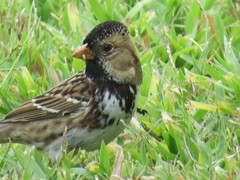
Harris's sparrow (Zonotrichia querula) is a large sparrow. Their breeding habitat is the north part of central Canada (primarily the Northwest Territories and Nunavut, ranging slightly into northern Manitoba and Saskatchewan), making it Canada's only endemic breeding bird. In the winter they migrate to the Great Plains states of the United States, from southern South Dakota to central Texas. The common name of this species commemorates the American amateur ornithologist Edward Harris (1799–1863).

This species is the largest of the sparrows in the family Passerellidae, though other superficially dissimilar species in the family may slightly exceed them in size. They range in total length from 17 to 20 cm (6.7 to 7.9 in), with a 27 cm (11 in) wingspan and weigh from 26 to 49 g (0.92 to 1.73 oz). Among standard measurements, the wing chord is 7.7 to 9.2 cm (3.0 to 3.6 in), the tail is 7.6 to 8.8 cm (3.0 to 3.5 in), the bill is 1.1 to 1.4 cm (0.43 to 0.55 in) and the tarsus is 2.2 to 2.5 cm (0.87 to 0.98 in).

This is a very distinctive looking species. Breeding plumage birds have conspicuous pink bills and black on the crown, face, throat and upper breast, contrasting... Wikipedia →

Sounds

Call0:22

United States · 2023

© Gregory Askew · XC773059 · CC BY-NC-SA 4.0

Song0:24

Canada · 2014

© Ian Cruickshank · XC210755 · CC BY-NC-SA 4.0

Flight call0:53

United States · 2014

© Andrew Spencer · XC176989 · CC BY-NC-SA 4.0

Global Distribution

Parks Where Found

# Park Country Daily sighting probability
1 Riding Mountain National Park 🇨🇦 Canada
<5%
2 Death Valley National Park 🇺🇸 United States
<5%
3 Grand Canyon National Park 🇺🇸 United States
<5%
4 Point Pelee National Park 🇨🇦 Canada
<5%
5 Yellowstone National Park 🇺🇸 United States
<5%
6 Channel Islands National Park 🇺🇸 United States
<5%
7 Rocky Mountain National Park 🇺🇸 United States
<5%

Cities Where Found

# City Country Daily sighting probability
1 Tijuana 🇲🇽 México
<5%
2 Dallas 🇺🇸 United States
<5%
3 Vancouver 🇨🇦 Canada
<5%
4 Salt Lake City 🇺🇸 United States
<5%
5 Denver 🇺🇸 United States
<5%
6 Austin 🇺🇸 United States
<5%
7 Edmonton 🇨🇦 Canada
<5%
8 Chicago 🇺🇸 United States
<5%
9 Minneapolis [Saint Paul] 🇺🇸 United States
<5%
10 San Francisco 🇺🇸 United States
<5%

Before you go

What are the chances of seeing a Harris's Sparrow in Death Valley National Park?

Rare

Under 5% of wildlife watchers report a Harris's Sparrow sighting in Death Valley National Park on a given day, based on 15 verified sightings from GBIF citizen-science data from 2019 to 2026. It is the 181st most-seen of the 213 birds we can rate there. Over three days the chance rises to under 5%, and over a week to about 10%, if each day is a fresh chance.

When is the best time to see a Harris's Sparrow in Death Valley National Park?

February

In that month about 10% of wildlife watchers report a Harris's Sparrow in Death Valley National Park on a given day, against under 5% in March to January, the lowest months. That is one of Death Valley National Park's wettest months, with about 25 mm of rain against 5 mm in June.

What time of day is best to see a Harris's Sparrow?

Between 8 and 11 am

Across all the parks we cover, that three-hour window holds the most Harris's Sparrow sightings with a recorded time, and about 8 in 10 of them come between 6 am and 6 pm: it is a daytime animal.

Is Death Valley National Park the best place to see a Harris's Sparrow?

Among the best

Of the 7 parks where we can rate Harris's Sparrow sightings, Death Valley National Park ranks 2nd at under 5%, level with the leaders once rounded. The best odds are in Riding Mountain National Park (Canada, under 5%).

Where does the Harris's Sparrow sighting chance come from?

GBIF citizen-science records

It is estimated from how often the Harris's Sparrow is recorded against all the birds logged in Death Valley National Park (15 verified sightings from 2019 to 2026), calibrated against known sighting rates. Figures are rounded to the nearest 10% because citizen-science data supports honest approximations, not decimals, and months with records from fewer than five people show "—". How it works.

← Back to Death Valley National Park