
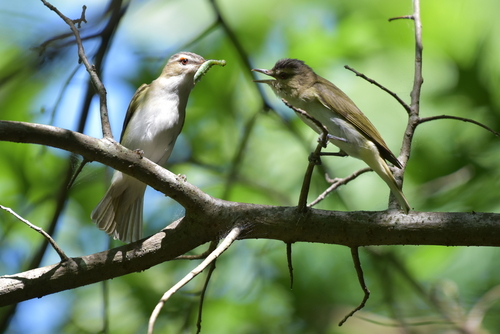
Rufous-crowned Greenlet

Rufous-crowned Greenlet

Hylophilus poicilotis

Silhouette: Sheatherius · PhyloPic

LCLeast ConcernNTVUENCR
Daily sighting probability ~10% · With luck
at Iguaçu National Park

In 3 days ~20% in a week ~30%

211 Verified sightings at Iguaçu National Park From 2019 to 2026
1,384 In all 4 parks
August Best month
☀️ Diurnal When it's spotted

About the Rufous-crowned Greenlet

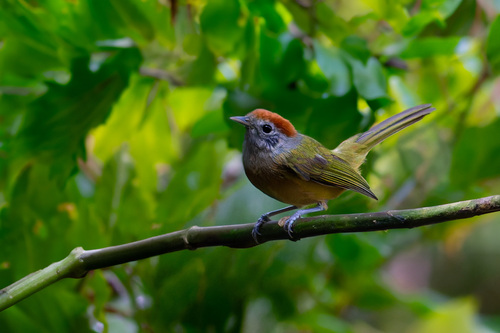
The rufous-crowned greenlet (Hylophilus poicilotis) is a species of bird in the family Vireonidae, the vireos, greenlets, and shrike-babblers. It is found in Argentina, Brazil, Paraguay, and possibly Bolivia. The rufous-crowned greenlet is monotypic. However, for much of the twentieth century what is now the grey-eyed greenlet (Hylophilus amaurocephalus) was treated as a subspecies of it. By the 1990s they were generally recognized as separate species.

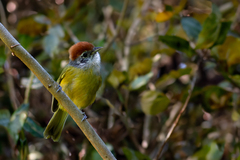
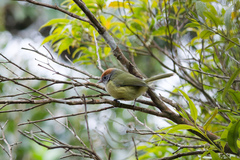
The rufous-crowned greenlet is about 12.5 cm (4.9 in) long and weighs 9 to 12 g (0.32 to 0.42 oz). The sexes have the same plumage. Adults have a bright chestnut-brown forehead and crown and mottled grayish black ear coverts. Their nape, upper back, and shoulders are olive-green and their lower back and rump are a brighter green. Their wings are dull grayish black with thin greenish edges on the outer webs of the primaries and secondaries and yellow-green edges on the inner webs of the tertials. Their tail is grayish green with brighter greenish edges on the feathers' outer webs. Their throat is dull pale gray, their upper breast yellowish gray, their lower breast dull yellow, their flanks... Wikipedia →

Sounds

Song0:38

Brazil · 2025

© Joost van Bruggen · XC1050573 · CC BY-NC-ND 4.0

Alarm call0:23

Brazil · 2022

© JAYRSON ARAUJO DE OLIVEIRA · XC725193 · CC BY-NC-SA 4.0

Call0:34

Bolivia · 2022

© Jacob Wijpkema · XC723967 · CC BY-NC-SA 4.0

Global Distribution

Parks Where Found

# Park Country Daily sighting probability
1 Itatiaia National Park 🇧🇷 Brazil
~40%
2 Serra dos Órgãos National Park 🇧🇷 Brazil
~20%
3 Iguazú National Park 🇦🇷 Argentina
~10%
4 Iguaçu National Park 🇧🇷 Brazil
~10%

Cities Where Found

# City Country Daily sighting probability
1 Curitiba 🇧🇷 Brazil
<5%
2 São Paulo 🇧🇷 Brazil
<5%

Before you go

What are the chances of seeing a Rufous-crowned Greenlet in Iguaçu National Park?

With luck

About 10% of wildlife watchers report a Rufous-crowned Greenlet sighting in Iguaçu National Park on a given day, based on 211 verified sightings from GBIF citizen-science data from 2019 to 2026. It is the 157th most-seen of the 346 birds we can rate there. Over three days the chance rises to about 20%, and over a week to about 30%, if each day is a fresh chance.

When is the best time to see a Rufous-crowned Greenlet in Iguaçu National Park?

January, June–August and November

In those months about 10% of wildlife watchers report a Rufous-crowned Greenlet in Iguaçu National Park on a given day, against under 5% in February–May, September–October and December, the lowest months.

What time of day is best to see a Rufous-crowned Greenlet?

Between 9 am and noon

Across all the parks we cover, that three-hour window holds the most Rufous-crowned Greenlet sightings with a recorded time, and about 9 in 10 of them come between 6 am and 6 pm: it is a daytime animal.

Which relatives of the Rufous-crowned Greenlet live in Iguaçu National Park?

Same family: Vireonidae

The closest relatives of the Rufous-crowned Greenlet that you can see in Iguaçu National Park (family Vireonidae, Vireos, Shrike-Babblers, and Erpornis) are Red-eyed Vireo (about 20%) and Rufous-browed Peppershrike (about 10%), with each one's daily chance of a sighting.

Where does the Rufous-crowned Greenlet sighting chance come from?

GBIF citizen-science records

It is estimated from how often the Rufous-crowned Greenlet is recorded against all the birds logged in Iguaçu National Park (211 verified sightings from 2019 to 2026), calibrated against known sighting rates. Figures are rounded to the nearest 10% because citizen-science data supports honest approximations, not decimals, and months with records from fewer than five people show "—". How it works.

← Back to Iguaçu National Park