Spotted Firebug

Spotted Firebug

Corizus hyoscyami

Daily sighting probability ~10% · With luck
at Ecrins National Park

In 3 days ~30% in a week ~60%

13 Verified sightings at Ecrins National Park From 2019 to 2026
153 In all 9 parks
October Best month
☀️ Diurnal When it's spotted

About the Spotted Firebug

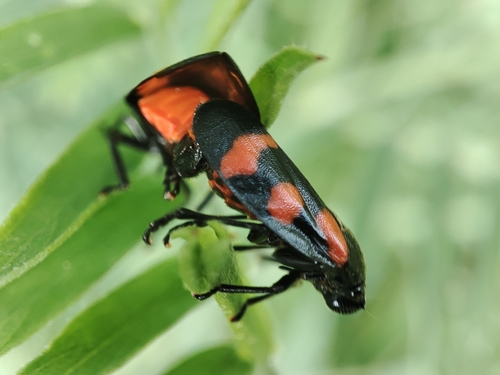
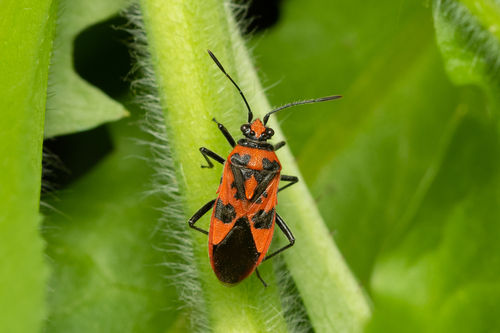
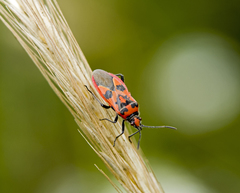
Corizus hyoscyami is a species of scentless plant bug belonging to the family Rhopalidae, subfamily Rhopalinae. It is commonly called the cinnamon bug or black and red squash bug. Corizus hyoscyami hyoscyami (Linnaeus, 1758)

Corizus hyoscyami nigridorsum (Puton, 1874) Corizus hyoscyami subs. hyoscyami is found in most of Europe; in Britain, the species appears to be spreading northwards, having been recorded in Yorkshire. Corizus hyoscyami subs. nigridorsum is present in Spain, Italy, Morocco and Tunisia.

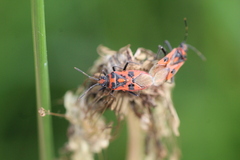
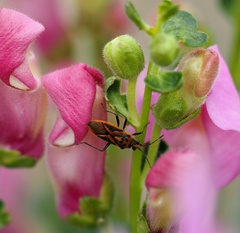
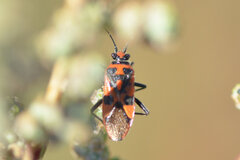
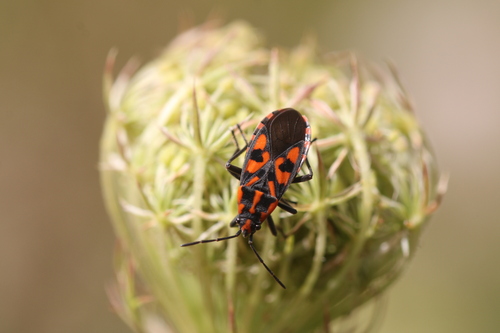
Adults of Corizus hyoscyami are about 9 millimetres (0.35 in) long. Like all scentless plant bugs, it lacks well-developed scent glands and can be distinguished by numerous veins in the membrane of the hemelytra, characteristic of all members of the Rhopalidae.

In Corizus hyoscyami subs. hyoscyami the third and fourth abdominal tergites are red, while in Corizus hyoscyami subs. nigridorsum they are completely black. The dorsum colours are visible in elitrale transparency under the membrane.

Although striking in colour, Corizus hyoscyami may be confused with the similarly marked but unrelated Pyrrhocoris apterus (firebug) (see comparison... Wikipedia →
Global Distribution

Parks Where Found

# Park Country Daily sighting probability
1 Sierra Nevada National Park 🇪🇸 Spain
~20%
2 Vanoise National Park 🇫🇷 France
~20%
3 Cévennes National Park 🇫🇷 France
~10%
4 Ecrins National Park 🇫🇷 France
~10%
5 Snowdonia National Park 🇬🇧 United Kingdom
~10%
6 Pyrénées National Park 🇫🇷 France
~10%
7 Sierra de Guadarrama National Park 🇪🇸 Spain
~10%
8 Bavarian Forest National Park 🇩🇪 Germany
~10%
9 Wadden Sea National Park 🇩🇪 Germany
<5%

Cities Where Found

# City Country Daily sighting probability
1 London 🇬🇧 United Kingdom
~10%
2 Birmingham 🇬🇧 United Kingdom
~10%
3 Algiers 🇩🇿 Algeria
~10%
4 Brussels 🇧🇪 Belgium
~10%
5 Lyon 🇫🇷 France
~10%
6 Liverpool 🇬🇧 United Kingdom
~10%
7 Kharkiv 🇺🇦 Ukraine
~10%
8 Bucharest 🇷🇴 Romania
~10%
9 Munich 🇩🇪 Germany
~10%
10 Paris 🇫🇷 France
~10%

Before you go

What are the chances of seeing a Spotted Firebug in Ecrins National Park?

With luck

About 10% of wildlife watchers report a Spotted Firebug sighting in Ecrins National Park on a given day, based on 13 verified sightings from GBIF citizen-science data from 2019 to 2026. It is the 93rd most-seen of the 251 insects we can rate there. Over three days the chance rises to about 30%, and over a week to about 60%, if each day is a fresh chance.

When is the best time to see a Spotted Firebug in Ecrins National Park?

September and October

In those months about 30% of wildlife watchers report a Spotted Firebug in Ecrins National Park on a given day, against under 5% in November to June, the lowest months.

What time of day is best to see a Spotted Firebug?

Between 10 am and 1 pm

Across all the parks we cover, that three-hour window holds the most Spotted Firebug sightings with a recorded time, and about 8 in 10 of them come between 6 am and 6 pm: it is a daytime animal.

Which relatives of the Spotted Firebug live in Ecrins National Park?

Same order: Hemiptera

The closest relatives of the Spotted Firebug that you can see in Ecrins National Park (order Hemiptera, True Bugs, Hoppers, Aphids, and allies) are European Striped Shield Bug (about 30%), Spilostethus saxatilis (about 30%) and Sloe Bug (about 20%), with each one's daily chance of a sighting.

Where does the Spotted Firebug sighting chance come from?

GBIF citizen-science records

It is estimated from how often the Spotted Firebug is recorded against all the insects logged in Ecrins National Park (13 verified sightings from 2019 to 2026), calibrated against known sighting rates. Figures are rounded to the nearest 10% because citizen-science data supports honest approximations, not decimals, and months with records from fewer than five people show "—". How it works.

← Back to Ecrins National Park