
Bell's Vireo

Bell's Vireo

Vireo bellii

Silhouette: Caleb Gordon · PhyloPic

LCLeast ConcernNTVUENCR
Daily sighting probability <5% · Rare
at El Vizcaíno Biosphere Reserve

In 3 days <5% in a week ~10%

14 Verified sightings at El Vizcaíno Biosphere Reserve From 2019 to 2026
4,297 In all 14 parks
October Best month
☀️ Diurnal When it's spotted

About the Bell's Vireo

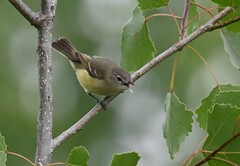
Bell's vireo (Vireo bellii) is a songbird that migrates between a breeding range in Western North America and a winter range in Central America. It is dull olive-gray above and whitish below. It has a faint white eye ring and faint wing bars.

This bird was named by Audubon for John Graham Bell, who accompanied him on his trip up the Missouri River in the 1840s. The least Bell's vireo (Vireo bellii pusillus) is an endangered subspecies in Southern California. Consideration of Bell's vireo has been a factor in several land development projects, to protect least Bell's vireo habitat. The decline of the least Bell's vireo is mostly due to a loss of riparian habitat.

Measurements: Length: 4.5–4.9 in (11.5–12.5 cm) Weight: 0.3–0.3 oz (7.4–9.8 g) Wingspan: 6.7–7.5 in (17–19 cm) Least Bell's vireo, V.b. pusillus (southern California) Arizona Bell's vireo, V.b. arizonae (southwestern United States, northern Mexico)

V.b. medius (southwestern Texas, Mexico) V.b. belli (central and midwestern United States to central Mexico) In its breeding range, Bell's vireo often uses dense shrubbery in riparian areas or otherwise near water. Willow... Wikipedia →

Sounds

Song1:30

United States · 2023

© Richard E. Webster · XC827553 · CC BY-NC-SA 4.0

Call0:24

United States · 2022

© Bobby Wilcox · XC717636 · CC BY-NC-SA 4.0

Alarm call0:32

Mexico · 2021

© Manuel Grosselet · XC623943 · CC BY-NC-SA 4.0

Global Distribution

Parks Where Found

# Park Country Daily sighting probability
1 Big Bend National Park 🇺🇸 United States
~40%
2 Saguaro National Park 🇺🇸 United States
~10%
3 Death Valley National Park 🇺🇸 United States
~10%
4 Cabo Pulmo National Park 🇲🇽 Mexico
~10%
5 Badlands National Park 🇺🇸 United States
<5%
6 Guadalupe Mountains National Park 🇺🇸 United States
<5%
7 Cumbres de Monterrey National Park 🇲🇽 Mexico
<5%
8 Bahía de Loreto National Park 🇲🇽 Mexico
<5%
9 El Vizcaíno Biosphere Reserve 🇲🇽 Mexico
<5%
10 Zion National Park 🇺🇸 United States
<5%
11 Point Pelee National Park 🇨🇦 Canada
<5%
12 Channel Islands National Park 🇺🇸 United States
<5%
13 Grand Canyon National Park 🇺🇸 United States
<5%
14 Everglades National Park 🇺🇸 United States
<5%

Cities Where Found

# City Country Daily sighting probability
1 Los Angeles 🇺🇸 United States
<5%
2 Monterrey 🇲🇽 México
<5%
3 San Diego 🇺🇸 United States
<5%
4 Mesa 🇺🇸 United States
<5%
5 San Antonio 🇺🇸 United States
<5%
6 Austin 🇺🇸 United States
<5%
7 Dallas 🇺🇸 United States
<5%
8 Phoenix 🇺🇸 United States
<5%
9 Houston 🇺🇸 United States
<5%
10 Mexico City 🇲🇽 México
<5%

Before you go

What are the chances of seeing a Bell's Vireo in El Vizcaíno Biosphere Reserve?

Rare

Under 5% of wildlife watchers report a Bell's Vireo sighting in El Vizcaíno Biosphere Reserve on a given day, based on 14 verified sightings from GBIF citizen-science data from 2019 to 2026. It is the 194th most-seen of the 237 birds we can rate there. Over three days the chance rises to under 5%, and over a week to about 10%, if each day is a fresh chance.

When is the best time to see a Bell's Vireo in El Vizcaíno Biosphere Reserve?

Any time of year

In every month with enough records, under 5% of wildlife watchers report a Bell's Vireo in El Vizcaíno Biosphere Reserve on a given day, so our monthly data shows no clear season.

What time of day is best to see a Bell's Vireo?

Between 7 and 10 am

Across all the parks we cover, that three-hour window holds the most Bell's Vireo sightings with a recorded time, and about 9 in 10 of them come between 6 am and 6 pm: it is a daytime animal.

Is El Vizcaíno Biosphere Reserve the best place to see a Bell's Vireo?

9th of 14

Of the 14 parks where we can rate Bell's Vireo sightings, El Vizcaíno Biosphere Reserve ranks 9th at under 5%. The best odds are in Big Bend National Park (United States, about 40%), Saguaro National Park (United States, about 10%) and Death Valley National Park (United States, about 10%).

Where does the Bell's Vireo sighting chance come from?

GBIF citizen-science records

It is estimated from how often the Bell's Vireo is recorded against all the birds logged in El Vizcaíno Biosphere Reserve (14 verified sightings from 2019 to 2026), calibrated against known sighting rates. Figures are rounded to the nearest 10% because citizen-science data supports honest approximations, not decimals, and months with records from fewer than five people show "—". How it works.

← Back to El Vizcaíno Biosphere Reserve