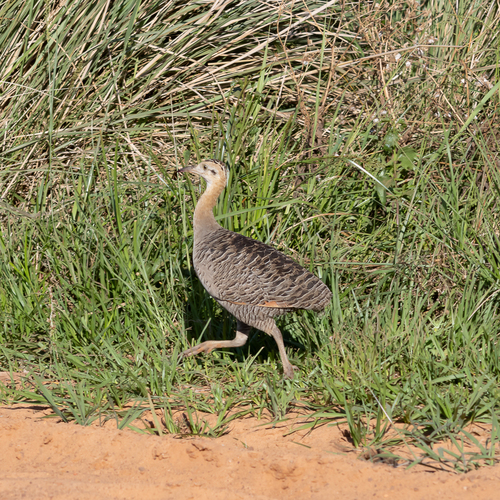
Small-billed Tinamou

Small-billed Tinamou

Crypturellus parvirostris

Silhouette: J. N. Wiegers · PhyloPic

LCLeast ConcernNTVUENCR
Daily sighting probability ~40% · Likely
at Emas National Park

In 3 days ~80% in a week >90%

108 Verified sightings at Emas National Park From 2019 to 2026
513 In all 8 parks
September Best month
☀️ Diurnal When it's spotted

About the Small-billed Tinamou

The small-billed tinamou (Crypturellus parvirostris) is a type of tinamou commonly found in dry savanna in Amazonian South America. The small-billed tinamou was formally described in 1827 by the German naturalist Johann Georg Wagler based on a specimen collected in Brazil. Wagler coined the binomial name Crypturus parvirostris. The specific epithet combines the Latin parvus meaning "small" with -rostris meaning "-billed". The small-billed tinamou is now one of 21 species placed in the genus Crypturellus that was introduced in 1914 by the British ornithologists Baron Brabourne and Charles Chubb. The species is monotypic: no subspecies are recognised.

All tinamou are from the family Tinamidae, and in the larger scheme are also ratites. Unlike other ratites, tinamous can fly, although in general, they are not strong fliers. All ratites evolved from prehistoric flying birds, and tinamous are the closest living relative of these birds.

The small-billed tinamou is approximately 22 cm (8.7 in) in length. Its upperparts are dark brown, with grey to brownish underparts and head. Its bill and legs are red. The small-billed tinamou... Wikipedia →

Sounds

Song0:19

Argentina · 2024

© Faustino Hollmann · XC1176813 · CC BY-NC-SA 4.0

Call0:05

Brazil · 2025

© JAYRSON ARAUJO DE OLIVEIRA · XC1027577 · CC BY-NC-SA 4.0

Canto0:37

Brazil · 2015

© Caio Brito · XC427712 · CC BY-NC-SA 4.0

Global Distribution

Parks Where Found

# Park Country Daily sighting probability
1 Emas National Park 🇧🇷 Brazil
~40%
2 Chapada Diamantina National Park 🇧🇷 Brazil
~20%
3 Serra da Canastra National Park 🇧🇷 Brazil
~10%
4 Chapada dos Guimarães National Park 🇧🇷 Brazil
~10%
5 Parque Estadual Encontro das Águas 🇧🇷 Brazil
<5%
6 Iguaçu National Park 🇧🇷 Brazil
<5%
7 Iguazú National Park 🇦🇷 Argentina
<5%
8 Tambopata National Reserve 🇵🇪 Peru
<5%

Cities Where Found

# City Country Daily sighting probability
1 Goiânia 🇧🇷 Brazil
<5%
2 Belo Horizonte 🇧🇷 Brazil
<5%

Before you go

What are the chances of seeing a Small-billed Tinamou in Emas National Park?

Likely

About 40% of wildlife watchers report a Small-billed Tinamou sighting in Emas National Park on a given day, based on 108 verified sightings from GBIF citizen-science data from 2019 to 2026. It is the 43rd most-seen of the 187 birds we can rate there. Over three days the chance rises to about 80%, and over a week to over 90%, if each day is a fresh chance.

When is the best time to see a Small-billed Tinamou in Emas National Park?

September

In that month about 60% of wildlife watchers report a Small-billed Tinamou in Emas National Park on a given day, against about 30% in March and October, the lowest months. That is one of Emas National Park's driest months, with about 35 mm of rain against 190 mm in January. April and December–February have too few records to rate.

What time of day is best to see a Small-billed Tinamou?

Between 7 and 10 am

Across all the parks we cover, that three-hour window holds the most Small-billed Tinamou sightings with a recorded time, and about 8 in 10 of them come between 6 am and 6 pm: it is a daytime animal.

Where does the Small-billed Tinamou sighting chance come from?

GBIF citizen-science records

It is estimated from how often the Small-billed Tinamou is recorded against all the birds logged in Emas National Park (108 verified sightings from 2019 to 2026), calibrated against known sighting rates. Figures are rounded to the nearest 10% because citizen-science data supports honest approximations, not decimals, and months with records from fewer than five people show "—". How it works.

← Back to Emas National Park