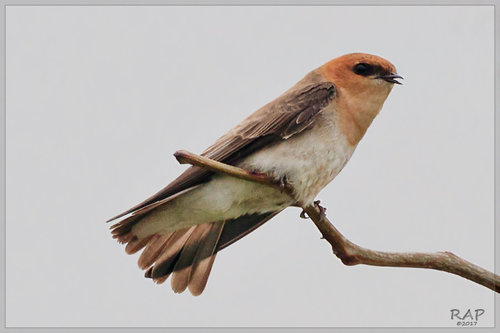
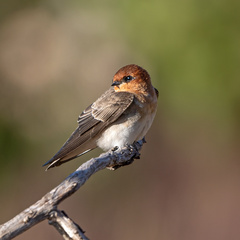


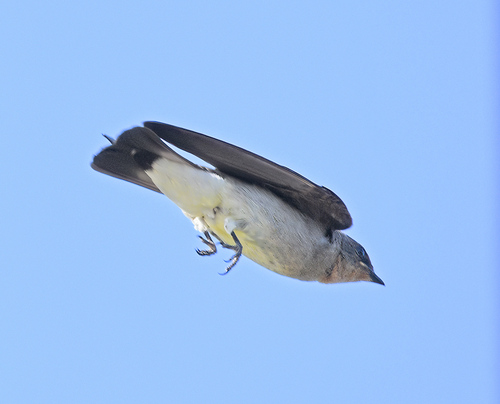
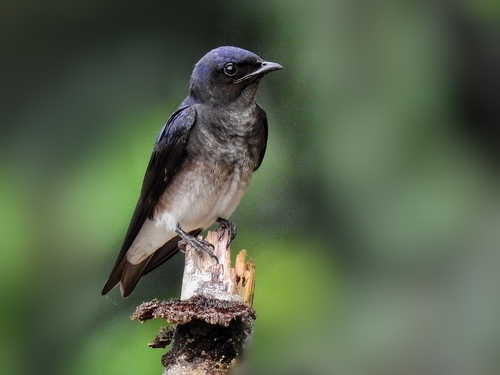
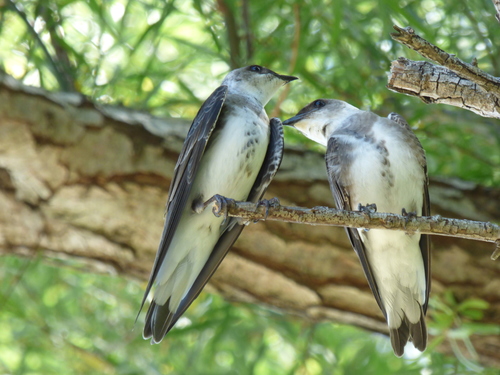

Tawny-headed Swallow

Tawny-headed Swallow

Alopochelidon fucata

Silhouette: Sheatherius · PhyloPic

LCLeast ConcernNTVUENCR
Daily sighting probability ~20% · Possible
at Emas National Park

In 3 days ~50% in a week ~80%

44 Verified sightings at Emas National Park From 2019 to 2026
322 In all 5 parks
June Best month
☀️ Diurnal When it's spotted

About the Tawny-headed Swallow

The tawny-headed swallow (Alopochelidon fucata) is a species of bird in the family Hirundinidae. It is the only species placed in the genus Alopochelidon. It is found in Argentina, Bolivia, Brazil, Colombia, Falkland Islands, Paraguay, Peru, Uruguay, and Venezuela, where its natural habitats are dry savanna and subtropical or tropical seasonally wet or flooded lowland grassland.

The tawny-headed swallow was formally described as Hirundo fucata by the Dutch zoologist Coenraad Temminck in 1822. The type locality is São Paulo in Brazil. The tawny-headed swallow is now the only species placed in the genus Alopochelidon that was introduced in 1903 by Robert Ridgway. The genus name combines the Ancient Greek alōpos meaning "fox-like" (alōpēx means "fox") with khelidōn meaning "swallow". The specific epithet is from Latin fucatus meaning "painted". Phylogenetic analysis has shown that tawny-headed swallow is most closely related to the swallows in the genus Orochelidon.

Although no subspecies of the tawny-headed swallow are recognised, it differs slightly depending on where it occurs. A tawny-headed swallow that occurs in the southern part of its range will usually... Wikipedia →

Sounds

Flight call0:22

Argentina · 2022

© Franco Vushurovich · XC748007 · CC BY-NC-SA 4.0

Song0:22

Brazil · 2022

© Miguel Angelo Biz · XC723856 · CC BY-NC-SA 4.0

Call0:12

Brazil · 2019

© JAYRSON ARAUJO DE OLIVEIRA · XC506251 · CC BY-NC-SA 4.0

Global Distribution

Parks Where Found

# Park Country Daily sighting probability
1 Serra da Canastra National Park 🇧🇷 Brazil
~30%
2 Emas National Park 🇧🇷 Brazil
~20%
3 Iberá National Park 🇦🇷 Argentina
<5%
4 Iguaçu National Park 🇧🇷 Brazil
<5%
5 Iguazú National Park 🇦🇷 Argentina
<5%

Cities Where Found

# City Country Daily sighting probability
1 Rosario 🇦🇷 Argentina
~10%
2 Cordoba 🇦🇷 Argentina
<5%
3 Asuncion 🇵🇾 Paraguay
<5%
4 Buenos Aires 🇦🇷 Argentina
<5%

Before you go

What are the chances of seeing a Tawny-headed Swallow in Emas National Park?

Possible

About 20% of wildlife watchers report a Tawny-headed Swallow sighting in Emas National Park on a given day, based on 44 verified sightings from GBIF citizen-science data from 2019 to 2026. It is the 84th most-seen of the 187 birds we can rate there. Over three days the chance rises to about 50%, and over a week to about 80%, if each day is a fresh chance.

When is the best time to see a Tawny-headed Swallow in Emas National Park?

June

In that month about 50% of wildlife watchers report a Tawny-headed Swallow in Emas National Park on a given day, against about 10% in August and September, the lowest months. That is one of Emas National Park's driest months, with about 10 mm of rain against 190 mm in January. April and December–February have too few records to rate.

What time of day is best to see a Tawny-headed Swallow?

Between 9 am and noon

Across all the parks we cover, that three-hour window holds the most Tawny-headed Swallow sightings with a recorded time, and about 8 in 10 of them come between 6 am and 6 pm: it is a daytime animal.

Is Emas National Park the best place to see a Tawny-headed Swallow?

2nd of 5

Of the 5 parks where we can rate Tawny-headed Swallow sightings, Emas National Park ranks 2nd at about 20%. The best odds are in Serra da Canastra National Park (Brazil, about 30%).

Which relatives of the Tawny-headed Swallow live in Emas National Park?

Same family: Hirundinidae

The closest relatives of the Tawny-headed Swallow that you can see in Emas National Park (family Hirundinidae, Swallows and Martins) are Southern Rough-winged Swallow (about 50%), White-rumped Swallow (about 50%) and Cliff Swallow (about 10%), with each one's daily chance of a sighting.

Where does the Tawny-headed Swallow sighting chance come from?

GBIF citizen-science records

It is estimated from how often the Tawny-headed Swallow is recorded against all the birds logged in Emas National Park (44 verified sightings from 2019 to 2026), calibrated against known sighting rates. Figures are rounded to the nearest 10% because citizen-science data supports honest approximations, not decimals, and months with records from fewer than five people show "—". How it works.

← Back to Emas National Park