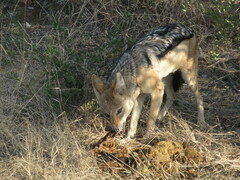
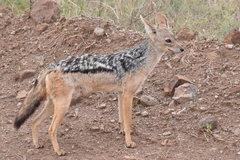
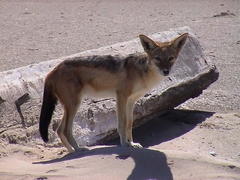
Black-backed Jackal

Black-backed Jackal

Canis mesomelas

Daily sighting probability ~60% · Likely
at Etosha National Park

In 3 days ~90% in a week >90%

260 Verified sightings at Etosha National Park From 2019 to 2026
2,163 In all 23 parks
February Best month
☀️ Diurnal When it's spotted

About the Black-backed Jackal

The black-backed jackal (Lupulella mesomelas) is a medium-sized canine native to eastern and southern Africa. These regions are separated by roughly 900 km (560 mi). One region includes the southernmost tip of the continent, including South Africa, Namibia, Botswana and Zimbabwe. The other area is along the eastern coastline, including Kenya, Somalia, Djibouti, Eritrea, and Ethiopia. It is listed on the IUCN Red List as least concern due to its widespread range and adaptability, although it is still persecuted as a livestock predator and rabies vector.

It has a reddish brown to tan coat and a black saddle that extends from the shoulders to the base of the tail. It is a monogamous animal, whose young may remain with the family to help raise new generations of pups. The black-backed jackal has a wide array of food sources, feeding on small to medium-sized animals, as well as plant matter and human refuse.

It also plays a prominent role in African folklore, often depicted as a cunning and adaptable trickster figure. Despite ongoing conflict with humans due to livestock predation, its populations remain stable thanks to its resilience and adaptability across diverse landscapes.

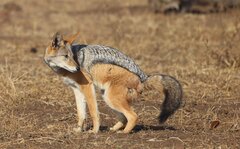
Wikipedia →

Global Distribution

Parks Where Found

# Park Country Daily sighting probability
1 Ruaha National Park 🇹🇿 Tanzania
~70%
2 Etosha National Park 🇳🇦 Namibia
~60%
3 Kgalagadi Transfrontier Park 🇿🇦 South Africa
~60%
4 Golden Gate Highlands National Park 🇿🇦 South Africa
~60%
5 Masai Mara National Reserve 🇰🇪 Kenya
~50%
6 Nairobi National Park 🇰🇪 Kenya
~50%
7 Samburu National Reserve 🇰🇪 Kenya
~50%
8 Meru National Park 🇰🇪 Kenya
~50%
9 Tarangire National Park 🇹🇿 Tanzania
~50%
10 Chobe National Park 🇧🇼 Botswana
~50%
11 Hwange National Park 🇿🇼 Zimbabwe
~40%
12 Tsavo West National Park 🇰🇪 Kenya
~40%
13 Lake Nakuru National Park 🇰🇪 Kenya
~40%
14 Tsavo East National Park 🇰🇪 Kenya
~40%
15 Addo Elephant National Park 🇿🇦 South Africa
~40%
16 Amboseli National Park 🇰🇪 Kenya
~40%
17 Serengeti National Park 🇹🇿 Tanzania
~40%
18 Namib-Naukluft National Park 🇳🇦 Namibia
~40%
19 Ngorongoro Conservation Area 🇹🇿 Tanzania
~40%
20 Moremi Game Reserve 🇧🇼 Botswana
~40%
21 Gonarezhou National Park 🇿🇼 Zimbabwe
~40%
22 Pilanesberg National Park 🇿🇦 South Africa
~30%
23 Kruger National Park 🇿🇦 South Africa
~30%

Zoos & Centres Where Found

# Zoo / Centre Country
1 Zoo Pilsen 🇨🇿 Czechia In captivity
2 Columbus Zoo and Aquarium 🇺🇸 United States In captivity
3 Beijing Zoo 🇨🇳 China In captivity
4 National Zoological Garden of South Africa 🇿🇦 South Africa In captivity
5 Wildlife World Zoo 🇺🇸 United States In captivity
6 Night Safari 🇸🇬 Singapore In captivity
7 Singapore Zoo 🇸🇬 Singapore In captivity
8 Plumpton Park Zoo 🇺🇸 United States In captivity
9 River Wonders 🇸🇬 Singapore In captivity
10 Jardín Zoológico El Bosque 🇨🇺 Cuba In captivity
11 Ralph Perkins II Wildlife Center and Woods Garden 🇺🇸 United States In captivity

Before you go

What are the chances of seeing a Black-backed Jackal in Etosha National Park?

Likely

About 60% of wildlife watchers report a Black-backed Jackal sighting in Etosha National Park on a given day, based on 260 verified sightings from GBIF citizen-science data from 2019 to 2026. It is the 10th most-seen of the 38 mammals we can rate there. Over three days the chance rises to about 90%, and over a week to over 90%, if each day is a fresh chance.

When is the best time to see a Black-backed Jackal in Etosha National Park?

February–March, June and November

In those months about 70% of wildlife watchers report a Black-backed Jackal in Etosha National Park on a given day, against about 50% in April–May and September, the lowest months.

What time of day is best to see a Black-backed Jackal?

Between 6 and 9 am

Across all the parks we cover, that three-hour window holds the most Black-backed Jackal sightings with a recorded time, and about 8 in 10 of them come between 6 am and 6 pm: it is a daytime animal.

Is Etosha National Park the best place to see a Black-backed Jackal?

2nd of 23

Of the 23 parks where we can rate Black-backed Jackal sightings, Etosha National Park ranks 2nd at about 60%. The best odds are in Ruaha National Park (Tanzania, about 70%). All parks ranked.

Which relatives of the Black-backed Jackal live in Etosha National Park?

Same family: Canidae

The closest relatives of the Black-backed Jackal that you can see in Etosha National Park (family Canidae, Canids) are Cape Fox (about 10%) and Bat-eared Fox (about 10%), with each one's daily chance of a sighting.

Where does the Black-backed Jackal sighting chance come from?

GBIF citizen-science records

It is estimated from how often the Black-backed Jackal is recorded against all the mammals logged in Etosha National Park (260 verified sightings from 2019 to 2026), calibrated against known sighting rates. Figures are rounded to the nearest 10% because citizen-science data supports honest approximations, not decimals, and months with records from fewer than five people show "—". How it works.

← Back to Etosha National Park