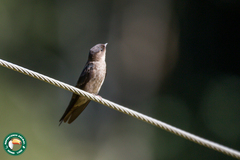
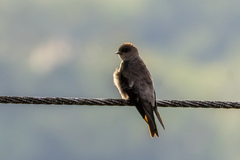
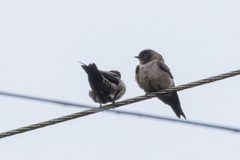
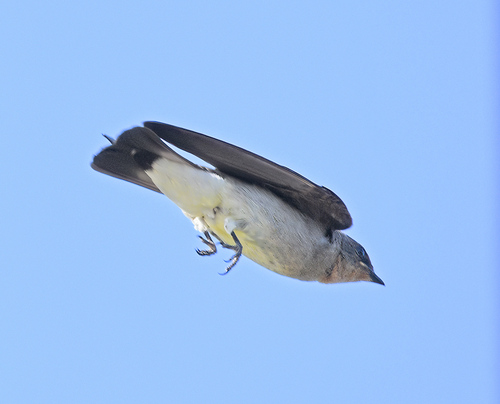
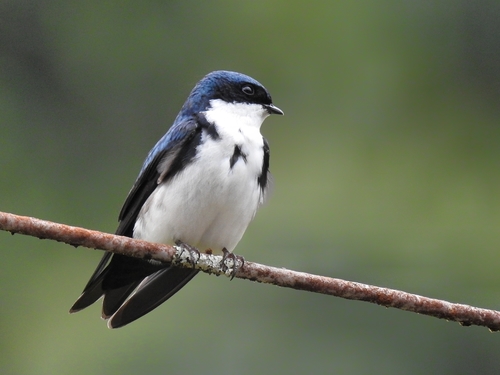
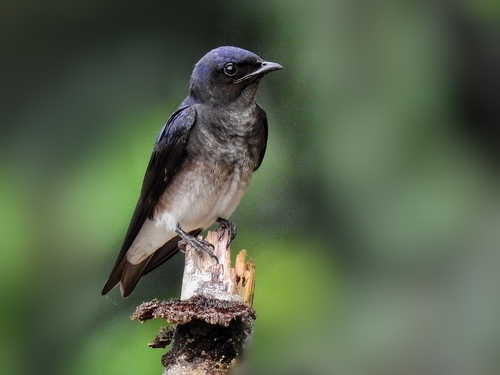
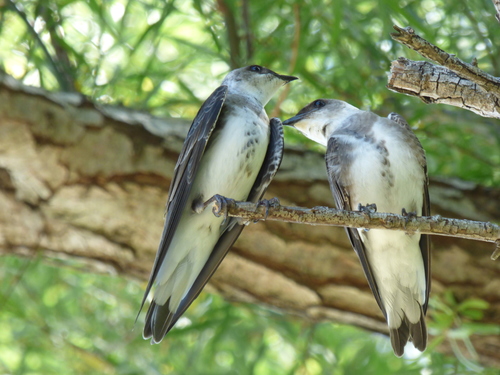
White-thighed Swallow

White-thighed Swallow

Neochelidon tibialis

Silhouette: Sheatherius · PhyloPic

LCLeast ConcernNTVUENCR
Daily sighting probability <5% · Rare
at Farallones de Cali National Natural Park

In 3 days ~10% in a week ~20%

91 Verified sightings at Farallones de Cali National Natural Park From 2019 to 2026
485 In all 8 parks
June Best month
☀️ Diurnal When it's spotted

About the White-thighed Swallow

The white-thighed swallow (Atticora tibialis) is a species of bird in the family Hirundinidae, the swallows and martins. It is found in Bolivia, Brazil, Colombia, Ecuador, French Guiana, Guyana, Panama, Peru, Suriname, and Venezuela.

The white-thighed swallow was described in 1853 by John Cassin as "Petrochelidon ? tibialis". Cassin was unsure that it belonged in that genus, stating that it "does not appear to us to belong to either of the genera of swallows heretofore established", which were Petrochelidon and Collocalia. (The latter genus is now applied to some swifts.) In the late 1800s it was assigned to genus Microchelidon and for much of the twentieth century and into the twenty-first it was assigned to the monotypic genus Neochelidon. Based in part on a study published in 2005, beginning in 2008 Neochelidon was merged into the present genus Atticora.

The white-thighed swallow and the black-capped swallow (A. pileata) are sister species and share genus Atticora with the white-banded swallow (A. fasciata). The white-thighed swallow has these three subspecies: Atticora tibialis minima (Chapman, 1924)

Atticora tibialis griseiventris (Chapman, 1924... Wikipedia →
Sounds

Flight call0:25

Ecuador · 1997

© Olaf Jahn · XC262374 · CC BY-NC-SA 4.0

Call0:29

Brazil · 2006

© Peter Boesman · XC226642 · CC BY-NC-ND 4.0

Song0:33

Ecuador · 2011

© Andrew Spencer · XC85868 · CC BY-NC-ND 2.5

Global Distribution

Parks Where Found

# Park Country Daily sighting probability
1 Serra dos Órgãos National Park 🇧🇷 Brazil
~30%
2 Sierra de la Macarena National Park 🇨🇴 Colombia
~10%
3 Podocarpus National Park 🇪🇨 Ecuador
<5%
4 Farallones de Cali National Natural Park 🇨🇴 Colombia
<5%
5 Darién National Park 🇵🇦 Panama
<5%
6 Manu National Park 🇵🇪 Peru
<5%
7 Tambopata National Reserve 🇵🇪 Peru
<5%
8 Soberanía National Park 🇵🇦 Panama
<5%

Before you go

What are the chances of seeing a White-thighed Swallow in Farallones de Cali National Natural Park?

Rare

Under 5% of wildlife watchers report a White-thighed Swallow sighting in Farallones de Cali National Natural Park on a given day, based on 91 verified sightings from GBIF citizen-science data from 2019 to 2026. It is the 281st most-seen of the 542 birds we can rate there. Over three days the chance rises to about 10%, and over a week to about 20%, if each day is a fresh chance.

When is the best time to see a White-thighed Swallow in Farallones de Cali National Natural Park?

June

In that month about 20% of wildlife watchers report a White-thighed Swallow in Farallones de Cali National Natural Park on a given day, against under 5% in August and October–May, the lowest months.

What time of day is best to see a White-thighed Swallow?

Between 8 and 11 am

Across all the parks we cover, that three-hour window holds the most White-thighed Swallow sightings with a recorded time, and about 9 in 10 of them come between 6 am and 6 pm: it is a daytime animal.

Which relatives of the White-thighed Swallow live in Farallones de Cali National Natural Park?

Same family: Hirundinidae

The closest relatives of the White-thighed Swallow that you can see in Farallones de Cali National Natural Park (family Hirundinidae, Swallows and Martins) are Southern Rough-winged Swallow (about 30%) and Blue-and-white Swallow (about 20%), with each one's daily chance of a sighting.

Where does the White-thighed Swallow sighting chance come from?

GBIF citizen-science records

It is estimated from how often the White-thighed Swallow is recorded against all the birds logged in Farallones de Cali National Natural Park (91 verified sightings from 2019 to 2026), calibrated against known sighting rates. Figures are rounded to the nearest 10% because citizen-science data supports honest approximations, not decimals, and months with records from fewer than five people show "—". How it works.

← Back to Farallones de Cali National Natural Park