About the Central Bearded Dragon
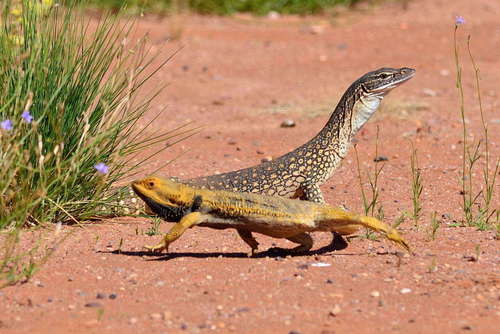
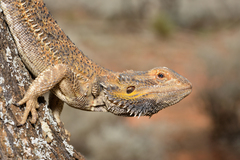
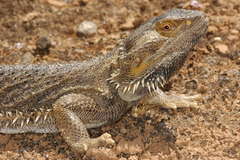
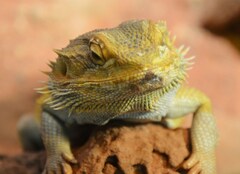
The central bearded dragon (Pogona vitticeps), also known commonly as the inland bearded dragon, is a species of lizard in the family Agamidae. The species is native to eastern and central Australia. Its common name refers to the pouch under their chin that they can inflate and darken in coloration, similar to the frilled lizard. The bearded dragon grows to around up to 60 cm (24 in) from head to tail tip and can weigh 550 g (1.2 lb). Males are generally larger than females. The lizard's body is generally brown, tan, yellow, and red.
Pogona vitticeps was first described by German zoologist Ernst Ahl in 1926, who placed it in the genus Amphibolurus. Mature bearded dragons can reach a total length of around 60 cm (24 in), or two feet, with the tail accounting for more than half of that. Some sexual dimorphism is present, as males can be distinguished from females by a wider cloacal opening, a wider tail-base, a larger and more angular head, a more developed beard (guttural throat-pouch), and the obvious possession of hemipenes. Males also have more pronounced femoral pores than females (these can be seen as waxy bumps on the underside of the back legs... Wikipedia →