Tree Skink

Tree Skink

Egernia striolata

Silhouette: Kailah Thorn & Ben King · PhyloPic

LCLeast ConcernNTVUENCR Endemic
Daily sighting probability ~40% · Likely
at Flinders Ranges National Park

In 3 days ~80% in a week >90%

35 Verified sightings at Flinders Ranges National Park From 2019 to 2026
35 In 1 park
October Best month
🌙 Nocturnal When it's spotted

About the Tree Skink

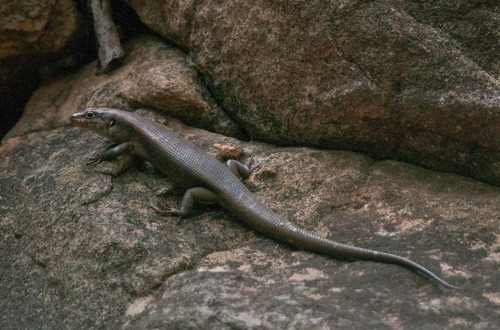
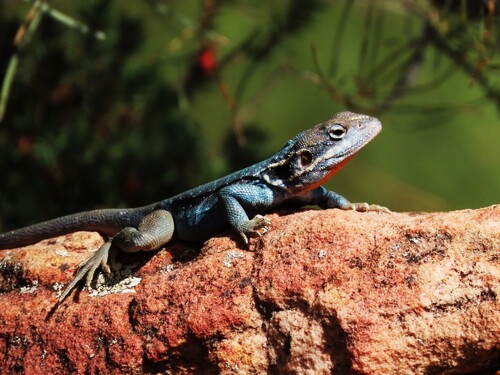
The tree-crevice skink or tree skink (Egernia striolata) is a species of skink, a lizard in the family Scincidae. The species is endemic to Australia and is found in the states of Victoria, the Northern Territory, Queensland, New South Wales and South Australia. E. striolata tend to live in crevices and cracks in hollow logs or rocks. They greatly prefer heterogeneous and structurally diverse habitats and their behavior changes depending on the habitat they live in.

They are moderately large lizards of the genus Egernia and are generally colored dark-black to grey-brown with a pale stripe going from their head to their tail. They grow to be around 100–118 mm long and can live for up to ten years. Their primary diet consists of larger, hard-bodied insects. Snakes, birds, and mammals are their major predators.

They are well known for their complex social interactions and their ability to flexibly adjust their behavior depending on environmental factors. They generally live in small nuclear family groups of 2-10 individuals, made up of parents and their offspring. Offspring stay with their parents in these units until they fully mature, after which they will disperse. They mate monogamously and can live with up to several generations of their offspring at a time. The unique ability of E. striolata to chemically identify their kin and quickly react to novel social situations allows them to live in multi-generational family units. They almost always prefer to live in groups over individually. Even when there are multiple unoccupied habitats well-suited to an individual's needs, E. striolata still opts to live in groups over living alone. E. striolata are highly territorial and mark their territory using scat. E. striolata acts more aggressively or cautiously around individuals that are not identified to be family members. Wikipedia →

Global Distribution

Parks Where Found

# Park Country Daily sighting probability
1 Flinders Ranges National Park 🇦🇺 Australia
~40%

More parks will be added in future updates.

Zoos & Centres Where Found

# Zoo / Centre Country
1 Wrocław Zoological Garden 🇵🇱 Poland In captivity
2 Africarium 🇵🇱 Poland In captivity
3 terrarium ogrodu zoologicznego we Wrocławiu 🇵🇱 Poland In captivity

Closest Relatives at Flinders Ranges National Park

Before you go

What are the chances of seeing a Tree Skink in Flinders Ranges National Park?

Likely

About 40% of wildlife watchers report a Tree Skink sighting in Flinders Ranges National Park on a given day, based on 35 verified sightings from GBIF citizen-science data from 2019 to 2026. It is the 5th most-seen of the 19 reptiles we can rate there. Over three days the chance rises to about 80%, and over a week to over 90%, if each day is a fresh chance.

When is the best time to see a Tree Skink in Flinders Ranges National Park?

April and October

In those months about 60% of wildlife watchers report a Tree Skink in Flinders Ranges National Park on a given day, against under 5% in May, July and November, the lowest months.

What time of day is best to see a Tree Skink?

Between 3 and 6 am

Across all the parks we cover, that three-hour window holds the most Tree Skink sightings with a recorded time, and about 7 in 10 of them come between 6 pm and 6 am: it is mostly seen at night.

Where else can you see a Tree Skink?

Only Flinders Ranges National Park, in our data

Flinders Ranges National Park is the only park on Wallace's Line with enough records to rate Tree Skink sightings: about 40% of wildlife watchers there report one on a given day.

Where does the Tree Skink sighting chance come from?

GBIF citizen-science records

It is estimated from how often the Tree Skink is recorded against all the reptiles logged in Flinders Ranges National Park (35 verified sightings from 2019 to 2026), calibrated against known sighting rates. Figures are rounded to the nearest 10% because citizen-science data supports honest approximations, not decimals, and months with records from fewer than five people show "—". How it works.

← Back to Flinders Ranges National Park