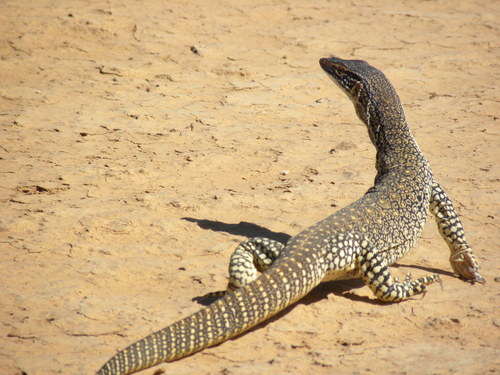
Gidgee Skink

Gidgee Skink

Egernia stokesii

Silhouette: Kailah Thorn & Ben King · PhyloPic

LCLeast ConcernNTVUENCR Endemic
Daily sighting probability ~20% · Possible
at Flinders Ranges National Park

In 3 days ~60% in a week ~90%

10 Verified sightings at Flinders Ranges National Park From 2019 to 2026
10 In 1 park
April Best month
🌅 Crepuscular When it's spotted

About the Gidgee Skink

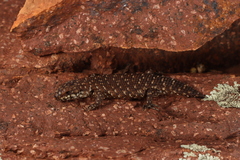
Egernia stokesii is a gregarious species of lizard of the Scincidae family. This diurnal species is endemic to Australia, and is also known as the Gidgee skink, spiny-tailed skink, Stokes's skink and Stokes's egernia. The species forms stable, long-term social aggregations, much like the social groups seen in mammalian and avian species. This characteristic is rarely found in the Squamata order, but is widespread within the Australian subfamily of Egerniinae skinks. Populations of E. stokesii are widely distributed, but fragmented, and occur in semi-arid environments. There are three recognised subspecies. The conservation status for the species is listed as least concern, however, one subspecies is listed as endangered.

Egernia stokesii range in colour from olive to reddish brown, with lighter ventral scales that range from white to yellow. The species often displays scatterings of lighter coloured dorsal scales. The dorsal scales are keeled from the back of the neck to the tail and spiny tail scales are a prominent feature of the species. The tail is flattened rather than cylindrical, and shorter than the head and body of the animal, at approximately... Wikipedia →

Global Distribution

Parks Where Found

# Park Country Daily sighting probability
1 Flinders Ranges National Park 🇦🇺 Australia
~20%

More parks will be added in future updates.

Zoos & Centres Where Found

# Zoo / Centre Country
1 Zoo Pilsen 🇨🇿 Czechia In captivity
2 Alice Springs Desert Park 🇦🇺 Australia In captivity
3 Phoenix Zoo 🇺🇸 United States In captivity
4 Taronga Zoo 🇦🇺 Australia In captivity
5 Wilhelma 🇩🇪 Germany In captivity
6 Allwetterzoo Münster 🇩🇪 Germany In captivity
7 Münster Zoo 🇩🇪 Germany In captivity
8 Lone Pine Koala Sanctuary 🇦🇺 Australia In captivity
9 San Antonio Zoo 🇺🇸 United States In captivity
10 Schönbrunn Zoo 🇦🇹 Austria In captivity
11 London Zoo 🇬🇧 United Kingdom In captivity
12 Sydney Zoo 🇦🇺 Australia In captivity

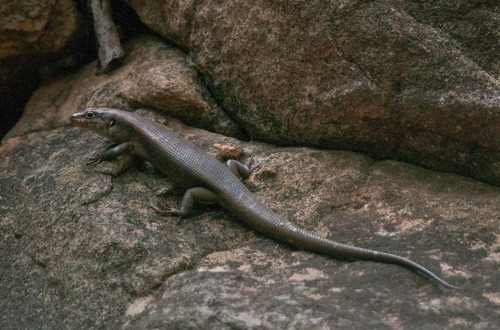
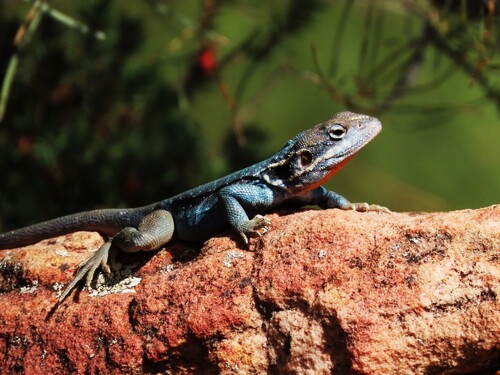
Closest Relatives at Flinders Ranges National Park

Before you go

What are the chances of seeing a Gidgee Skink in Flinders Ranges National Park?

Possible

About 20% of wildlife watchers report a Gidgee Skink sighting in Flinders Ranges National Park on a given day, based on 10 verified sightings from GBIF citizen-science data from 2019 to 2026. It is the 14th most-seen of the 19 reptiles we can rate there. Over three days the chance rises to about 60%, and over a week to about 90%, if each day is a fresh chance.

When is the best time to see a Gidgee Skink in Flinders Ranges National Park?

February, April and December

In those months about 40% of wildlife watchers report a Gidgee Skink in Flinders Ranges National Park on a given day, against under 5% in March, May–August and November, the lowest months.

What time of day is best to see a Gidgee Skink?

Between 2 and 5 am

Across all the parks we cover, that three-hour window holds the most Gidgee Skink sightings with a recorded time, and about 6 in 10 of them come between 6 pm and 6 am: it is most active around dawn and dusk.

Where else can you see a Gidgee Skink?

Only Flinders Ranges National Park, in our data

Flinders Ranges National Park is the only park on Wallace's Line with enough records to rate Gidgee Skink sightings: about 20% of wildlife watchers there report one on a given day.

Where does the Gidgee Skink sighting chance come from?

GBIF citizen-science records

It is estimated from how often the Gidgee Skink is recorded against all the reptiles logged in Flinders Ranges National Park (10 verified sightings from 2019 to 2026), calibrated against known sighting rates. Figures are rounded to the nearest 10% because citizen-science data supports honest approximations, not decimals, and months with records from fewer than five people show "—". How it works.

← Back to Flinders Ranges National Park