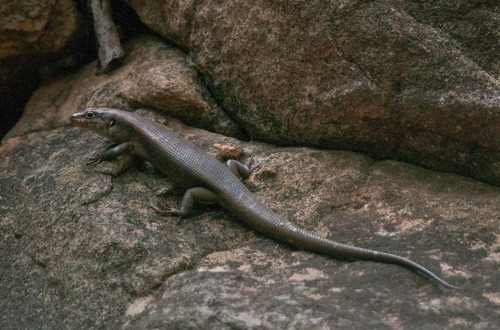
Ragged Snake-eyed Skink

Ragged Snake-eyed Skink

Cryptoblepharus pannosus

Silhouette: David Orr · PhyloPic

LCLeast ConcernNTVUENCR Endemic
Daily sighting probability ~20% · Possible
at Flinders Ranges National Park

In 3 days ~50% in a week ~80%

8 Verified sightings at Flinders Ranges National Park From 2019 to 2026
45 In all 3 parks
September Best month
☀️ Diurnal When it's spotted

About the Ragged Snake-eyed Skink

Cryptoblepharus pannosus, also known commonly as the ragged snake-eyed skink, is a species of lizard in the family Scincidae. The species is endemic to Australia. Within Australia, C. pannosus is found in New South Wales, Northern Territory, Queensland, South Australia, Victoria and the Australian Capital Territory.

C. pannosus are very agile climbers, and because of this they are mainly arboreal and extremely versatile, they can be found living under rocks and logs. C. pannosus can also live in or under human structures, including fences and walls throughout Eastern Australia. C. pannosus also occur in a variety of habitats, including forest, shrubland, and grassland.

Medium-sized for its genus and short-legged for its genus, as an adult C. pannosus has a snout-to-vent length (SVL) of 4.0–4.4 cm (1.6–1.7 in). C. pannosus has a longitudinally-aligned pattern, with usually 5 supraciliary scales, pale, acute plantar scales, strongly keeled sub digital lamellae, 43–56 (modally 48) paravertebral scales, and relatively short limbs.

Brown, grey to blackish with variable, complex ragged pattern including broad dark vertebral zone 3–4 scales... Wikipedia →


Global Distribution

Parks Where Found

# Park Country Daily sighting probability
1 Hattah-Kulkyne National Park 🇦🇺 Australia
~30%
2 Grampians National Park 🇦🇺 Australia
~20%
3 Flinders Ranges National Park 🇦🇺 Australia
~20%

Before you go

What are the chances of seeing a Ragged Snake-eyed Skink in Flinders Ranges National Park?

Possible

About 20% of wildlife watchers report a Ragged Snake-eyed Skink sighting in Flinders Ranges National Park on a given day, based on 8 verified sightings from GBIF citizen-science data from 2019 to 2026. It is the 18th most-seen of the 19 reptiles we can rate there. Over three days the chance rises to about 50%, and over a week to about 80%, if each day is a fresh chance.

When is the best time to see a Ragged Snake-eyed Skink in Flinders Ranges National Park?

March and August–September

In those months about 30% of wildlife watchers report a Ragged Snake-eyed Skink in Flinders Ranges National Park on a given day, against under 5% in April, June–July and November–February, the lowest months.

What time of day is best to see a Ragged Snake-eyed Skink?

Between 10 am and 1 pm

Across all the parks we cover, that three-hour window holds the most Ragged Snake-eyed Skink sightings with a recorded time, and about 9 in 10 of them come between 6 am and 6 pm: it is a daytime animal.

Is Flinders Ranges National Park the best place to see a Ragged Snake-eyed Skink?

3rd of 3

Of the 3 parks where we can rate Ragged Snake-eyed Skink sightings, Flinders Ranges National Park ranks 3rd at about 20%. The best odds are in Hattah-Kulkyne National Park (Australia, about 30%) and Grampians National Park (Australia, about 20%).

Which relatives of the Ragged Snake-eyed Skink live in Flinders Ranges National Park?

Same family: Scincidae

The closest relatives of the Ragged Snake-eyed Skink that you can see in Flinders Ranges National Park (family Scincidae, Skinks) are Shingleback Lizard (about 50%), Flinder's Ranges Rock-skink (about 50%) and Tree Skink (about 40%), with each one's daily chance of a sighting.

Where does the Ragged Snake-eyed Skink sighting chance come from?

GBIF citizen-science records

It is estimated from how often the Ragged Snake-eyed Skink is recorded against all the reptiles logged in Flinders Ranges National Park (8 verified sightings from 2019 to 2026), calibrated against known sighting rates. Figures are rounded to the nearest 10% because citizen-science data supports honest approximations, not decimals, and months with records from fewer than five people show "—". How it works.

← Back to Flinders Ranges National Park