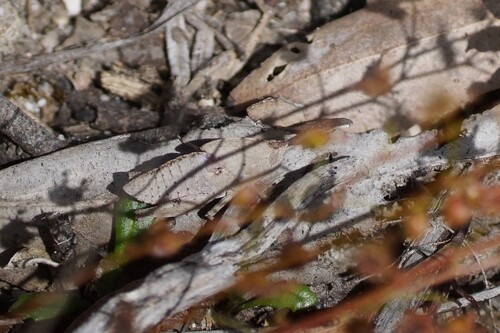
Inchman Ant

Inchman Ant

Myrmecia forficata

Endemic
Daily sighting probability ~30% · Possible
at Freycinet National Park

In 3 days ~70% in a week >90%

30 Verified sightings at Freycinet National Park From 2019 to 2026
174 In all 5 parks
January Best month
☀️🌙 Day & Night When it's spotted

About the Inchman Ant

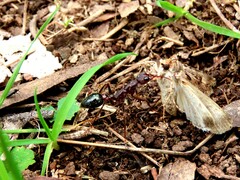
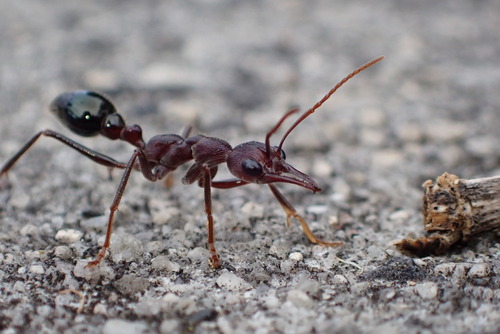
Myrmecia forficata, commonly known as the inchman ant, is a species of bull ant that is native to Australia. The ants are recorded in the south eastern part of the country, but are most common in the Australian Alps at elevations above 300m but can be found down to sea level around Melbourne and in Tasmania.

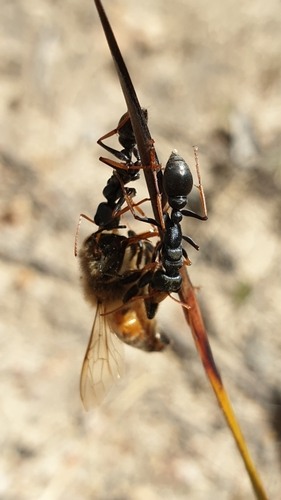
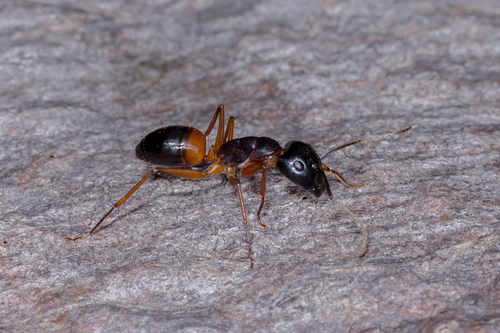
The inchman is the most venomous of the bulldog ants, ranging from about 15 to 25 mm (0.6 to 1.0 in) long, but less aggressive than the Jack jumper ant. These ants are purplish-brown, with a black abdomen. Their large size gave them their name, although most are slightly smaller than the traditional inch (25.4 mm). Their nests may be inconspicuously hidden under a rock or in a small hole.

As with many species of bulldog ants, the inchman are usually solitary when they forage, though they live in colonies like most ants. Inchman are carnivores and scavengers. They sting their victims with venom analogous to stings of wasps, bees, and fire ants. Their venom is some of the most powerful in the insect world. The reputation for being the most venomous ant is possibly due to the tendency of the toxin to induce anaphylaxis which can be fatal in some people.

The symptoms of the stings of the ants are similar to stings of the fire ants. The reaction is local; swelling, reddening and fever, followed by formation of a blister. The heart rate increases, and blood pressure falls rapidly. In about 3% of cases, the sting causes anaphylaxis. Treatment is very similar to wasp and bee stings. Wikipedia →
Global Distribution

Parks Where Found

# Park Country Daily sighting probability
1 Freycinet National Park 🇦🇺 Australia
~30%
2 Wilsons Promontory National Park 🇦🇺 Australia
~30%
3 Great Otway National Park 🇦🇺 Australia
~20%
4 Grampians National Park 🇦🇺 Australia
~10%
5 Kosciuszko National Park 🇦🇺 Australia
~10%

Cities Where Found

# City Country Daily sighting probability
1 Hobart 🇦🇺 Australia
~10%
2 Melbourne 🇦🇺 Australia
~10%

Before you go

What are the chances of seeing an Inchman Ant in Freycinet National Park?

Possible

About 30% of wildlife watchers report an Inchman Ant sighting in Freycinet National Park on a given day, based on 30 verified sightings from GBIF citizen-science data from 2019 to 2026. It is the most-seen of the 14 insects we can rate there. Over three days the chance rises to about 70%, and over a week to over 90%, if each day is a fresh chance.

When is the best time to see an Inchman Ant in Freycinet National Park?

April, September and December–February

In those months about 40% of wildlife watchers report an Inchman Ant in Freycinet National Park on a given day, against under 5% in May, August and November, the lowest months.

What time of day is best to see an Inchman Ant?

Between 7 and 10 pm

Across all the parks we cover, that three-hour window holds the most Inchman Ant sightings with a recorded time, and about 6 in 10 of them come between 6 am and 6 pm: it is seen both by day and at night.

Is Freycinet National Park the best place to see an Inchman Ant?

Yes

Of the 5 parks where we can rate Inchman Ant sightings, Freycinet National Park has the highest daily chance: about 30%. Next come Wilsons Promontory National Park (Australia, about 30%) and Great Otway National Park (Australia, about 20%).

Where does the Inchman Ant sighting chance come from?

GBIF citizen-science records

It is estimated from how often the Inchman Ant is recorded against all the insects logged in Freycinet National Park (30 verified sightings from 2019 to 2026), calibrated against known sighting rates. Figures are rounded to the nearest 10% because citizen-science data supports honest approximations, not decimals, and months with records from fewer than five people show "—". How it works.

← Back to Freycinet National Park