Black Meadowhawk

Black Meadowhawk

Sympetrum danae

Daily sighting probability ~10% · With luck
at Glacier National Park

In 3 days ~20% in a week ~30%

8 Verified sightings at Glacier National Park From 2019 to 2026
465 In all 18 parks
October Best month
☀️ Diurnal When it's spotted

About the Black Meadowhawk

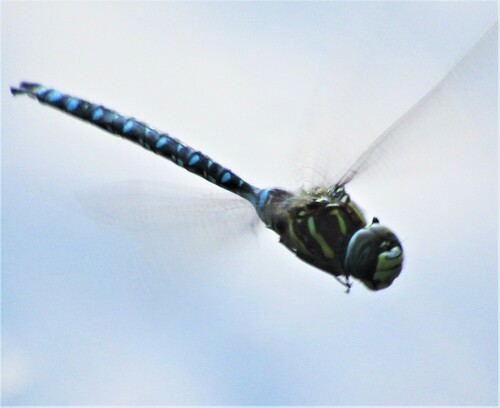
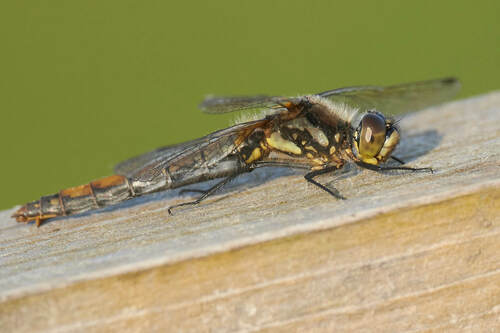
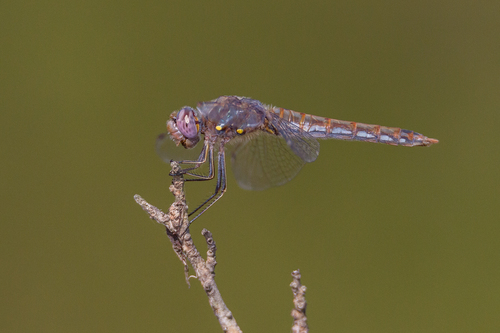
Sympetrum danae, the black darter or black meadowhawk, is a dragonfly with a northern Holarctic distribution in northern Europe, northern Asia, and northern North America. It is a very active late summer insect typical of heathland and moorland bog pools.

Members of the genus Sympetrum are known as darters in Europe, and as meadowhawks in North America. At 29–34 mm (1.1–1.3 in) long and with a 20–30 mm (0.8–1.2 in) hindwing, it is one of the smallest species of Sympetrum, and Britain's smallest resident dragonfly. Both sexes have black legs and pterostigmata. The abdomen is narrowest near the base, widening towards the tip.

The male has a mainly black thorax and abdomen. In younger males, the thorax has three diagonal yellow side marks separated by a bold black panel, and the abdomen has yellow marks on the side, that darken with age; fully mature males are entirely black. It is the only species of Sympetrum with no red on the males.

Females and teneral (newly emerged) males are patterned black and yellow, with three diagonal yellow bars on the thorax and an extensively yellow upper side of the abdomen, becoming browner with age. The wings are transparent with a network... Wikipedia →
Global Distribution

Parks Where Found

# Park Country Daily sighting probability
1 Cairngorms National Park 🇬🇧 United Kingdom
~30%
2 Elk Island National Park 🇨🇦 Canada
~20%
3 Vanoise National Park 🇫🇷 France
~10%
4 Gros Morne National Park 🇨🇦 Canada
~10%
5 Grand Teton National Park 🇺🇸 United States
~10%
6 Snowdonia National Park 🇬🇧 United Kingdom
~10%
7 Tatra National Park 🇸🇰 Slovakia
~10%
8 Great Bear Rainforest 🇨🇦 Canada
~10%
9 Bavarian Forest National Park 🇩🇪 Germany
~10%
10 Cévennes National Park 🇫🇷 France
~10%
11 Riding Mountain National Park 🇨🇦 Canada
~10%
12 Jasper National Park 🇨🇦 Canada
~10%
13 Banff National Park 🇨🇦 Canada
~10%
14 Pacific Rim National Park Reserve 🇨🇦 Canada
~10%
15 Pyrénées National Park 🇫🇷 France
~10%
16 Glacier National Park 🇺🇸 United States
~10%
17 Yellowstone National Park 🇺🇸 United States
~10%
18 Rocky Mountain National Park 🇺🇸 United States
<5%

Cities Where Found

# City Country Daily sighting probability
1 Helsinki 🇫🇮 Finland
~10%
2 Novosibirsk 🇷🇺 Russia
~10%
3 Anchorage 🇺🇸 United States
~10%
4 Edmonton 🇨🇦 Canada
~10%
5 Minsk 🇧🇾 Belarus
~10%
6 Calgary 🇨🇦 Canada
~10%
7 Saint Petersburg 🇷🇺 Russia
~10%
8 Yekaterinburg 🇷🇺 Russia
~10%
9 Moscow 🇷🇺 Russia
~10%
10 Kazan 🇷🇺 Russia
~10%

Before you go

What are the chances of seeing a Black Meadowhawk in Glacier National Park?

With luck

About 10% of wildlife watchers report a Black Meadowhawk sighting in Glacier National Park on a given day, based on 8 verified sightings from GBIF citizen-science data from 2019 to 2026. It is the 119th most-seen of the 147 insects we can rate there. Over three days the chance rises to about 20%, and over a week to about 30%, if each day is a fresh chance.

When is the best time to see a Black Meadowhawk in Glacier National Park?

October

In that month about 20% of wildlife watchers report a Black Meadowhawk in Glacier National Park on a given day, against under 5% in November to August, the lowest months.

What time of day is best to see a Black Meadowhawk?

Between 11 am and 2 pm

Across all the parks we cover, that three-hour window holds the most Black Meadowhawk sightings with a recorded time, and nearly all of them come between 6 am and 6 pm: it is a daytime animal.

Is Glacier National Park the best place to see a Black Meadowhawk?

16th of 18

Of the 18 parks where we can rate Black Meadowhawk sightings, Glacier National Park ranks 16th at about 10%. The best odds are in Cairngorms National Park (United Kingdom, about 30%), Elk Island National Park (Canada, about 20%) and Vanoise National Park (France, about 10%).

Where does the Black Meadowhawk sighting chance come from?

GBIF citizen-science records

It is estimated from how often the Black Meadowhawk is recorded against all the insects logged in Glacier National Park (8 verified sightings from 2019 to 2026), calibrated against known sighting rates. Figures are rounded to the nearest 10% because citizen-science data supports honest approximations, not decimals, and months with records from fewer than five people show "—". How it works.

← Back to Glacier National Park