Argali

Argali

Ovis ammon

Silhouette: Scott Hartman · PhyloPic

LCNTNear ThreatenedVUENCR
Daily sighting probability ~40% · Likely
at Gobi Gurvansaikhan National Park

In 3 days ~80% in a week >90%

14 Verified sightings at Gobi Gurvansaikhan National Park From 2019 to 2026
14 In 1 park
April Best month
☀️ Diurnal When it's spotted

About the Argali

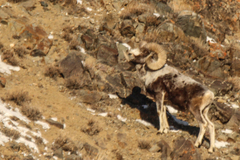
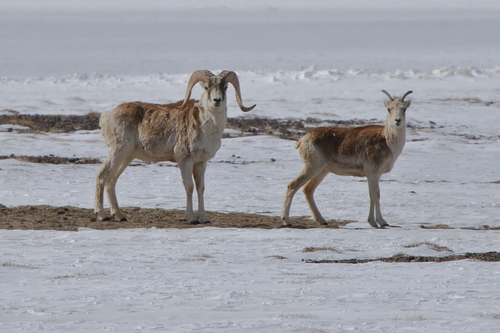
The argali (Ovis ammon), also known as the mountain sheep, is the largest species of wild sheep. It is native to the highlands of western East Asia, the Himalayas, Tibet, and the Altai Mountains. The name 'argali' is the Mongolian word for wild sheep. It is the largest species of wild sheep. Argali stand 85 to 135 cm (3 to 4 ft) high at the shoulder and measure 136 to 200 cm (4 to 7 ft) long from the head to the base of the tail. The female, or ewe is the smaller sex by a considerable margin, sometimes weighing less than half as much as the male, or ram. The ewes can weigh from 43.2 to 100 kg (95 to 220 lb) and the rams typically from 97 to 328 kg (214 to 723 lb), with a maximum reported mass of 356 kg (785 lb). The Pamir argali (also called Marco Polo sheep, for they were first described by that traveler), O. a. polii, is the largest race on average, regularly measuring more than 180 cm (5 ft 11 in) long without the tail, and is less sexually dimorphic in body mass than most other subspecies. The argali has relatively the shortest tail of any wild goat-antelope or sheep, with reported tail lengths of 9.5–17 cm (3.7–6.7 in).

The general coloration varies between each... Wikipedia →
Global Distribution

Parks Where Found

# Park Country Daily sighting probability
1 Gobi Gurvansaikhan National Park 🇲🇳 Mongolia
~40%

More parks will be added in future updates.

Zoos & Centres Where Found

# Zoo / Centre Country
1 Karagandy Zoo 🇰🇿 Kazakhstan In captivity
2 Shenzhen Safari Park 🇨🇳 China In captivity
3 Almaty Zoo 🇰🇿 Kazakhstan In captivity
4 Kinderbauernhof auf dem Görlitzer 🇩🇪 Germany In captivity
5 Iwate Safari Park 🇯🇵 Japan In captivity

Before you go

What are the chances of seeing an Argali in Gobi Gurvansaikhan National Park?

Likely

About 40% of wildlife watchers report an Argali sighting in Gobi Gurvansaikhan National Park on a given day, based on 14 verified sightings from GBIF citizen-science data from 2019 to 2026. It is the 9th most-seen of the 12 mammals we can rate there. Over three days the chance rises to about 80%, and over a week to over 90%, if each day is a fresh chance.

When is the best time to see an Argali in Gobi Gurvansaikhan National Park?

April

In that month about 60% of wildlife watchers report an Argali in Gobi Gurvansaikhan National Park on a given day, against under 5% in July to September, the lowest months. October to March have too few records to rate.

What time of day is best to see an Argali?

Between 6 and 9 am

Across all the parks we cover, that three-hour window holds the most Argali sightings with a recorded time, and about 7 in 10 of them come between 6 am and 6 pm: it is a daytime animal.

Where else can you see an Argali?

Only Gobi Gurvansaikhan National Park, in our data

Gobi Gurvansaikhan National Park is the only park on Wallace's Line with enough records to rate Argali sightings: about 40% of wildlife watchers there report one on a given day.

Which relatives of the Argali live in Gobi Gurvansaikhan National Park?

Same family: Bovidae

The closest relatives of the Argali that you can see in Gobi Gurvansaikhan National Park (family Bovidae, Bovids) are Siberian Ibex (about 80%), Goitered Gazelle (about 70%) and Mongolian Gazelle (about 40%), with each one's daily chance of a sighting.

Where does the Argali sighting chance come from?

GBIF citizen-science records

It is estimated from how often the Argali is recorded against all the mammals logged in Gobi Gurvansaikhan National Park (14 verified sightings from 2019 to 2026), calibrated against known sighting rates. Figures are rounded to the nearest 10% because citizen-science data supports honest approximations, not decimals, and months with records from fewer than five people show "—". How it works.

← Back to Gobi Gurvansaikhan National Park